
AWS Lambda: The Complete Guide for Enterprises
Palash Upadhyay
May 14, 2026
AWS Lambda has fundamentally changed how enterprises build and run applications in the cloud. Instead of provisioning servers, managing infrastructure, or paying for idle compute, Lambda lets your code run exactly when it needs to — and charges you only for the time it actually runs. In this guide, Electromech Cloudtech walks you through exactly what AWS Lambda is, how it works, its most powerful features in 2026, and which industries use it to build faster and spend less.
Quick Navigation
What Is AWS Lambda?
AWS Lambda is Amazon’s serverless compute service. It runs your code in response to events — an HTTP request, a file upload, a database change, a scheduled timer — without requiring you to manage any servers at all. AWS provisions the compute, scales it automatically, and tears it down once the function finishes.
In other words, you write the function. AWS handles everything else.
Since its launch in 2014, AWS Lambda has grown into one of the most widely adopted services across the entire AWS ecosystem. Today, enterprises run mission-critical API backends, real-time data pipelines, AI inference workloads, and complex multi-step workflows entirely on Lambda. Furthermore, the platform’s 2025–2026 updates — including Durable Functions, Managed Instances, and expanded runtime support — have made Lambda a genuine multi-modal compute platform rather than just a tool for simple event handlers.
How AWS Lambda Works
At its core, AWS Lambda follows a simple execution model. Here is exactly how it works, step by step:
- An event triggers the function. For example, a user submits a form on your website, an object lands in an S3 bucket, or a message arrives in an SQS queue.
- AWS spins up an execution environment. Lambda provisions the compute resources your function needs — memory, CPU, networking — in milliseconds.
- Your function code runs. Lambda executes your handler function with the event data as input. It supports Python, Node.js, Java, .NET, Go, Ruby, and Rust.
- Lambda returns the result to the caller, writes output to another service, or triggers a downstream event.
- AWS scales automatically. If 10,000 users trigger your function simultaneously, Lambda runs 10,000 parallel instances without any configuration on your part.
- You pay only for what runs. Billing stops the moment your function finishes. You pay nothing for idle time.
That model is a radical departure from traditional compute. With EC2, you pay for the server whether it sits idle at 3 AM or handles peak traffic at noon. With Lambda, cost and consumption align perfectly.
The Execution Environment
Each Lambda invocation runs in an isolated execution environment. AWS manages OS patching, runtime updates, security hardening, and capacity provisioning entirely on your behalf. As a result, your engineering team can focus entirely on writing business logic rather than maintaining infrastructure.
Key Features of AWS Lambda
1. Event-Driven Triggers — Connect to the Entire AWS Ecosystem
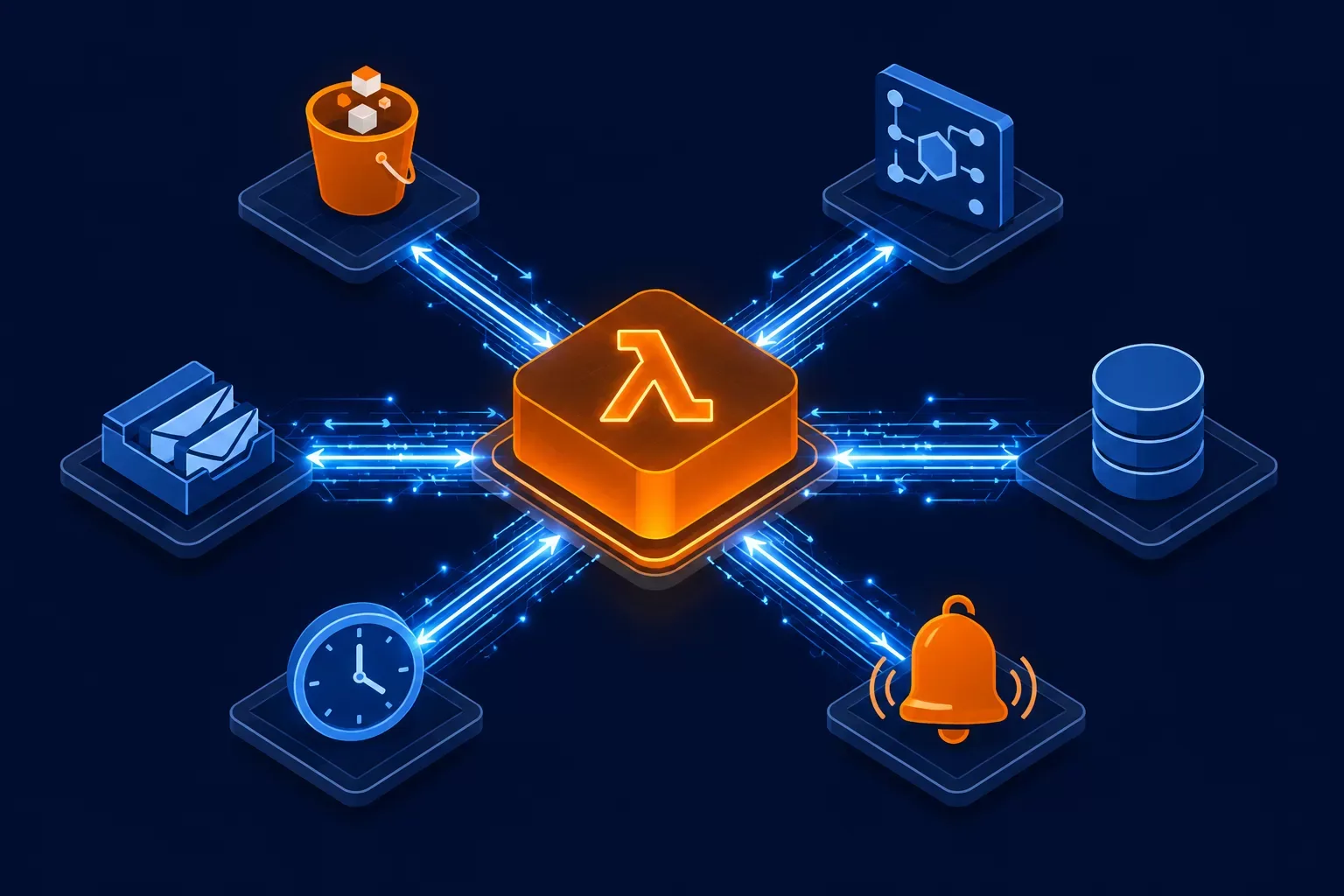
One of AWS Lambda’s greatest strengths is its native integration with virtually every AWS service. Lambda functions respond to events from more than 200 triggers, including:
- Amazon API Gateway — build REST and WebSocket APIs without managing web servers
- Amazon S3 — process files automatically as soon as they upload
- Amazon DynamoDB Streams — react to database changes in real time
- Amazon SQS and SNS — build decoupled, message-driven architectures
- Amazon EventBridge — respond to scheduled events or cross-account event buses
- AWS Step Functions — orchestrate Lambda functions into complex multi-step workflows
This breadth of integration means Lambda works as the glue layer across your entire AWS architecture. Moreover, each trigger delivers structured event data directly into your function, so you can start processing immediately without writing boilerplate parsing code.
2. Lambda Durable Functions — Stateful, Long-Running Workflows
Historically, Lambda functions had a 15-minute maximum execution time. That constraint limited their usefulness for multi-step, long-running business processes. AWS solved this problem at re:Invent 2025 with Lambda Durable Functions.
Durable Functions let you build stateful workflows that run from seconds to up to one year — all within Lambda. Built-in methods handle progress checkpointing and error recovery automatically, so your workflow survives failures, retries, and external wait times without losing state.
For example, you can now build a Lambda workflow that:
- Submits an order and waits for payment confirmation (which may take minutes)
- Pauses execution while a human reviews a flagged transaction (which may take hours)
- Resumes and completes the workflow once the external event arrives
Importantly, you pay nothing while the function waits. Billing only covers active compute time. Today, Durable Functions support Python and TypeScript, with a Java SDK currently in preview.
3. Lambda Managed Instances — EC2 Power with Serverless Simplicity
Lambda Managed Instances, launched at re:Invent 2025, represent the most significant architectural expansion in Lambda’s history. They let you run Lambda functions on dedicated EC2 instances from your own AWS account — giving you control over instance type, memory, vCPU count, and fleet size — while AWS continues to manage OS patching, security, load balancing, auto-scaling, and the Lambda runtime.
In practice, this solves three critical enterprise problems:
- Performance predictability — dedicated EC2 instances eliminate the performance variability of shared Lambda execution environments
- Cost control for steady workloads — when a function runs nearly continuously, EC2-based pricing is dramatically more economical than per-invocation Lambda pricing
- Access to specialised hardware — Managed Instances support GPU-backed instances, which is essential for machine learning inference, video processing, and AI workloads
As of March 2026, Managed Instances support up to 32 GB memory and 16 vCPUs. Additionally, AWS added Rust language support in March 2026, enabling parallel request processing within a single instance for CPU-bound workloads.
Today, only 23% of enterprises use serverless for mission-critical workloads. Managed Instances directly address the performance and cost concerns that hold the other 77% back.
4. Automatic Scaling — From Zero to Millions of Requests
Standard Lambda scales automatically from zero to thousands of concurrent executions in seconds. However, for applications that experience sudden massive traffic spikes, the previous burst scaling limit was a bottleneck. AWS addressed this directly in 2025 by doubling the function scaling rate to 1,000 new execution environments per 10 seconds.
Furthermore, the SQS Provisioned Mode ESM integration allows Lambda to pre-scale its consumer fleet before traffic arrives, eliminating cold-start latency for queue-driven workloads that experience predictable burst patterns.
For most enterprise applications, this means Lambda now handles traffic spikes — flash sales, viral content, scheduled batch jobs — without any manual intervention or capacity planning.
5. Response Streaming — Real-Time Output for AI and Large Payloads
AWS Lambda now supports response streaming via the responseStream object in Node.js, with payload support up to 200 MB. This feature is especially powerful for two enterprise scenarios.
First, it transforms the user experience for AI inference. When your Lambda function calls an LLM via Amazon Bedrock, response streaming delivers generated tokens to the client as they produce — creating the familiar, responsive typewriter effect rather than making users wait for the entire response. Second, it enables processing and streaming of large documents, reports, and media files that previously required workarounds due to Lambda’s earlier payload limits.
In addition, AWS increased the maximum async payload size from 256 KB to 1 MB across Lambda, SQS, and EventBridge in Q1 2026. As a result, context-rich event-driven architectures no longer need complex data-chunking workarounds.
6. Lambda Layers and Container Image Support
AWS Lambda supports two deployment models beyond standard zip packages:
Lambda Layers let you package shared libraries, custom runtimes, and configuration files separately from your function code. Teams share a single layer across multiple functions, which reduces duplication and keeps deployments lean.
Container Image Support lets you package your Lambda function as a Docker container image up to 10 GB. This approach is ideal for functions that need large dependencies — ML models, complex data processing libraries, or custom binaries — that exceed the standard zip deployment limit. Consequently, teams that already build Docker-based CI/CD pipelines can adopt Lambda without changing their packaging workflow.
7. Runtime Support — Latest Languages and Performance Improvements
AWS Lambda supports all major programming languages. As of Q1 2026, the runtime catalogue includes:
- Python 3.13
- Node.js 24
- .NET 10 (with Native AOT support and file-based app support, launched Q1 2026)
- Java 21
- Go 1.x
- Ruby 3.3
- Rust (on Managed Instances, added March 2026)
The .NET 10 runtime, in particular, delivers meaningful cold-start improvements through Native AOT compilation. This converts .NET functions to native machine code at build time, which significantly reduces startup time for latency-sensitive applications.
8. Security — IAM, VPC, and Tenant Isolation
AWS Lambda runs inside the AWS security perimeter and integrates deeply with AWS Identity and Access Management. Each Lambda function carries its own IAM execution role, which defines exactly which AWS resources the function can access. This approach follows the principle of least privilege by default.
Additionally, Lambda supports VPC integration, so your functions connect to private databases, internal APIs, and on-premises systems through your own network boundary. AWS never exposes your function code or execution environment to other customers.
For SaaS applications, Lambda Tenant Isolation — launched in 2025 — provides a built-in mechanism to guarantee strict execution environment separation between tenants. Previously, developers built their own isolation logic. Now, AWS enforces it at the platform level, which is a significant compliance and security advancement for multi-tenant architectures.
Furthermore, AZ metadata, added in Q1 2026, lets functions read the Availability Zone ID of their execution environment. This enables AZ-aware routing decisions, such as preferring same-AZ downstream services to reduce cross-AZ data transfer costs and latency.
9. Observability — CloudWatch, X-Ray, and Lambda Powertools
Every Lambda invocation generates logs automatically in Amazon CloudWatch. You can query those logs, set alarms, and build dashboards without any additional configuration. For distributed tracing, AWS X-Ray maps the full execution path of a request across Lambda functions, APIs, and downstream services — making it straightforward to pinpoint latency and errors in complex architectures.
For teams who want production-grade observability out of the box, Lambda Powertools provides opinionated utilities for Python, Java, TypeScript, and .NET. It standardises structured logging, distributed tracing, and metrics collection, and additionally provides idempotency handlers, batch processing utilities, and event parsing. AWS considers Powertools a best practice for all new Lambda projects.
AWS Lambda Use Cases
Serverless API Backends
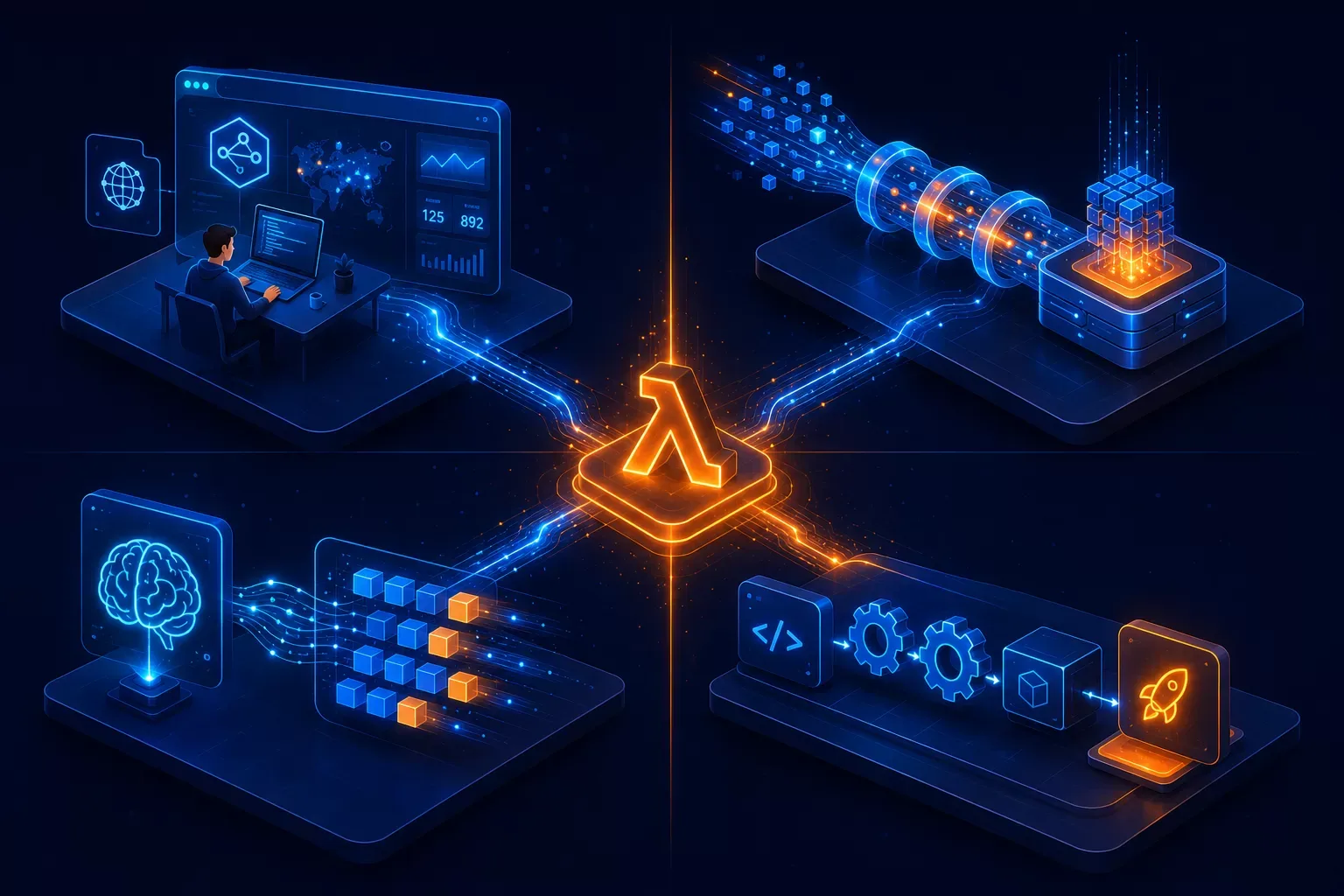
Teams pair Lambda with Amazon API Gateway to build REST and GraphQL APIs that scale instantly. Because Lambda charges per request, API backends that handle variable traffic — low overnight, high during business hours — cost a fraction of an always-on EC2-based API server.
Real-Time Data Processing
Lambda functions connect to Kinesis Data Streams, DynamoDB Streams, and SQS queues to process records as they arrive. As a result, enterprises build real-time fraud detection systems, IoT sensor pipelines, clickstream analysers, and log enrichment workflows that process millions of events daily without managing stream-processing infrastructure.
Scheduled Automation and Batch Jobs
EventBridge Scheduler triggers Lambda functions on a cron or rate schedule. Teams use this to run nightly reports, clean up stale data, sync records between systems, and send scheduled notifications — all without running a dedicated compute instance for jobs that take seconds to complete.
AI and Machine Learning Inference
Lambda integrates directly with Amazon Bedrock, SageMaker endpoints, and self-hosted models. Furthermore, with Managed Instances and GPU support, Lambda now handles inference workloads that previously required dedicated EC2 GPU instances. Response streaming delivers AI-generated output to end users in real time.
File and Media Processing
When files land in S3, Lambda triggers automatically to resize images, transcode video, extract text from PDFs, validate data files, or generate thumbnails. This event-driven model processes files the moment they arrive, with no polling logic or scheduled jobs required.
DevOps and CI/CD Automation
Development teams trigger Lambda functions from CodePipeline to run integration tests, deploy configuration changes, send Slack notifications, update DNS records, and roll back failed deployments. Consequently, Lambda serves as the automation backbone of serverless DevOps pipelines.
Multi-Step Business Workflows with Durable Functions
With Durable Functions, enterprises now orchestrate complex approval workflows, order management processes, compliance checks, and onboarding sequences entirely within Lambda. These workflows pause and resume across hours or days, paying nothing for idle wait time.
AWS Lambda Pricing Overview
AWS Lambda pricing has two dimensions: compute duration and the number of requests.
| Component | Free Tier | Beyond Free Tier |
|---|---|---|
| Requests | 1 million requests/month | $0.20 per 1 million requests |
| Duration | 400,000 GB-seconds/month | $0.0000166667 per GB-second |
| Managed Instances | N/A | Based on EC2 instance type and hours |
The free tier never expires. For most low-to-medium traffic applications, Lambda is genuinely free or costs a few dollars per month.
Cost optimisation tips:
- Right-size memory. Lambda allocates CPU proportionally to memory. More memory often speeds up execution enough to reduce total GB-seconds billed — and therefore total cost.
- Use Graviton (ARM) architecture. Lambda functions running on AWS Graviton processors cost 20% less and often run faster than x86 equivalents.
- Use Managed Instances for steady workloads. If a function runs nearly 24/7, Managed Instances with EC2 pricing are far more economical than per-invocation pricing.
Outbound link: AWS Lambda pricing details on aws.amazon.com
Is AWS Lambda Right for Your Business?
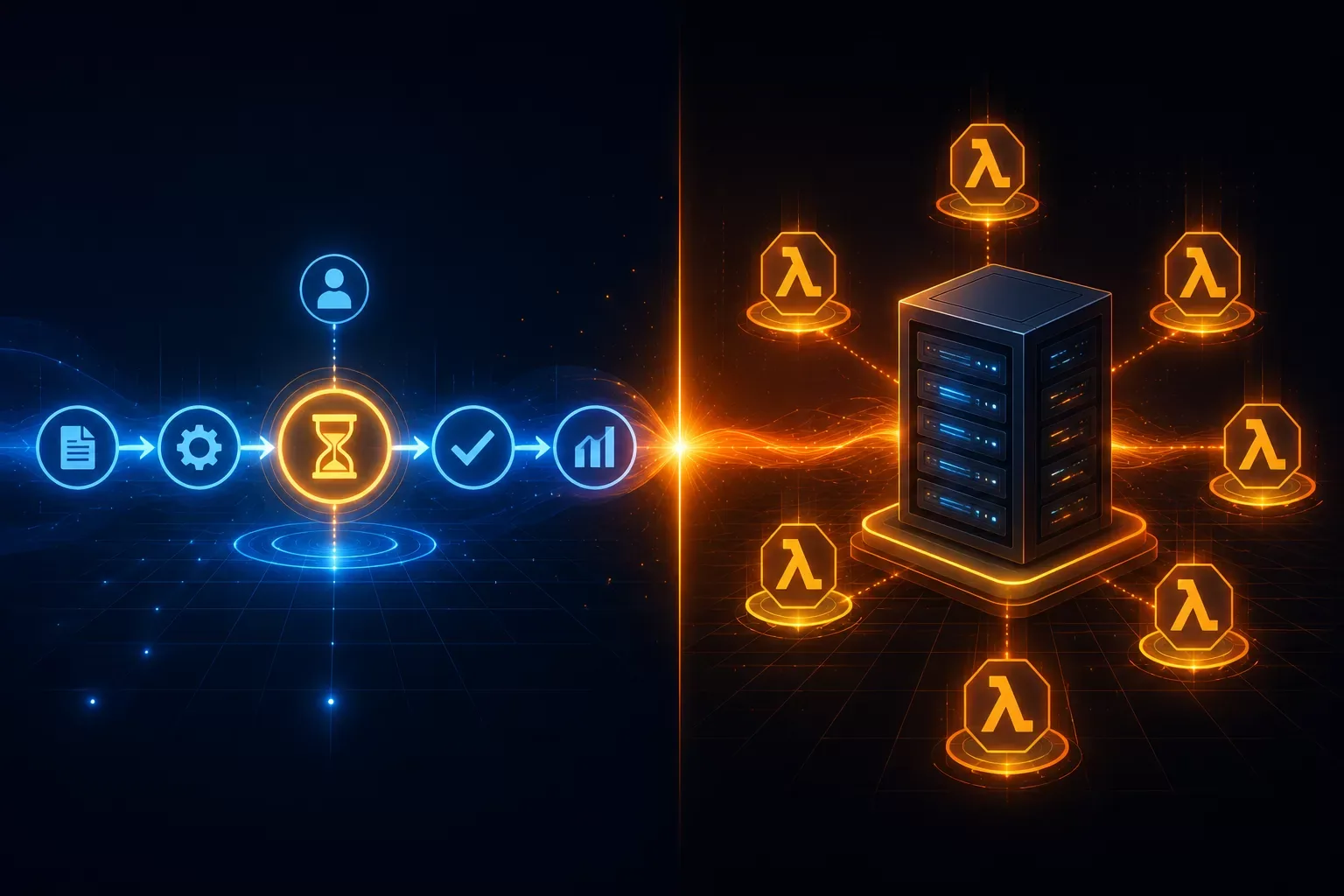
AWS Lambda is the right choice if:
- Your workloads are event-driven, intermittent, or variable in traffic volume
- You want to eliminate server provisioning and infrastructure management entirely
- You need to scale from zero to massive traffic instantly without pre-warming capacity
- You want to pay only for actual compute consumption, not for idle server time
- You are building microservices, APIs, data pipelines, or automation workflows
- You need strict per-function security isolation via IAM roles
However, Lambda may not be the best fit if:
- Your application runs continuously at very high utilisation (in that case, EC2 or ECS may be more cost-effective — or consider Lambda Managed Instances as a middle ground)
- You need execution times longer than 15 minutes and Durable Functions do not fit your architecture
- Your team has deep expertise in container orchestration and prefers Kubernetes-based workflows
How Electromech Cloudtech Can Help
At Electromech Cloudtech, we help enterprises design, deploy, and optimise AWS Lambda architectures from the ground up. Whether you are migrating existing workloads to serverless, building a new event-driven platform, or optimising a Lambda deployment that has grown beyond its original design, our team delivers practical AWS expertise at every stage.
Specifically, our AWS Lambda services include:
- Serverless architecture design — mapping your workloads to the right Lambda patterns, triggers, and integrations
- Lambda Durable Functions implementation — designing and building stateful, long-running workflows for complex business processes
- Managed Instances deployment — right-sizing EC2-backed Lambda fleets for performance-sensitive and cost-sensitive production workloads
- Event-driven pipeline development — building real-time data processing architectures with SQS, Kinesis, DynamoDB Streams, and EventBridge
- Security and compliance hardening — configuring IAM roles, VPC integration, Tenant Isolation, and CloudTrail audit logging
- Cost optimisation — right-sizing memory, switching to Graviton, analysing invocation patterns, and building cost monitoring dashboards
- Observability and monitoring setup — deploying Lambda Powertools, X-Ray tracing, and CloudWatch dashboards for full production visibility
- Ongoing managed services — keeping your Lambda architecture secure, up to date, and cost-efficient as AWS evolves the platform
FAQs
What is AWS Lambda in simple terms?
AWS Lambda is a serverless compute service. You upload your code, define what event should trigger it, and AWS runs it automatically — handling all the underlying infrastructure, scaling, and security. You pay only for the milliseconds your code actually runs.
What is the difference between AWS Lambda and EC2?
EC2 gives you a virtual server that runs continuously — you pay for it whether your code runs or not. Lambda runs your code only when triggered — you pay for execution time only. Lambda suits event-driven, variable workloads. EC2 suits applications that run continuously at high utilisation. Lambda Managed Instances bridge the gap by combining serverless simplicity with dedicated EC2 compute.
What languages does AWS Lambda support?
AWS Lambda supports Python, Node.js, Java, .NET (including .NET 10 as of Q1 2026), Go, Ruby, and Rust (on Managed Instances). You can also bring any custom runtime using the Lambda runtime API.
What is the maximum execution time for AWS Lambda?
Standard Lambda functions run for up to 15 minutes per invocation. However, with the new Lambda Durable Functions feature, you can build stateful workflows that run for up to one year by checkpointing state between steps and pausing execution while waiting for external events.
How does AWS Lambda handle scaling?
Lambda scales automatically. It creates a new execution environment for each concurrent invocation and can scale at a rate of 1,000 new environments per 10 seconds (doubled in 2025). You set no minimum or maximum — Lambda handles bursts instantly without any manual configuration.
Is AWS Lambda secure?
Yes. Each Lambda function runs with its own IAM execution role, which defines exactly which AWS resources it can access. Functions run inside isolated execution environments, support VPC integration for network-level isolation, and generate full audit logs via AWS CloudTrail. The 2025 Tenant Isolation feature adds platform-level separation for multi-tenant applications.
What are Lambda Durable Functions?
Lambda Durable Functions is a feature that lets you build multi-step, stateful workflows inside Lambda. Unlike standard Lambda functions that must complete within 15 minutes, Durable Functions checkpoint their progress automatically and can pause for hours, days, or even months while waiting for external events — then resume exactly where they left off, paying only for active compute time.
Final Thoughts
AWS Lambda has grown from a simple function runner into a full enterprise compute platform. With Durable Functions enabling year-long stateful workflows, Managed Instances bringing EC2-level performance to serverless, GPU support unlocking AI inference, and a security model that satisfies the most demanding compliance teams, Lambda now serves workloads that were impossible to run serverless just two years ago.
Ultimately, the enterprises winning on cloud in 2026 are not over-provisioning servers. They are building event-driven, pay-per-use architectures on Lambda — and spending their engineering time on products, not infrastructure.
Ready to build or optimise your AWS Lambda architecture? Electromech Cloudtech is here to help you move fast, stay secure, and keep costs firmly under control.
Uncategorized