

Red Hat DO180 OpenShift Course: Is It Worth It? (Complete Guide)
Palash Upadhyay
April 14, 2026
If you are looking into the Red Hat DO180 OpenShift course, you are probably wondering whether it is worth your time, what it actually teaches, and what career doors it opens. This complete guide to the Red Hat DO180 OpenShift course answers all of that — including real salary data, who the course is designed for, and what to study next once you finish.
Table of Contents
- What is the Red Hat DO180 OpenShift course?
- What will you learn in the Red Hat DO180 OpenShift course?
- Who should take the Red Hat DO180 OpenShift course?
- Red Hat DO180 OpenShift course: prerequisites and requirements
- Is the Red Hat DO180 course worth doing?
- Job roles and career benefits after the Red Hat DO180 OpenShift course
- Red Hat DO180 OpenShift course salary expectations: what can you earn?
- What comes after the DO180 course?
- Frequently asked questions about DO180
What is the Red Hat DO180 OpenShift Course?
The Red Hat DO180 OpenShift course — officially titled Red Hat OpenShift Administration I: Operating a Production Cluster — is Red Hat’s official training course for IT professionals who want to manage and administer containerised applications on a Red Hat OpenShift cluster.
OpenShift is Red Hat’s enterprise-grade Kubernetes platform. It extends Kubernetes with added security hardening, developer tooling, CI/CD integration, and multi-cloud portability. DO180 is the official entry-level administration course for this platform, designed to give hands-on production skills from day one.
The course is currently based on Red Hat OpenShift 4.18 and the skills you develop are fully applicable across all major OpenShift deployment types:
- Red Hat OpenShift Container Platform (self-managed on-premises or cloud)
- Red Hat OpenShift on AWS (ROSA)
- Azure Red Hat OpenShift (ARO)
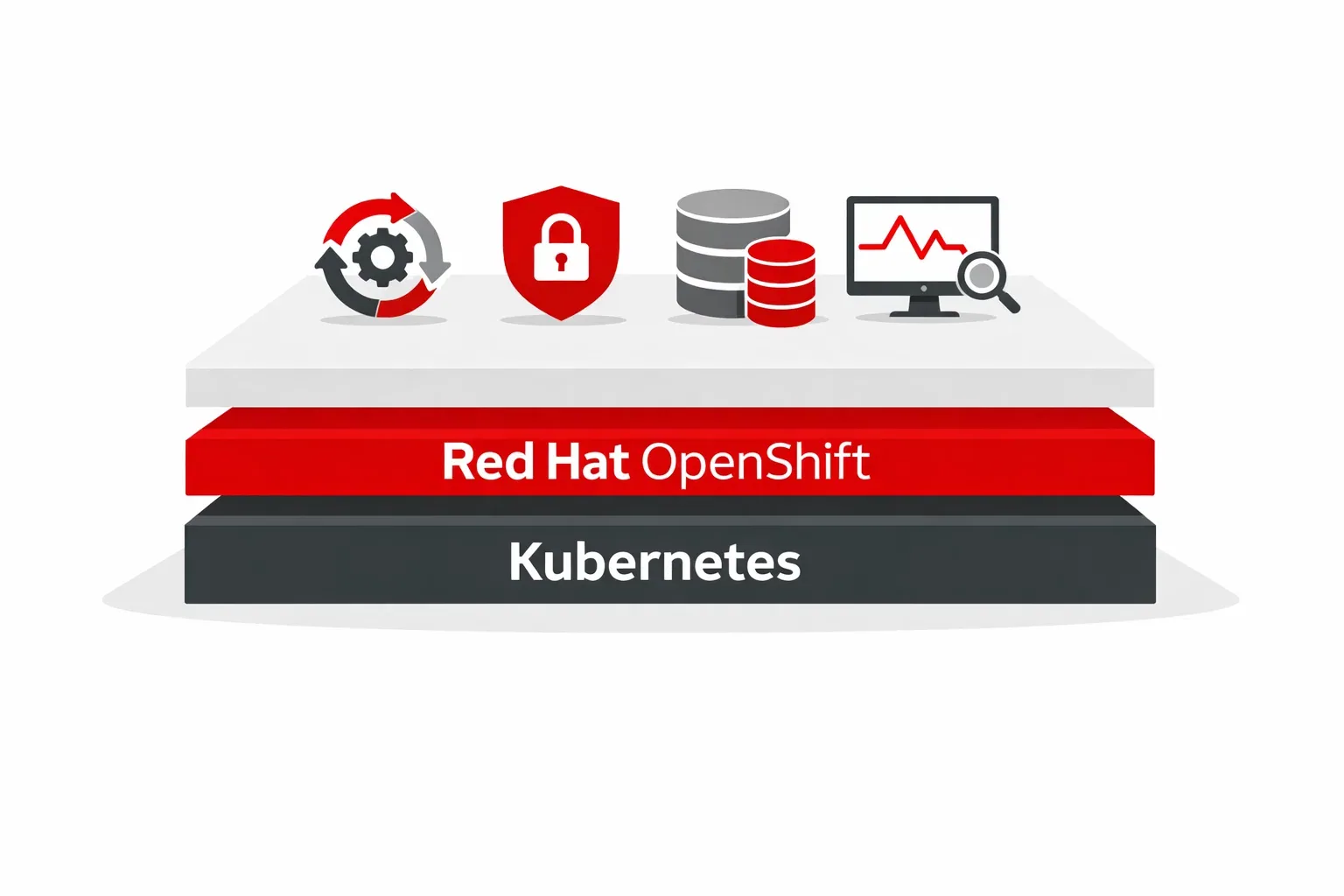
DO180 course at a glance
| Detail | Information |
|---|---|
| Full course name | Red Hat OpenShift Administration I: Operating a Production Cluster |
| Course code | DO180 |
| OpenShift version | 4.18 (current release) |
| Duration | 4–5 days (instructor-led) or self-paced online |
| Lab access post-course | Up to 45 days (live courses with virtual environment) |
| Certification exam | EX180 — Red Hat Certified Technologist in OpenShift |
| Related certifications | Red Hat Certified Specialist in OpenShift Administration |
| Prerequisite courses | DO080 (Containers, Kubernetes & OpenShift Technical Overview) |
What Will You Learn in the Red Hat DO180 OpenShift Course?
The Red Hat DO180 OpenShift course is built around hands-on labs and practical exercises rather than lecture-only theory. You will work directly with real OpenShift clusters throughout the course, building skills you can apply in a production environment from the moment the course ends.
Core syllabus — what DO180 covers
1. OpenShift and Kubernetes architecture You will learn how OpenShift clusters are structured at a technical level, how Kubernetes API resources are organised, and how to monitor cluster services and platform health from both the web console and the command line.
2. Managing clusters from the CLI and web console DO180 teaches you to use the oc command-line tool — OpenShift’s CLI — to access clusters, query Kubernetes API resources, and diagnose the state of a running cluster. You will also learn to navigate the OpenShift web console for day-to-day management tasks.
3. Deploying containerised applications You will learn to deploy applications from container images, Kubernetes manifests, and OpenShift templates. This includes exposing services to traffic from both inside and outside the cluster using Routes and Services.
4. Networking and connectivity troubleshooting DO180 covers how to diagnose and resolve network connectivity problems between applications running inside an OpenShift cluster and external services or users.
5. Storage configuration for application data You will learn to externalise application configuration using Kubernetes ConfigMaps and Secrets, as well as provision persistent storage volumes (PVCs) for stateful workloads that need to retain data across restarts.
6. High availability and resilience configuration DO180 teaches you how to configure applications to run with high availability — using replica sets, liveness and readiness probes, resource requests and limits, and pod disruption budgets.
7. Application updates and rollbacks You will learn how to manage reproducible application updates and clean rollbacks across container images, application settings, and Kubernetes manifests — a critical skill for production environments.
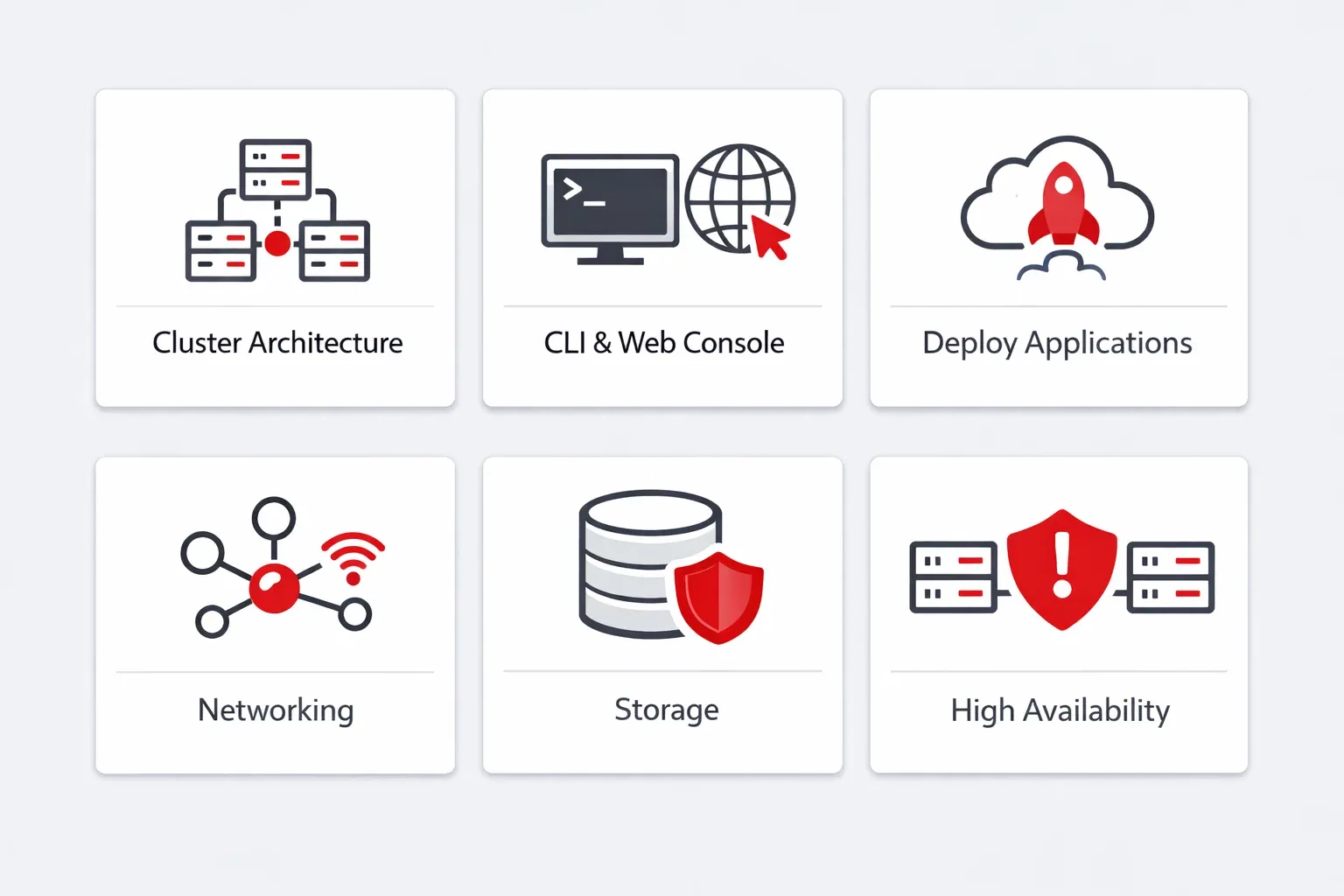
What you will be able to do after DO180
After completing the Red Hat DO180 course, you will be able to:
- Deploy, manage, and troubleshoot containerised applications running as Kubernetes workloads on OpenShift
- Monitor the health of production OpenShift clusters from the CLI and web console
- Identify, diagnose, and escalate application and infrastructure issues to development, operations, and vendor teams
- Configure applications for high availability, resilience, and scalability
- Manage application updates and rollbacks without service disruption

Who Should Take the Red Hat DO180 OpenShift Course?
Red Hat targets DO180 at two groups. Understanding which group you fall into helps you get maximum value from the course and plan your learning path effectively.
Primary audience — infrastructure and operations professionals
The core audience for DO180 is IT professionals who are directly responsible for managing production infrastructure and want to operate OpenShift clusters day-to-day.
This includes:
- Platform Engineers responsible for maintaining container platforms
- System Administrators transitioning from traditional server management to container orchestration
- Cloud Administrators managing workloads on AWS, Azure, or hybrid cloud with OpenShift
- Infrastructure Engineers supporting application teams in production environments
- IT Operations Engineers responsible for tier-1 infrastructure support
If your job involves keeping applications running, scaling infrastructure, and responding to production incidents — DO180 is directly relevant to your work.
Secondary audience — developers and architects working with infrastructure
Professionals who design infrastructure or work closely with operations teams also benefit significantly from the DO180 course, even if they are not directly managing clusters day-to-day.
This includes:
- DevOps Engineers building and maintaining CI/CD pipelines on OpenShift
- Site Reliability Engineers (SREs) responsible for service reliability and incident response
- Enterprise Architects designing cloud-native application platforms
- Software Developers who want a deeper understanding of how their applications run in production
Important note: If you are a developer or SRE who is completely new to containers, Red Hat recommends completing DO188 (Red Hat OpenShift Development I: Introduction to Containers with Podman) before enrolling in DO180. DO180 assumes you already understand container fundamentals.
Red Hat DO180 OpenShift Course: Prerequisites and Requirements
The Red Hat DO180 OpenShift course is not an absolute beginner course. To get full value from it and prepare for the associated certification exam, you should meet these requirements before enrolling.
Required knowledge
- Linux command-line proficiency — You must be comfortable using a terminal, running operating system commands, and working with Bash. Red Hat recommends completing RH104 (Getting Started with Linux Fundamentals) or having equivalent experience.
- Container fundamentals — You need a working understanding of how containers work before taking DO180. Red Hat offers DO080 (Containers, Kubernetes and Red Hat OpenShift Technical Overview) as a free prerequisite course.
Recommended but not required
- Red Hat Certified System Administrator (RHCSA) certification or equivalent Linux administration experience
- Familiarity with web application architectures and how they are deployed
- Some experience with shell scripting
Who does NOT need DO180 first
If you are completely new to containers and have never worked with Docker, Podman, or Kubernetes before, start with DO188 (Introduction to Containers with Podman) instead. DO180 builds directly on container knowledge — going in without it will make the course much harder to follow.
Is the Red Hat DO180 Course Worth Doing?
The short answer is yes — especially if you work in an environment that runs OpenShift or is moving towards containerised workloads. Here is a more detailed breakdown of the value it provides.
Reasons DO180 is worth it
It covers a platform used at enterprise scale. OpenShift is widely deployed across large enterprises, government agencies, financial services firms, and telecoms providers. Red Hat OpenShift runs on AWS, Azure, and on-premises data centres — the skills you learn in DO180 apply across all of them.
It is hands-on from start to finish. The course is built around lab exercises on real clusters, not slides and multiple-choice questions. You will have up to 45 days of continued lab access after the course ends, giving you real practice time.
It leads directly to a vendor-recognised certification. DO180 prepares you for the EX180 exam, which leads to the Red Hat Certified Technologist in OpenShift credential. This certification is recognised by hiring managers and shows up in job listings across the IT industry.
The job market for OpenShift skills is strong. Demand for professionals with OpenShift and Kubernetes experience has grown steadily as more enterprises adopt cloud-native architectures. DO180 positions you directly in this market.
It is the gateway to a full OpenShift learning path. DO180 is the foundation for more advanced Red Hat courses including DO280, DO380, and specialised certifications. Completing it opens up a structured career progression within the Red Hat ecosystem.
When DO180 may not be worth it right now
- If you have no Linux or command-line experience — build that foundation first
- If your organisation does not use OpenShift and has no plans to — consider a more general Kubernetes course (such as CKA preparation) instead
- If you are a complete beginner to containers — start with DO188 or DO080
Job Roles and Career Benefits After the Red Hat DO180 OpenShift Course
Completing the Red Hat DO180 OpenShift course — especially combined with the EX180 certification — directly supports progression into several well-compensated IT roles.
Job titles that value DO180 and OpenShift skills
OpenShift Administrator / Platform Engineer The most direct role for DO180 graduates. Platform engineers manage and maintain OpenShift clusters in production, handle updates and patches, and support application teams deploying workloads.
Cloud Administrator Cloud administrators managing infrastructure on AWS, Azure, or hybrid environments increasingly need OpenShift skills as enterprises standardise on Red Hat’s managed OpenShift offerings (ROSA, ARO).
DevOps Engineer DevOps engineers who work with OpenShift-based CI/CD pipelines use the cluster management and deployment skills taught in DO180 every day.
Site Reliability Engineer (SRE) SREs responsible for service reliability on OpenShift platforms benefit directly from DO180’s focus on high availability configuration, troubleshooting, and incident response.
Systems Administrator (Cloud/Containers) Traditional sysadmins transitioning into cloud-native and container-based environments use DO180 as a structured path to modernise their skills.
Enterprise Architect Architects designing cloud-native platforms benefit from understanding how OpenShift clusters work at an operational level — DO180 provides that grounding.
Skills that make DO180 graduates more employable
- Kubernetes workload management (high demand across all cloud environments)
- OpenShift CLI and web console administration
- Container networking and troubleshooting
- High availability and resilience configuration
- Storage provisioning for stateful workloads
- Application update and rollback management

Red Hat DO180 OpenShift Course Salary Expectations: What Can You Earn?
OpenShift and Kubernetes skills command strong salaries in the current job market. Here is a summary of salary data for roles that directly use the skills taught in DO180.
OpenShift Administrator salaries (United States, 2025–2026)
| Level | Annual Salary (USD) |
|---|---|
| Entry level (under 1 year experience) | ~$100,000 – $119,000 |
| Mid-level (2–5 years experience) | ~$120,000 – $133,000 |
| Senior (5+ years experience) | ~$140,000 – $160,000 |
| Top earners (90th percentile) | $178,500+ |
| Average across all levels | ~$120,000 – $141,500 |
Salary data sourced from ZipRecruiter, Salary.com, and Talent.com (2025–2026).
Key factors that influence your salary after DO180
- Certification level — holding the EX280 (Red Hat Certified OpenShift Administrator) alongside DO180 significantly increases earnings potential
- Cloud platform experience — combining OpenShift skills with AWS, Azure, or GCP knowledge commands a premium
- Industry — financial services, defence, and healthcare sectors pay above average for OpenShift administrators
- Location — US cities including Concord CA, San Francisco, and Seattle consistently pay above the national average for these roles
- Security clearance — roles requiring government security clearances can pay $140,000–$160,000+ for OpenShift administrators
What Comes After the DO180 Course?
DO180 is the first step on a structured Red Hat OpenShift learning and certification path. Here is where you can go from here.
Certification exam — EX180
The natural next step after completing DO180 is to sit the EX180 exam (Red Hat Certified Technologist in OpenShift). This is a practical, hands-on exam — not multiple choice — where you demonstrate the skills you learned in DO180 on a live cluster.
Advanced OpenShift administration — DO280
DO280 (Red Hat OpenShift Administration II: Configuring a Production Cluster) builds on DO180 with more advanced cluster configuration topics including authentication, authorisation, network policy, and cluster monitoring. Completing DO280 prepares you for the EX280 exam and the Red Hat Certified OpenShift Administrator certification.
Specialised OpenShift paths
Once you hold the EX280 certification, Red Hat recommends selecting from specialist courses including:
- DO380 — Red Hat OpenShift Administration III: Scaling Deployments in the Enterprise
- DO316 — Red Hat OpenShift Virtualization Administration Rapid Track Course
- DO346 — Migrating Virtual Machines to Red Hat OpenShift Virtualization with Ansible Automation Platform
Related Red Hat learning paths
- DO288 — Red Hat OpenShift Developer II: Building and Deploying Cloud-native Applications (for developers)
- DO188 — Red Hat OpenShift Development I: Introduction to Containers with Podman (pre-DO180 for beginners)
Career progression summary
DO080 (free overview) ↓ DO188 (containers with Podman — for beginners) ↓ DO180 → EX180 (Certified Technologist in OpenShift) ↓ DO280 → EX280 (Certified OpenShift Administrator) ↓ DO380 / DO316 / DO346 (specialist tracks)Frequently Asked Questions About DO180
Is DO180 suitable for complete beginners?
DO180 is not designed for complete beginners. It assumes you are comfortable with Linux, the command line, and the fundamentals of how containers work. If you are new to containers, start with DO080 (free) or DO188 before enrolling in DO180.
Does DO180 include a certification exam?
DO180 itself is a training course, not an exam. The associated exam is EX180 (Red Hat Certified Technologist in OpenShift). The exam is sold separately and is a hands-on practical assessment, not a multiple-choice test.
How long does it take to complete DO180?
The instructor-led version runs for approximately 4–5 days. Self-paced online access allows you to work through the material at your own speed. After completing any live course version, you have up to 45 days of continued lab access to practise the skills.
Is DO180 available online or only in person?
DO180 is available in multiple formats: instructor-led classroom training, virtual instructor-led training (VILT), and self-paced online learning through Red Hat’s training platform.
What is the difference between DO180 and DO280?
DO180 is the introductory OpenShift Administration course, focusing on deploying and managing workloads on an existing cluster. DO280 is the intermediate-level follow-on course, covering more advanced cluster configuration including network policy, authentication, role-based access control, and monitoring. DO180 is a recommended prerequisite for DO280.
Is Red Hat OpenShift the same as Kubernetes?
OpenShift is built on top of Kubernetes — it is an enterprise distribution of Kubernetes developed and supported by Red Hat. OpenShift adds security hardening, a built-in container registry, developer tooling, web console, and additional operational features on top of standard Kubernetes. Skills from DO180 apply to both OpenShift and core Kubernetes environments.
How much does the DO180 course cost?
Course pricing varies by region, delivery format, and training provider. Red Hat Training subscriptions and individual course purchases are available directly through Red Hat. Third-party training providers such as Global Knowledge and New Horizons also offer DO180. Check the official Red Hat Training website for current pricing.
Summary: Is the Red Hat DO180 Course Worth It?
The Red Hat DO180 OpenShift course is one of the most direct and practical ways to build enterprise Kubernetes and container administration skills. It is worth doing if you work in infrastructure, cloud operations, DevOps, or platform engineering — or if you are looking to move into any of those roles.
The course is hands-on, leads to a recognised certification (EX180), and directly supports career progression into roles paying $100,000–$160,000+ annually. It is the foundation of Red Hat’s OpenShift learning path, opening the door to advanced certifications that are in high demand across enterprise IT.
If you already have Linux skills and a basic understanding of containers, DO180 is a strong investment in your career.
Ready to Get Started with DO180? Talk to a Red Hat Partner
Making the decision to invest in OpenShift training is the easy part. Knowing exactly which course, delivery format, and learning path is right for your team — that is where having a trusted partner makes all the difference.
We are an official Red Hat Partner, which means we work directly with Red Hat to help individuals and organisations access the right training, certifications, and support at every stage of their OpenShift journey.
What we can help you with
- Course enrolment and scheduling — We can help you book DO180 in the format that suits you: instructor-led, virtual, or self-paced. We will make sure you are placed in the right cohort with the right prerequisites in place.
- Team training programmes — If you are looking to upskill an entire team of system administrators, platform engineers, or DevOps engineers, we can put together a structured training plan that moves everyone forward together.
- Learning path planning — DO180 is just the beginning. We will map out the full certification path from DO180 through to EX180, DO280, EX280, and any specialist tracks relevant to your environment.
- Licensing and Red Hat subscriptions — As a Red Hat Partner, we can advise on Red Hat training subscriptions, OpenShift platform licensing, and how to get the most value from your investment.
- Ongoing support — Our relationship does not end when the course does. We support our clients through exam preparation, hands-on lab guidance, and career planning beyond the certification.
Why work with a Red Hat Partner rather than going direct?
Going direct to Red Hat is always an option — but working with a certified Red Hat Partner gives you a local, dedicated point of contact who understands your business context. We can tailor recommendations to your team’s existing skill level, your organisation’s technology stack, and your specific business goals. You get personalised guidance, not a generic course catalogue.
We are an authorised Red Hat training partner. When you book through us, you get the same official Red Hat curriculum and certification pathway — with the added benefit of expert advice and ongoing support from a team that knows the Red Hat ecosystem inside out.
Get in touch
Whether you are an individual looking to start your OpenShift journey with DO180, or an IT manager planning a team-wide upskilling programme, we would love to hear from you.
Contact us today and one of our Red Hat-certified consultants will get back to you to discuss your options — no obligation, no hard sell, just practical advice from people who know this platform well.
Uncategorized