
Introduction
If your team is still logging into the AWS Console to spin up EC2 instances or configure security groups manually, you are accumulating risk. Every manual change is a potential misconfiguration, an undocumented deviation, and a future incident waiting to happen. Infrastructure as code on AWS solves this at the root. It treats your cloud resources — servers, networks, IAM roles, databases — as software: written in files, stored in Git, reviewed in pull requests, and deployed through automated pipelines. In 2026, infrastructure as code on AWS is no longer optional for teams that want to operate at scale. This guide covers everything: what IaC is, why it matters, which tools to use, current trends, and best practices to set your team up for long-term success.
What Is Infrastructure as Code on AWS?
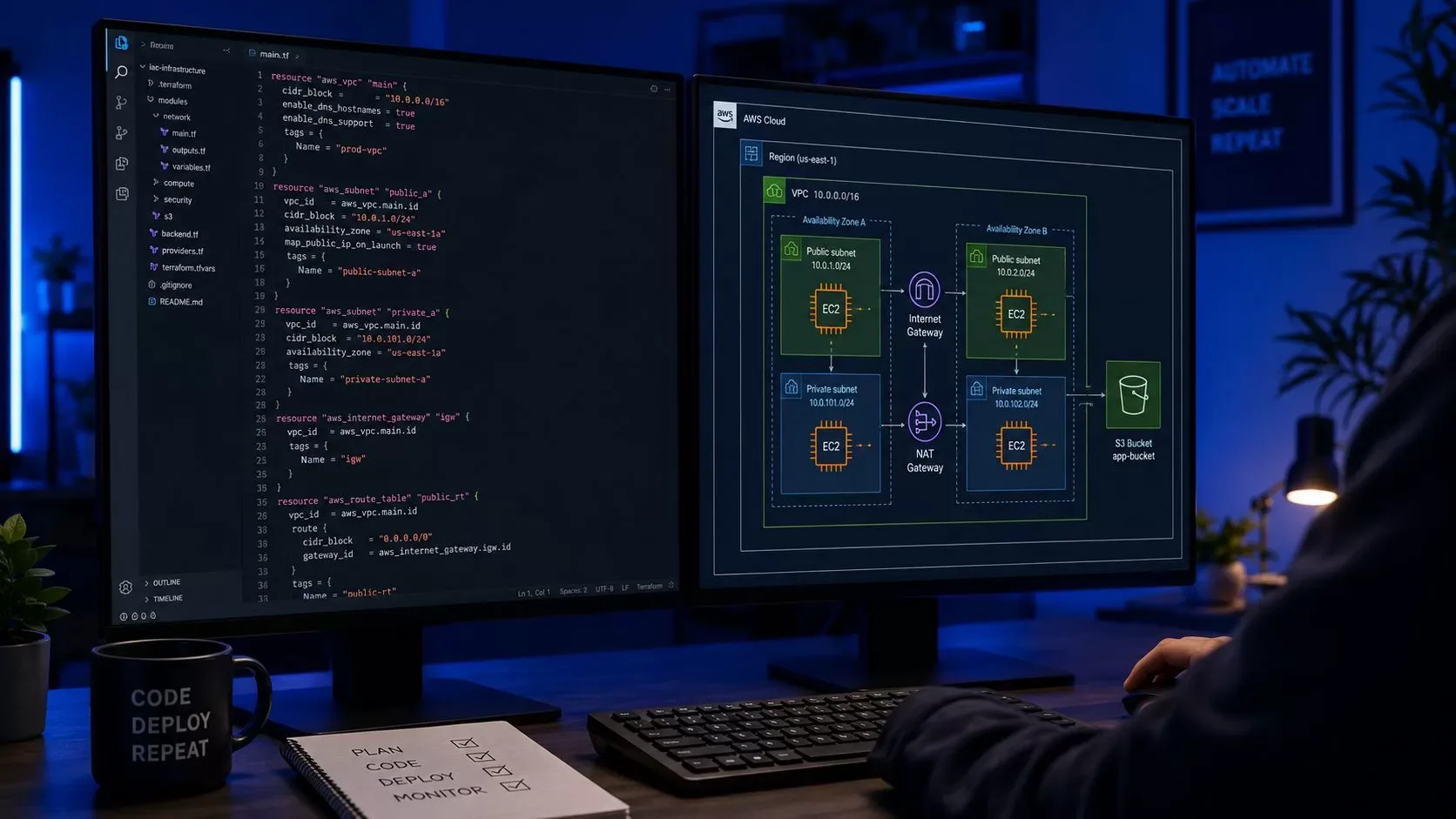
Infrastructure as code on AWS is the practice of defining and managing your cloud resources through machine-readable configuration files. Instead of clicking through the console, you write a file describing your desired state. A tool reads that file, calls the AWS API, and provisions exactly what you specified.
This approach delivers three core properties:
Idempotency — Applying the same configuration repeatedly produces the same result. No duplicate resources, no unintended side effects.
Declarative intent — You describe what you want, not how to achieve it. The tool resolves dependencies and sequences API calls automatically.
Version control — Every infrastructure change is a Git commit. You can see who changed what, when, and why. Rolling back is a git revert.
The result is infrastructure that behaves like software. It can be tested, reviewed, audited, and reproduced on demand.
Why Infrastructure as Code on AWS Is Non-Negotiable in 2026
The case for IaC has strengthened significantly. Here is what is driving adoption across organizations of every size.
Configuration Drift at Scale
In teams doing manual cloud management, environments drift over time. The dev environment has a security group rule that never reached staging. Production has an IAM policy nobody can explain. Infrastructure as code on AWS eliminates this problem. Every environment is provisioned from the same source of truth, so drift becomes structurally impossible.
Speed and Consistency
Launching a new environment manually takes hours or days. With IaC, it is a pipeline run. Need to spin up an isolated environment for a new feature? Done in minutes. Onboarding a new client? Duplicate a battle-tested stack automatically.
Security Built In from the Start
Security misconfigurations — open S3 buckets, overly permissive IAM roles, missing encryption — are a leading cause of cloud data breaches. With infrastructure as code on AWS, static analysis tools like Checkov and tfsec scan your definitions before anything is deployed. Security stops being a post-deployment audit. Instead, it becomes a pre-commit gate.
Compliance and Auditability
Regulated industries need to prove their infrastructure meets compliance standards at any point in time. An IaC-managed environment has a full audit trail in Git — every change, every reviewer, every approval. Manual environments cannot offer this.
The Real Cost of Not Adopting IaC
Manual provisioning causes configuration drift in 44% of organizations. Incidents caused by undocumented manual changes regularly consume engineering weekends. Therefore, the ROI of IaC adoption pays back in the first major incident it prevents.
The AWS IaC Ecosystem: Choosing the Right Tool
AWS offers several first-party IaC tools. The broader ecosystem adds powerful third-party options. Here is an honest comparison of each.
1. AWS CloudFormation
CloudFormation is AWS’s native infrastructure as code service. You write JSON or YAML templates describing your resources. AWS deploys and manages their full lifecycle.
Strengths:
- Day-one support for every new AWS service
- No separate state management — AWS handles everything
- Deep integration with AWS Config, Service Catalog, and StackSets for multi-account deployments
- Best choice for compliance-heavy environments
Weaknesses:
- JSON and YAML are verbose; simple setups can run to hundreds of lines
- Deployment times are slower — controlled benchmarks show CloudFormation takes more than twice as long as Terraform or Pulumi on average
- Limited expressiveness for complex conditional logic
Best for: Enterprise AWS environments with strict compliance requirements, or teams that need zero external dependencies.
2. AWS CDK (Cloud Development Kit)
AWS CDK lets you define infrastructure as code on AWS using real programming languages — TypeScript, Python, Java, C#, or Go. CDK compiles down to CloudFormation templates under the hood. Consequently, you inherit CloudFormation’s state management and AWS-native depth while writing in languages your developers already know.
CDK provides three abstraction levels:
- L1 constructs — direct 1:1 mappings to CloudFormation resources
- L2 constructs — higher-level abstractions with sensible defaults (e.g.,
s3. Bucketautomatically handles encryption and versioning) - L3 constructs (patterns) — full architectural patterns, such as a load-balanced Fargate service in a few lines of code
CDK is the fastest-growing IaC tool for AWS-native teams. Its 2025–2026 feature push — including the Toolkit Library, Refactor capability, and Mixins — has strengthened the developer experience significantly.
Best for: Development teams proficient in TypeScript or Python who are building primarily on AWS.
3. Terraform and OpenTofu
Terraform, built by HashiCorp (now IBM), uses its own declarative language called HCL. It supports AWS alongside Azure, GCP, Kubernetes, and hundreds of other providers. As a result, it is the default choice for multi-cloud and platform engineering teams.
A key development: after HashiCorp changed Terraform’s license from open-source to Business Source License (BSL) in 2023, the community forked Terraform into OpenTofu, now governed by the Linux Foundation. OpenTofu is drop-in compatible — same HCL syntax, same provider ecosystem, same state format. Teams that require a fully open-source license are increasingly adopting it.
Terraform holds approximately 65% of the IaC job market by postings. It remains the most widely deployed infrastructure as code tool globally.
Strengths:
- Multi-cloud and multi-provider support (200+ AWS services, plus Kubernetes, Datadog, GitHub, and more)
- Mature module ecosystem with thousands of community-maintained modules
- Faster provisioning than CloudFormation through direct API calls
- Massive community and extensive documentation
Weaknesses:
- Manual state management requires an S3 backend and DynamoDB lock table for team use
- BSL licensing on HashiCorp Terraform (OpenTofu resolves this)
Best for: Multi-cloud teams, platform engineering, or anyone whose infrastructure spans multiple providers.
4. Pulumi
Pulumi takes the “real programming languages” approach and extends it to 50+ cloud providers. It supports TypeScript, Python, Go, .NET, Java, and YAML. State is managed via Pulumi Cloud or a self-hosted backend.
Pulumi is production-ready and Apache 2.0 licensed. However, its community is smaller than Terraform’s, meaning fewer battle-tested modules and less coverage for edge-case debugging. AWS Prescriptive Guidance recommends it for teams comfortable with higher risk who need multi-cloud environments.
Best for: Polyglot teams that want Pulumi’s programming model across multiple clouds.
5. AWS SAM (Serverless Application Model)
AWS SAM is a CloudFormation extension built specifically for serverless workloads — Lambda functions, API Gateway, DynamoDB tables, and Step Functions. It simplifies the verbose CloudFormation syntax into concise, serverless-first declarations.
Best for: Teams building primarily serverless applications on AWS.
Tool Selection Matrix
| Scenario | Recommended Tool |
|---|---|
| AWS-only, developer team | AWS CDK |
| Multi-cloud or multi-provider | Terraform / OpenTofu |
| Enterprise compliance, StackSets | CloudFormation |
| Serverless-first workloads | AWS SAM |
| Open-source license required | OpenTofu or Pulumi |
| Learning IaC for career growth | Terraform (highest job demand) |
2026 Trends Shaping Infrastructure as Code on AWS
The IaC ecosystem is evolving rapidly. These five trends are reshaping how teams build and manage AWS infrastructure today.
1. AI-Assisted Infrastructure Provisioning
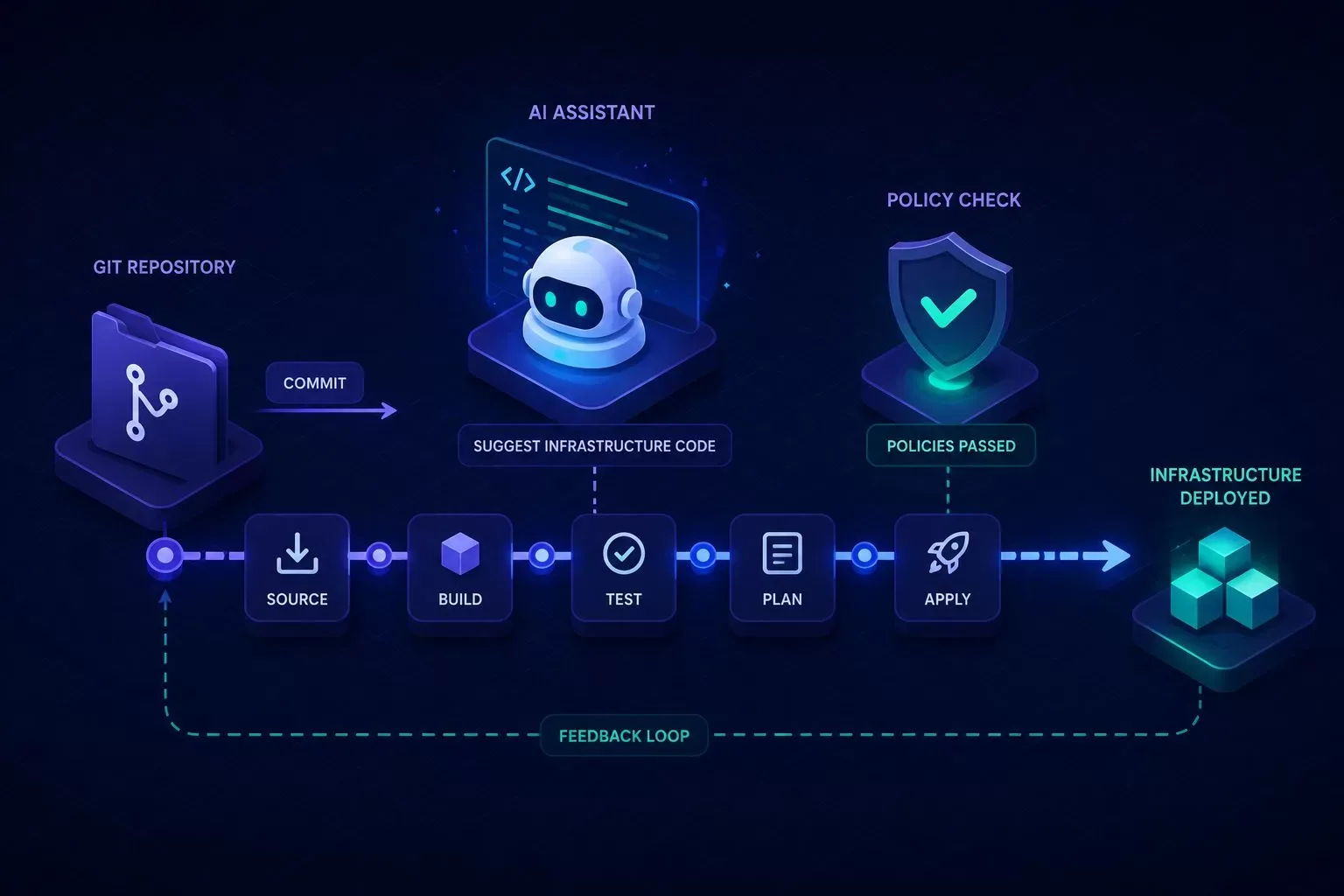
AWS recently launched the AWS IaC MCP Server — a tool built on the Model Context Protocol. It enables AI assistants like Claude, Cursor, and Kiro CLI to search CloudFormation and CDK documentation, validate templates, troubleshoot deployments, and suggest best practices in real time. All of this runs locally, preserving security.
This is not autocomplete. It is a context-aware infrastructure companion that understands what you are building. As AI coding tools become standard in developer workflows, infrastructure as code on AWS authoring is following the same trajectory — faster writing, fewer syntax errors, and in-context documentation at every step.
Additionally, AI-generated Terraform plan summaries are entering the apply workflow. Instead of reading hundreds of lines of plan output, engineers now receive a structured summary of what will change and why it matters.
2. GitOps Becomes Operational Hygiene
GitOps uses Git as the single source of truth for infrastructure state. Automated pipelines enforce that state continuously. In 2026, this is no longer an advanced practice — it is baseline governance. If your AWS infrastructure can be changed meaningfully outside a Git workflow, you do not have governance. You have drift.
The GitOps model creates self-healing infrastructure. A monitoring agent continuously compares live AWS state against the Git-defined state and automatically corrects any deviations. Manual production changes outside Git are structurally prevented, not just discouraged.
Tools like Atlantis for Terraform and ArgoCD for Kubernetes workloads have matured significantly. They are now standard components in enterprise AWS delivery pipelines.
3. Policy as Code Is the New Compliance Layer
As AI accelerates the volume of infrastructure changes, policy-as-code has become the enforcement layer that makes velocity safe. Tools like Open Policy Agent (OPA) and Checkov integrate directly into CI/CD pipelines. They catch misconfigurations — open S3 buckets, missing encryption, overly permissive IAM roles — before any code reaches AWS.
Furthermore, in regulated industries such as fintech, healthcare, and government, policy-as-code is increasingly a compliance requirement, not an optional best practice. The shift-left model means your blast radius for a misconfiguration is a failed pull request — not a live production exposure.
4. The OpenTofu and Terraform Divergence
The Terraform ecosystem is now genuinely bifurcated. Terragrunt hit 1.0 in March 2026, adding a Stacks feature for managing groups of related deployment units as a single deployable unit. OpenTofu continues to grow under Linux Foundation governance. For new projects without existing HashiCorp enterprise contracts, OpenTofu is the clear open-source choice. Existing Terraform deployments require no migration — the tooling is drop-in compatible.
5. Infrastructure as Code for AI Workloads on AWS
Organizations are deploying AI/ML infrastructure on AWS at scale — SageMaker endpoints, Bedrock models, Kendra indexes, and GPU-backed EC2 instances. Infrastructure as code on AWS is the only scalable way to manage these environments. Provisioning training clusters, managing model deployments as versioned infrastructure, and enforcing cost guardrails on GPU usage are all IaC use cases that emerged prominently in 2025–2026.
IaC Best Practices for AWS Teams
Structure Your Code in Layers
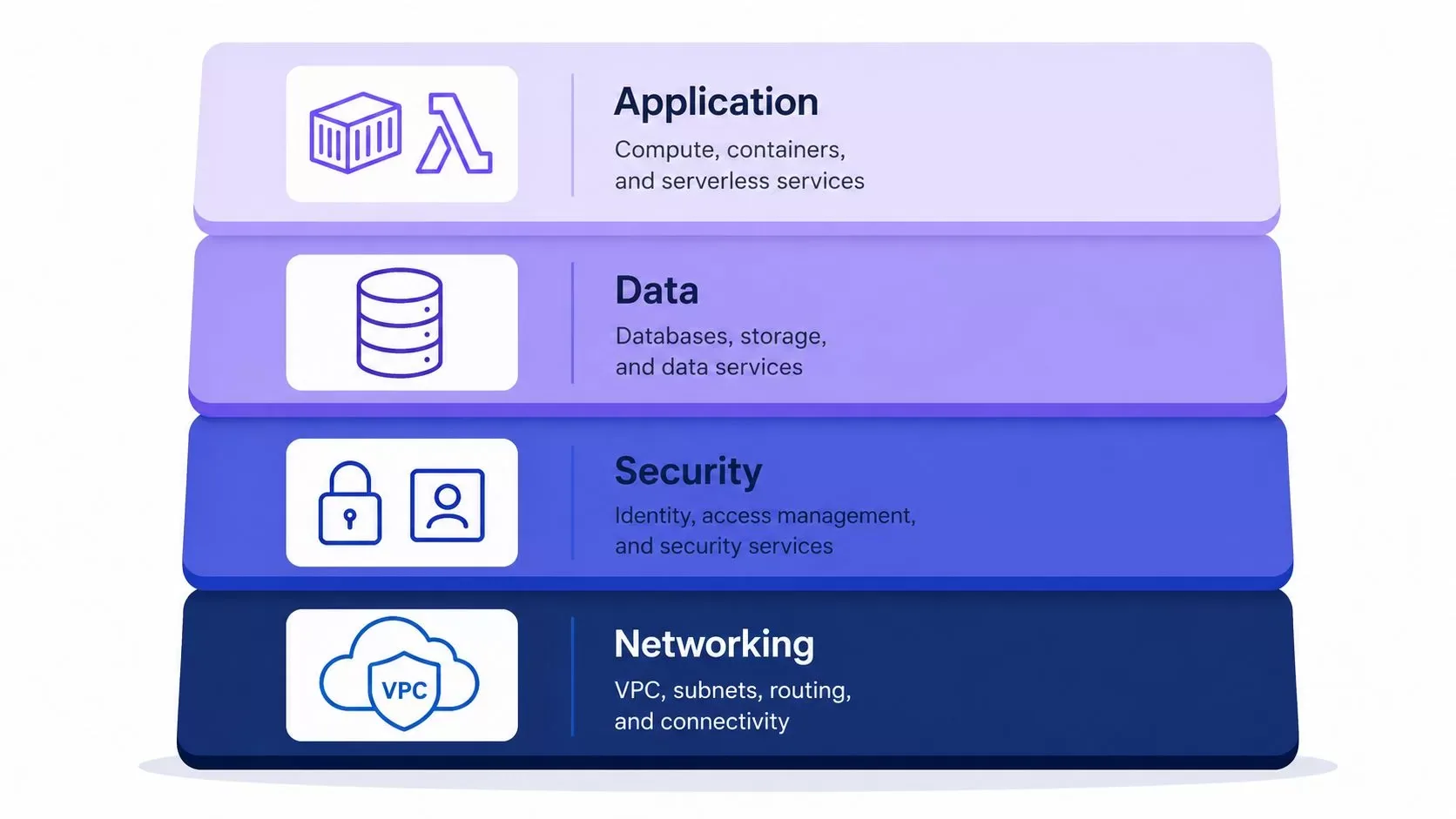
Separate your infrastructure as code on AWS into distinct layers: networking (VPCs, subnets), security (IAM, security groups), data (RDS, S3), and application (ECS, Lambda). Each layer can be updated independently. This reduces blast radius and makes ownership clear.
Treat Every Environment the Same
Dev, staging, and production should be separate stacks or workspaces. Provision all of them from the same modules with injected environment-specific values — never conditional logic in a shared stack. Inconsistency between environments is where incidents originate.
Lock Your Versions
Pin Terraform providers, CDK Construct Library versions, and CloudFormation transforms. Unpinned dependencies lead to surprise upgrades that break pipelines and introduce hard-to-debug regressions.
Never Store State Locally
For Terraform, always use a remote backend. S3 with DynamoDB state locking is the AWS-native standard. Local state in production is how teams lose track of their infrastructure.
Never Hardcode Secrets
IAM credentials, API keys, and database passwords have no place in IaC templates. Use AWS Secrets Manager or AWS Parameter Store and reference values by ARN. This applies equally to Terraform variables, CloudFormation parameters, and CDK context values.
Integrate Security Scanning
Run Checkov or tfsec on every pull request as a required CI check. Define your security baseline as failing pipeline rules, not as human review notes that get skipped under deadline pressure.
Test Your Infrastructure Code
Treat infrastructure code with the same rigor as application code. Use terraform validate and terraform plan in CI pipelines. For CDK, use the CDK assertions library for unit tests. For end-to-end validation, Terratest can provision real infrastructure, run assertions, and tear it down automatically.
Document Your Structure
A README at the root of every IaC repository — explaining the architecture, deployment steps, module structure, and required tool versions — costs 30 minutes and saves hours of onboarding for every future team member.
Your IaC Adoption Roadmap: From ClickOps to Automated AWS Infrastructure
Week 1 — Audit and baseline. Identify your most critical AWS resources managed manually. Start with networking. VPCs and subnets are the foundation everything else sits on.
Weeks 2–3 — Import existing resources. Use terraform import or CDK’s import feature to bring unmanaged resources under infrastructure as code on AWS control. This step is time-consuming, but it brings your real infrastructure into version control.
Month 2 — Establish the pipeline. Set up a CI/CD pipeline for your IaC: automated plan on pull request, policy scanning with Checkov, and a manual approval gate before apply. Start with a non-critical environment to build confidence.
Month 3 — Standardize modules. Build a library of reusable, pre-approved modules — a standard VPC module, an RDS module with encryption defaults, a Lambda deployment module. Platform teams publish them; application teams consume them without reinventing the wheel.
Ongoing — GitOps enforcement. Once modules and pipelines are in place, enable GitOps drift detection. AWS Config and tools like Spacelift can alert on or auto-remediate live AWS infrastructure that diverges from your IaC definitions.
Electromech Cloudtech: Your AWS IaC Partner
As an AWS Partner, Electromech Cloudtech helps organizations design, implement, and operationalize infrastructure as code on AWS — whether you are starting from scratch, migrating from ClickOps, or modernizing an existing Terraform estate.
Our engagements cover IaC architecture design, GitOps pipeline setup, policy-as-code integration, and team enablement. We have helped clients across manufacturing, fintech, and education move from manually managed AWS accounts to fully automated, auditable, version-controlled infrastructure.
Ready to stop firefighting your cloud and start engineering it?
Frequently Asked Questions
What is the difference between IaC and configuration management? Infrastructure as code on AWS provisions the infrastructure itself — compute, networking, storage, and IAM. Configuration management tools such as Ansible, Chef, and Puppet configure the software running on that infrastructure. In modern cloud-native architectures, immutable infrastructure managed by IaC often eliminates the need for configuration management entirely.
Should I learn Terraform or AWS CDK first? Learn Terraform first. It appears in approximately 65% of IaC job postings, works across multiple clouds, and its declarative concepts transfer directly to CDK. Once you understand state management and plan/apply workflows, learning CDK becomes significantly easier.
Is CloudFormation still worth using in 2026? Yes, for specific use cases. CloudFormation has Day-1 support for every new AWS service, requires no external tooling, and integrates natively with AWS Organizations, StackSets, and Service Catalog. For enterprise multi-account governance, it remains the right choice. For developer experience and productivity, CDK — which compiles to CloudFormation — is the modern answer.
What is OpenTofu and should I use it instead of Terraform? OpenTofu is a Linux Foundation-governed open-source fork of Terraform, created after HashiCorp changed Terraform’s license to BSL in 2023. It is drop-in compatible with Terraform. If open-source licensing matters to your organization and you have no existing HashiCorp enterprise contracts, OpenTofu is the recommended choice for new projects.
How does infrastructure as code on AWS improve security? IaC enables shift-left security. Misconfigurations are caught at the code review or CI stage — not after deployment. Static analysis tools scan your infrastructure definitions for vulnerabilities before any resource is provisioned. Combined with IAM least-privilege policies and policy-as-code enforcement, IaC dramatically reduces your AWS attack surface.
Uncategorized