Red Hat Certification Changes 2026: Everything You Need to Know (RHCSA, RHCE & RHCA)
Palash Upadhyay
The Red Hat Certification Changes 2026 are here — and they are the biggest structural update the program has seen in years. On May 11, 2026, Red Hat officially announced a complete overhaul of its certification program: new specialised tracks, new progressive levels, new credential titles, and a simpler way to renew.
Whether you are just starting out or already hold an RHCE, these changes affect your career path directly. Moreover, a lot of professionals are understandably confused about what stays the same, what has shifted, and what it all means going forward.
In this guide, Electromech Academy breaks down every aspect of the Red Hat Certification Changes 2026 clearly — for complete beginners starting from scratch and for working professionals who need to understand how renewal, career progression, and the new track system work.
Table of Contents
Why Red Hat Changed Its Certification Program
The 5 New Specialized Tracks
The 5 Levels of Certification Explained
What RHCA Means Now (This Is the Biggest Change)
Certification Titles That Got Renamed
New Recertification Rules — Simpler Than Before
What Happens to Your Existing Certifications?
Which Track Should You Choose?
Frequently Asked Questions
How to Start Preparing
1. Why Red Hat Changed Its Certification Program
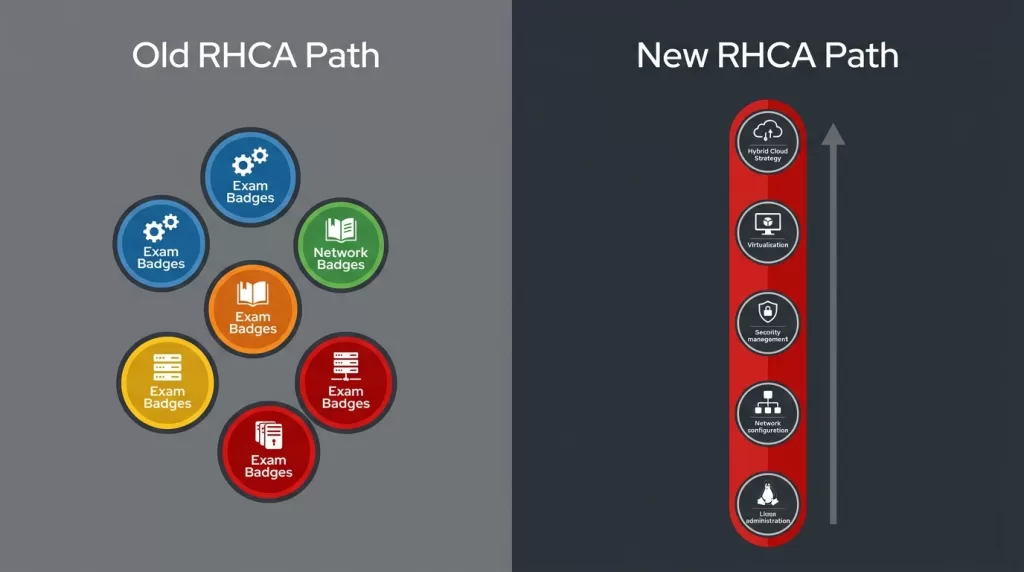
Red Hat certifications have always been respected in the industry because they are 100% hands-on and performance-based — no multiple choice, no memorization tricks. However, the old structure had a problem: the path from beginner to architect was a single, somewhat linear journey that did not clearly reflect the different technology domains professionals actually work in.
A Linux administrator, an Ansible automation engineer, and an OpenShift platform engineer were all climbing the same generic ladder. As a result, employers could not tell at a glance which area someone specialised in just from their RHCA title alone.
The Red Hat Certification Changes 2026 fix exactly this. The goal is to align certifications tightly with the actual Red Hat platforms in use at enterprises — and therefore make it easier for both professionals and hiring managers to navigate the program with purpose.
2. The 5 New Specialized Tracks
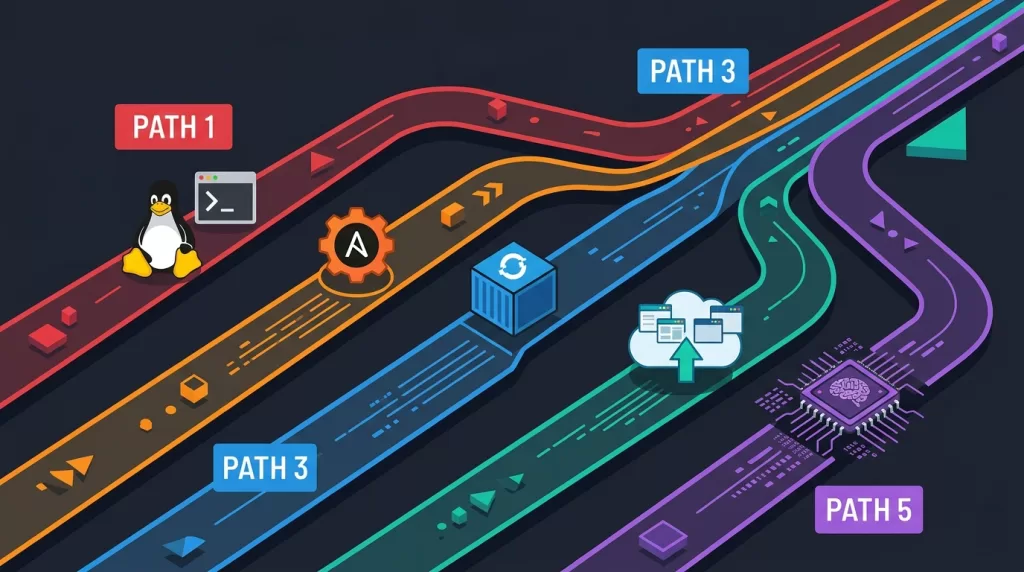
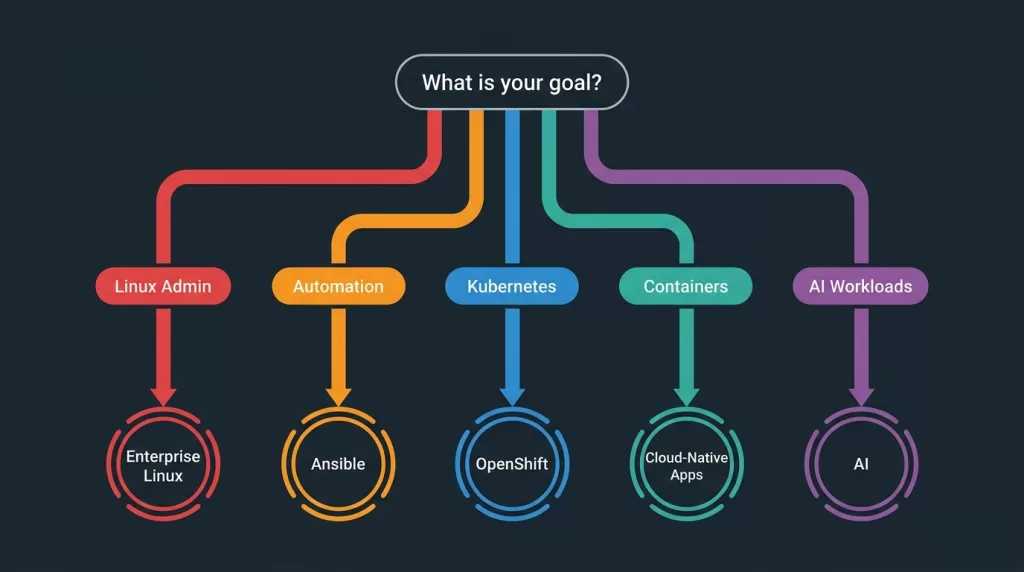
The most significant structural change in the Red Hat Certification Changes 2026 is the introduction of 5 specialized tracks. Every certification now lives inside one of these tracks:
Track
Who It’s For
Enterprise Linux
System administrators, infrastructure engineers
Ansible
Automation engineers, DevOps professionals
OpenShift
Platform engineers, SREs, cloud engineers
Cloud-Native Applications
Developers building containerized, microservices-based apps
AI
Engineers deploying and managing AI workloads on Red Hat platforms
Instead of a single RHCA credential, you can now earn an RHCA in Enterprise Linux, an RHCA in OpenShift, an RHCA in Ansible, and so on. This means your credential tells the market exactly what you specialize in — not just that you passed a pile of exams.
For beginners: Choose the track that matches the career path you are aiming for. If you want to work in Linux system administration, start with the Enterprise Linux track. If cloud and Kubernetes is your goal, go OpenShift.
For working professionals: Your existing certifications map into these new tracks. Nothing you earned goes away. The framework just got clearer labels.
3. The 5 Levels of Certification Explained
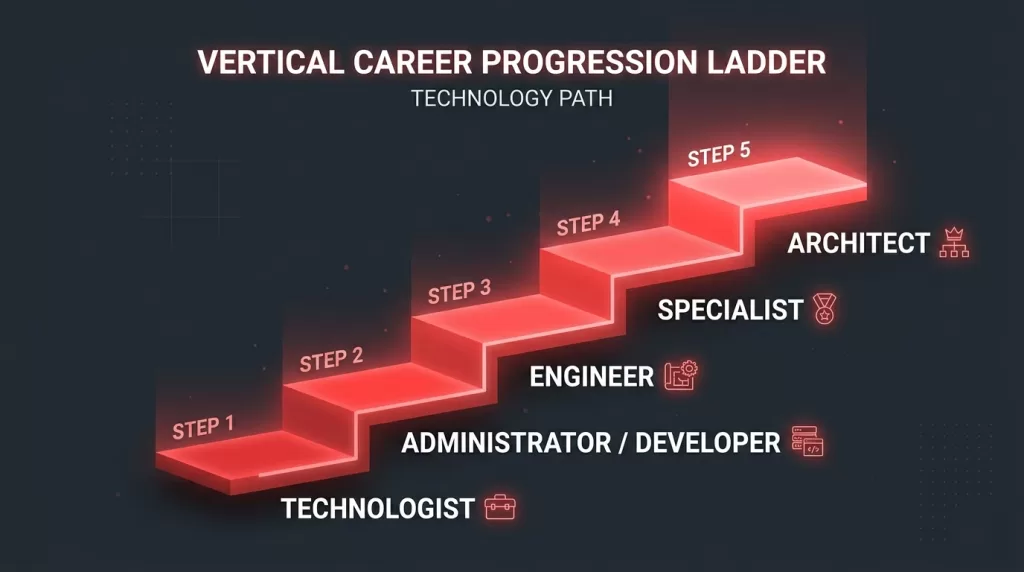
Within each track, Red Hat has organised certifications into 5 progressive levels. Think of it as a clear career ladder — each rung validates a higher depth of skill.
Level 1 — Red Hat Certified Technologist
This is a new, optional entry-level credential designed for people who are new to Red Hat technology. Specifically, it validates basic installation, configuration, and maintenance skills for a specific product. Although it is not required to move forward, it is a great confidence-builder for beginners or students setting up their first lab environment.
Level 2 — Red Hat Certified System Administrator (RHCSA) / Red Hat Certified Developer (RHCD)
In practice, this is where most people start in earnest. The RHCSA validates baseline system administration skills — including user management, storage, networking, service management, and SELinux. Similarly, the RHCD counterpart covers the same baseline for developer-focused tracks.
The RHCSA (EX200) exam remains the gold standard entry point for Linux careers. Notably, nothing has changed about the exam content or difficulty.
Level 3 — Red Hat Certified Engineer (RHCE)
The RHCE recognises comprehensive competency in managing, automating, and scaling enterprise-level environments. For instance, in the Enterprise Linux and Ansible tracks this means deep Ansible automation skills (EX294), while in the OpenShift track it maps to advanced cluster management.
Overall, the RHCE is widely considered the “sweet spot” in terms of job market demand and salary impact.
Level 4 — Red Hat Certified Specialist
These are elective certifications that validate deep proficiency in specific high-value areas. Examples include:
OpenShift administration
Security hardening
Identity management
Virtualization
Cloud-native development
AI deployment on Red Hat platforms
Importantly, you need three of these within your chosen track to qualify for the RHCA under the new system.
Level 5 — Red Hat Certified Architect (RHCA)
This is the pinnacle — but under the new rules, it is more achievable and more meaningful than before. More on this in the next section.
4. What RHCA Means Now — The Biggest Change
This is the section most working professionals are asking about, and it is where the Red Hat Certification Changes 2026 make the most impact.
The Old Way
Previously, earning an RHCA required your RHCE plus 5 specialist-level certifications from a broad pool. Crucially, those five certs could span completely different technology areas — so mixing and matching was allowed and common.
The New Way
Under the 2026 framework, RHCA is earned by completing:
One Administrator or Developer exam (Level 2 — e.g., RHCSA)
One Engineer exam in the same track (Level 3 — e.g., RHCE)
Three Specialist exams within the same specialization (Level 4)
That is 5 credentials total, but within one track. The result is a credential with a specific specialization label: RHCA in Enterprise Linux, RHCA in OpenShift, etc.
What This Means for You
If you are starting fresh, this is actually a cleaner, more focused path. You pick your track and climb it with purpose.
For those who are already an RHCA, your credential stays valid. The new specialized titles are displayed on the Red Hat verification page as of May 11, 2026.
Additionally, if you have an RHCE and a few specialist certs, check which track they align to — you may already be close to an RHCA under the new system.
Common question from Reddit: “I have my RHCE and 3 specialist certs from different areas. Am I close to RHCA?” Answer: It depends on whether your 3 specialist certs fall within the same specialization track. If they do, you are one specialist exam away from RHCA. If they span different tracks, you may need additional exams within a single track. Check the Red Hat certifications page to map your certs.
5. Certification Titles That Got Renamed
Several existing certifications got new names to fit the new framework. Important: only the names changed. Exam content, objectives, and difficulty level are identical.
Here is the complete rename table:
Old Certification Title
New Title (Effective May 11, 2026)
Red Hat Certified Enterprise Application Developer
Red Hat Certified Specialist in Enterprise Application Development
Red Hat Certified Specialist in Containers
Red Hat Certified Developer in Cloud-Native Applications
Red Hat Certified Specialist in OpenShift AI
Red Hat Certified Developer in AI
Red Hat Certified OpenShift Administrator
Red Hat Certified System Administrator in OpenShift
Red Hat Certified Specialist in OpenShift Application Development
Red Hat Certified Advanced Developer in Cloud-Native Applications
Red Hat Certified Specialist in Linux Diagnostics and Troubleshooting
Red Hat Certified Advanced System Administrator in Enterprise Linux
Red Hat Certified Cloud-Native Developer
Red Hat Certified Specialist in Cloud-Native Development
Red Hat Certified Specialist in OpenShift Automation and Integration
Red Hat Certified Advanced System Administrator in OpenShift
If you hold any of these certifications, your credential is automatically updated with the new title on your Red Hat profile and the public verification page. You do not need to do anything or re-take any exam.
6. New Recertification Rules — Simpler Than Before
Certifications still expire after 3 years, but one of the most welcome aspects of the Red Hat Certification Changes 2026 is the introduction of three flexible renewal paths. This is a significant quality-of-life improvement over the old system.
Path 1 — Retake
Pass the exam associated with your highest-level current certification. Doing so renews all your lower-level credentials in the same chain automatically.
Path 2 — Level Up
Earn a new certification at the same level as your highest credential — but in a new area. All your existing credentials are renewed at the same time as a result.
Path 3 — Advance
Earn a higher-level certification. This is the most efficient path, because moving up automatically renews everything below it.
What this means in practice: You no longer need to retake multiple exams just to keep a bundle of credentials current. Instead, one strategic exam pass can refresh your entire certification portfolio — as long as you keep moving forward.
Common question from Reddit: “My RHCSA is expiring soon. Do I have to retake EX200 or can I just pass my RHCE?” Answer: Yes. Passing your RHCE (EX294) will renew your RHCSA for another 3 years under the “Advance” path. You do not need to retake EX200.
7. What Happens to Your Existing Certifications?
The short answer: nothing negative. Red Hat has been clear on this point.
If you already hold an RHCSA, RHCE, or RHCA, your certifications remain valid for their original 3-year period. As of May 11, 2026, the updated credential titles listed in the rename table are now reflected on the official Red Hat verification page.
The only thing that requires your attention is recertification when your certs approach expiry — and now, as described above, you have three clear paths to handle that efficiently.
A Note for Existing RHCA Holders
Your credential remains at the top of the pyramid. Going forward, when employers look up your verification page, your RHCA will show the relevant specialization track it maps to — giving your credential even more context and market value than before.
8. Which Track Should You Choose?
This depends on your role and where the job market is strongest for your career goals. Here is a quick orientation guide.
Choose Enterprise Linux if:
You want to work as a system administrator, infrastructure engineer, or Linux specialist in enterprise environments. In terms of global demand, the RHCSA → RHCE → RHCA in Enterprise Linux path is the most established route available.
Choose Ansible if:
Automation, DevOps, and infrastructure-as-code are your focus. Ansible skills are in very high demand across industries, and therefore this track is ideal for professionals who already have Linux fundamentals and want to stand out in automation roles.
Choose OpenShift if:
You want to work as a platform engineer, SRE, or Kubernetes specialist. OpenShift is rapidly becoming the operating system of enterprise cloud, and as a result this track is the fastest-growing in terms of job postings and salary premium.
Choose Cloud-Native Applications if:
You are a developer building containerised applications, microservices, and APIs on Red Hat platforms. Specifically, this track combines container skills, application lifecycle management, and modern CI/CD patterns in one focused path.
Choose AI if:
You want to specialise in deploying and managing AI workloads on Red Hat infrastructure. Given that enterprises are moving AI from experimentation to production at speed, this is one of the fastest-growing specializations in the program.
9. Frequently Asked Questions
These are real questions asked by the Red Hat community online following the May 2026 announcement. Below, we address the most common ones in full.
Questions About Your Existing Certifications
Q: Do I have to choose a track before starting? Can I switch later?
Many levels are accessible without prior prerequisites. You can start with RHCSA, which is foundational across multiple tracks, and then choose your specialization when you reach Specialist level. As a result, you are not locked in from day one.
Q: I have an RHCE. Do I have to re-earn it under the new system?
No. Your RHCE is valid as-is. The new framework simply gives it a track context, but the credential remains entirely yours.
Q: What happens if I was partway through earning my RHCA under the old system — five certs from different areas?
Your earned credentials remain valid. Whether they count toward the new specialized RHCA depends on whether they align to a single track. Therefore, check the updated certification page to see which track each exam maps to. You may need one or two more exams within a single track to complete an RHCA specialization.
Q: Are Red Hat certifications still worth pursuing given these changes?
More than ever. In fact, the changes make the credentials more targeted and more legible to employers. An RHCA in OpenShift tells a hiring manager exactly what they need to know. Furthermore, the hands-on exam format — which has always been the reason these certs carry real weight — has not changed at all.
Questions About Exams, Fees, and Prerequisites
Q: Is RHCSA still the right starting point for a beginner?
Yes. The RHCSA (EX200) is still the most recommended entry-level exam for anyone entering the Red Hat ecosystem. In most tracks, it is the prerequisite for the RHCE — and hiring managers consistently look for it on a CV.
Q: Did exam fees change?
Red Hat has not announced any exam fee changes alongside this certification restructuring. Consequently, exam costs remain approximately $400–$500 USD per exam. Always verify current pricing at redhat.com/training.
Q: The old RHCE was about Ansible (EX294). Is that still the case?
In the Enterprise Linux and Ansible tracks, the RHCE exam (EX294) remains focused on Red Hat Ansible Automation. In other tracks like OpenShift, however, the RHCE maps to different Engineer-level exams. The exam objectives are now track-specific.
Q: Are there prerequisites for all levels?
Not for all. Red Hat’s updated framework notes that while certain advanced designations require foundational credentials, many levels are accessible without prior prerequisites. For example, the Specialist (Level 4) certifications can often be taken without an RHCE.
10. How to Start Preparing
Regardless of your starting point, the approach to Red Hat certifications has not changed: you must practise hands-on in a live RHEL environment. Simply put, there is no shortcut.
1 Admin + 1 Engineer + 3 Specialist exams, all within the same track
Cert titles renamed
8 certifications renamed; content unchanged
Recertification paths
3 options: Retake, Level Up, or Advance — one exam can renew all lower creds
Validity period
Still 3 years, unchanged
Existing credentials
All remain valid; updated titles reflected on verification page from May 11, 2026
Start Your Red Hat Journey with Electromech Academy
The Red Hat Certification Changes 2026 are an opportunity, not a disruption. Whether you are picking your first track or mapping your path to RHCA, the program is now cleaner, more focused, and more aligned with what enterprise employers actually need.
At Electromech Academy, we offer structured training programs for RHCSA, RHCE, and specialist-level certifications across the Enterprise Linux and Ansible tracks, with OpenShift content coming soon. Our courses are built around hands-on lab practice — the only way that actually works for Red Hat exams.