








AWS Bedrock is transforming how businesses build and deploy AI. Whether you run a startup exploring generative AI for the first time or lead an enterprise scaling AI across multiple departments, AWS Bedrock gives you a single, secure, fully managed platform — without touching a single server. In this guide, Electromech Cloudtech breaks down exactly what AWS Bedrock is, how its core features work, which industries already use it, and how you can get started today.
Quick Navigation
What Is AWS Bedrock?
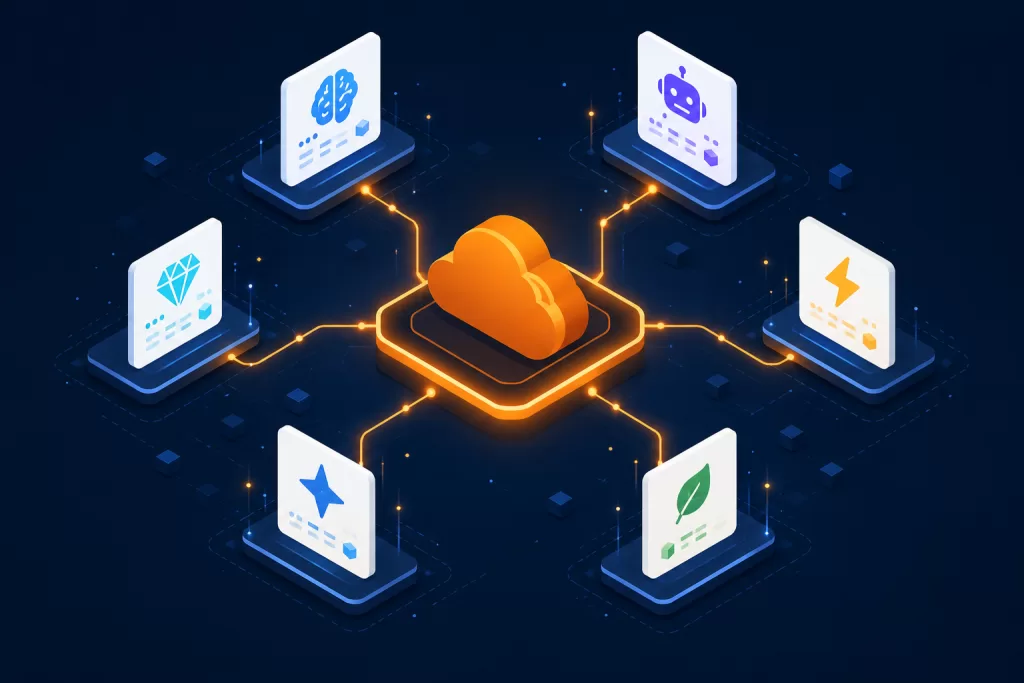
AWS Bedrock is Amazon’s fully managed generative AI platform. It gives businesses access to nearly 100 foundation models from leading AI providers — including Anthropic, Meta, Mistral, Google, NVIDIA, and OpenAI — through a single unified API. As a result, you no longer need to provision GPU servers, manage infrastructure, or negotiate separate contracts with every AI vendor.
Instead, you choose a model, send a prompt, and pay only for the tokens you use.
Just eighteen months ago, AWS Bedrock was a promising but niche service. Today, it powers generative AI for more than 100,000 organisations worldwide. Consequently, it has become the enterprise AI platform on AWS — the layer where business strategy finally meets execution.
Internal link suggestion: What is Generative AI? A Beginner’s Guide by Electromech Cloudtech (replace with your published URL)
How AWS Bedrock Works
At its core, AWS Bedrock acts as an API gateway for foundation models. Specifically, here is the basic flow every request follows:
- You select a foundation model from the Bedrock model catalogue — Claude, Llama, Nova, Mistral, and more.
- You send a request via the Bedrock API or AWS SDK from your application, Lambda function, or notebook.
- The model processes your prompt and returns a response instantly.
- You pay per token consumed — with no upfront commitment required.
That simplicity is, in fact, the entire point. Bedrock removes all the complexity of ML infrastructure so your engineering team can focus on building the product rather than managing servers.
The Single API Advantage
One of AWS Bedrock’s most powerful characteristics is model interoperability. In practice, you never lock into a single AI provider. Moreover, swapping from one model to another takes only a single API parameter change. This flexibility lets teams benchmark models freely, choose the best fit for each task, and stay agile as the AI landscape keeps evolving.
Key Features of AWS Bedrock
1. Access to Nearly 100 Foundation Models
AWS Bedrock’s model catalogue is, by far, the broadest in the market. In December 2025 alone, AWS added 18 new fully managed open-weight models — the largest single-month expansion in Bedrock’s history. Today, the catalogue includes models from Anthropic, Meta (Llama), Mistral, Google, NVIDIA, OpenAI, MiniMax, Moonshot, and Qwen, as well as Amazon’s own Nova 2 model family.
This variety delivers a clear strategic advantage. Different models excel at different tasks. For example, a fast, cost-optimised model handles customer-facing chatbots well, while a more capable reasoning model tackles complex document analysis in the back end.
2. Knowledge Bases and RAG (Retrieval-Augmented Generation)
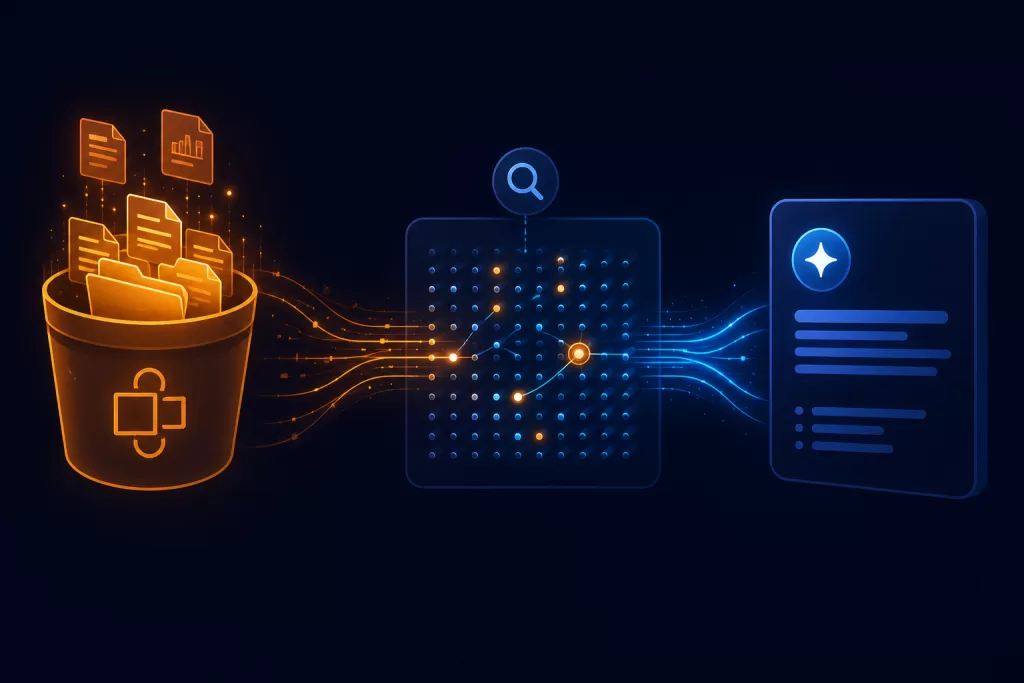
AWS Bedrock Knowledge Bases delivers a fully managed Retrieval-Augmented Generation (RAG) pipeline. Essentially, it connects foundation models to your company’s private data — documents, manuals, policies, and databases — so AI responses draw from your actual information rather than general training data.
Here is exactly how it works in practice:
- First, you connect a data source, such as an Amazon S3 bucket holding your product documentation.
- Next, Bedrock automatically chunks the documents, converts them to vector embeddings, and stores them in a vector index.
- Then, at query time, Bedrock matches the user’s question semantically to the most relevant document chunks.
- Finally, it injects those chunks into the model prompt, giving the model the context it needs to answer accurately.
The result is significant. RAG implementations reduce AI hallucinations by 50–90% compared to vanilla large language models. Furthermore, your data stays inside your AWS environment and never trains the underlying foundation models — a critical compliance requirement for banking, healthcare, and government organisations.
3. Bedrock Agents and AgentCore
Bedrock Agents lets you build AI systems that do not just answer questions — they take real action. Specifically, agents call APIs, run code, query databases, and chain multiple steps together without human input.
AWS Bedrock AgentCore, announced at AWS re:Invent 2025, takes this even further. It provides a fully managed runtime for production AI agents and handles:
- Session management — isolating each user’s context securely
- Identity and authentication — connecting agents to internal tools like Slack, Jira, and Salesforce
- Memory — persisting information across sessions
- Observability — logging, tracing, and monitoring every agent action
In addition to these infrastructure benefits, AgentCore already powers real-world use cases in production. For instance, customer support agents now handle returns end-to-end, IT helpdesk agents reset passwords and provision access automatically, and FinOps agents pull AWS Cost Explorer data to recommend cost savings. As a concrete example, one company cut campaign setup time by 30% and saved 8 hours of manual work per team per week after deploying AgentCore.
4. Bedrock Guardrails
Deploying AI responsibly requires strong safety controls. AWS Bedrock Guardrails lets you define and enforce those controls at the platform level — across every model and application you run on Bedrock.
Key Guardrails capabilities include:
- Content filtering — blocks harmful, offensive, or off-topic responses before they reach users
- Contextual grounding checks — detects AI responses that stray from your retrieved source data, which is especially critical for RAG applications
- Automated Reasoning checks — validates response accuracy against logical rules and flags hallucinations before they cause problems
- Prompt injection protection — defends against adversarial inputs designed to manipulate the model
Moreover, you can apply Guardrails policies consistently across multiple models and applications through IAM roles. This approach gives security and compliance teams a single, unified governance framework for all AI workloads.
5. Fine-Tuning and Model Customisation
Sometimes a general-purpose model simply does not deliver enough precision for your use case. In those situations, AWS Bedrock supports full model fine-tuning. You supply a labelled training dataset, and Bedrock creates a private, customised version of the foundation model inside your account. Importantly, the customised model stays exclusive to you — Bedrock never shares or exposes it externally.
This capability is especially valuable for organisations in regulated industries that need highly specific, auditable AI behaviour.
6. Cross-Region Inference and High Availability
For production applications, uptime is non-negotiable. To address this directly, AWS Bedrock’s Cross-Region Inference feature automatically routes API requests to a different AWS region whenever the primary region experiences an outage or capacity constraint. Even better, this reliability feature comes at no extra cost — pricing simply reflects the source region’s standard rates.
7. Security and Compliance Built In
AWS Bedrock runs on the same security foundation as the rest of AWS. As a result, it delivers enterprise-grade protection out of the box:
- IAM-based access control — you manage no API keys. Instead, AWS Identity and Access Management roles control every access decision at the resource level.
- VPC isolation — your prompts and responses stay entirely within your network boundary.
- No training on your data — AWS contractually guarantees it never uses your inputs or outputs to train foundation models.
- Audit trails via AWS CloudTrail — every API call produces a log entry for compliance and forensic review.
For banking, healthcare, and government workloads, this combination of contractual data guarantees and enterprise-grade IAM consistently proves to be the deciding factor.
AWS Bedrock Use Cases
Customer Service Automation
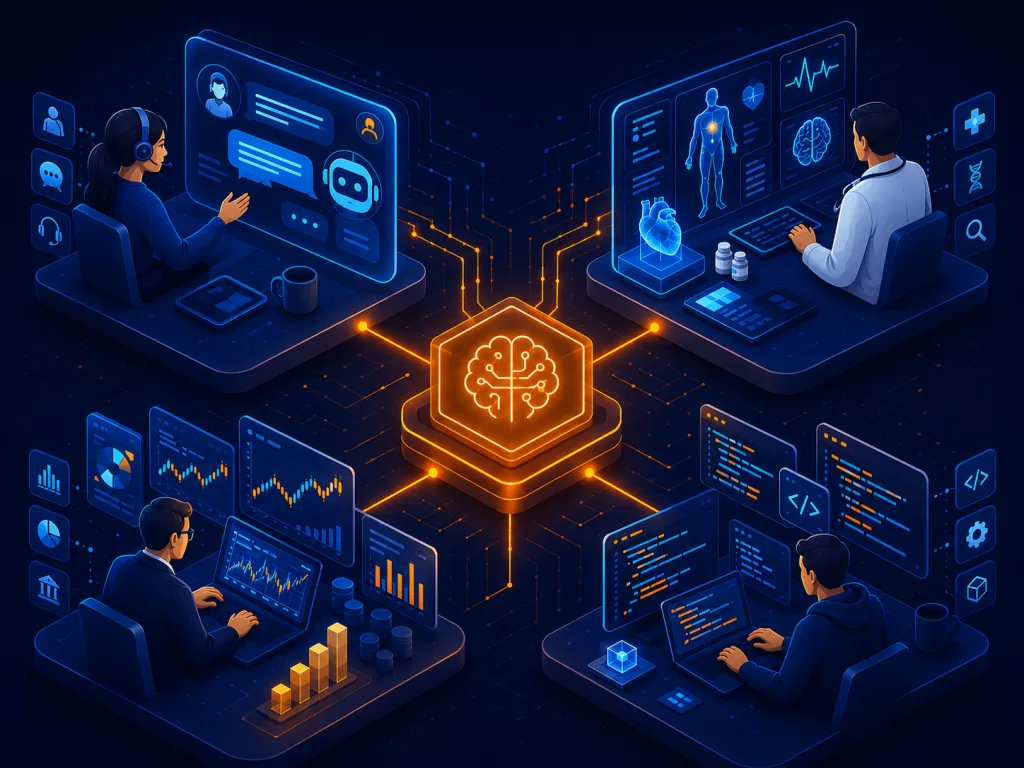
Businesses today use Bedrock to power intelligent support agents that handle FAQs, process refunds, check order status, and escalate complex cases to human agents — all while maintaining strict session isolation so each customer’s data stays private.
Enterprise Knowledge Management
Large organisations connect internal wikis, HR policies, legal documents, and technical manuals to Bedrock Knowledge Bases. As a result, employees ask questions in plain English and receive accurate, source-cited answers in seconds — instead of spending hours searching SharePoint or Confluence.
Document Processing and Analysis
Bedrock models read contracts, financial reports, clinical notes, and compliance documents at scale. They then extract key data points, summarise findings, flag anomalies, and produce structured outputs — dramatically cutting manual review time across teams.
Software Development Acceleration
Development teams integrate Bedrock into CI/CD pipelines for automated code review, documentation generation, and test case creation. Consequently, some teams report 30–40% reductions in routine development overhead.
Healthcare and Life Sciences
Hospitals and research organisations use Bedrock to analyse clinical trial data, support diagnostic documentation, and surface relevant medical literature. Furthermore, the strict data isolation model satisfies HIPAA requirements without additional configuration.
Financial Services
Banks and fintech companies deploy Bedrock for fraud pattern analysis, regulatory reporting assistance, personalised financial advice, and FinOps cost optimisation agents. Because all data stays within AWS, it meets strict financial compliance standards from day one.
AWS Bedrock Pricing Overview
AWS Bedrock offers four main pricing models to match different workload needs:
| Pricing Model | Best For |
|---|---|
| On-Demand (pay-per-token) | Variable workloads, experimentation, early-stage projects |
| Provisioned Throughput | High-volume, consistent production workloads needing guaranteed capacity |
| Batch Processing | Large-scale, non-real-time jobs (e.g. bulk document analysis) |
| Model Customisation | Fine-tuning foundation models for domain-specific tasks |
Text and embedding models charge by the number of input and output tokens. Image models charge per image. Additionally, Cross-Region Inference adds no extra fees — costs simply reflect the source region’s rates.
Cost optimisation tip: Always match the complexity of your foundation model to your actual use case. For example, running a high-capability reasoning model on a simple FAQ chatbot inflates costs unnecessarily. Start with a fast, lightweight model and step up only when your benchmarks justify it.
Outbound link: AWS Bedrock pricing details on aws.amazon.com
Is AWS Bedrock Right for Your Business?
AWS Bedrock is the right choice if:
- You already use AWS and want to keep AI workloads inside the same trust boundary
- You need access to multiple foundation models without juggling separate vendor relationships
- Data privacy, compliance, and security are non-negotiable requirements for your organisation
- You want to build AI agents or RAG applications without constructing custom infrastructure
- You need enterprise-grade observability, governance, and audit trails for AI
However, it may not be the best fit if:
- You run entirely outside of AWS and have no plans to migrate your workloads
- You need real-time, extremely high token throughput (because Bedrock’s default service quotas start low and require a manual increase via AWS support)
- You need a fully self-hosted, air-gapped AI deployment for sovereign cloud requirements
How Electromech Cloudtech Can Help
At Electromech Cloudtech, we help businesses design, deploy, and optimise AWS Bedrock implementations from the ground up. Whether you are evaluating Bedrock for the first time or already running in production and facing scaling or cost challenges, our team brings deep AWS expertise to every engagement.
Specifically, our AWS Bedrock services cover:
- Discovery and architecture design — mapping your business use cases to the right Bedrock features and foundation models
- Knowledge Base and RAG implementation — connecting your company data to foundation models for accurate, grounded AI responses
- Agent and AgentCore development — building multi-step AI agents that integrate with your existing tools and workflows
- Guardrails and governance setup — ensuring your AI deployment meets compliance, security, and responsible AI standards
- Cost optimisation — right-sizing models, configuring provisioned throughput, and building CloudWatch monitoring dashboards
- Ongoing support and managed services — so your AI investment keeps delivering value as AWS continues to evolve the platform
Internal link suggestion: Contact Electromech Cloudtech for a free AWS Bedrock consultation (replace with your contact page URL)
FAQs
What is AWS Bedrock in simple terms?
AWS Bedrock is a managed cloud service that lets businesses use powerful AI models through a simple API — without setting up any AI infrastructure. Think of it as AI-as-a-service built directly into AWS.
Is AWS Bedrock the same as AWS SageMaker?
No — these two services serve different purposes. SageMaker suits teams who want to train, tune, and deploy their own machine learning models from scratch. Bedrock, on the other hand, suits teams who want to use pre-built foundation models without managing any ML infrastructure. In short, Bedrock offers a faster start while SageMaker offers deeper custom control.
Which AI models are available on AWS Bedrock?
AWS Bedrock provides access to nearly 100 foundation models, including Claude (Anthropic), Llama (Meta), Mistral, Gemini (Google), models from NVIDIA and OpenAI, and Amazon’s own Nova 2 family, among others.
Is my data safe on AWS Bedrock?
Yes. AWS contractually guarantees that it never uses your prompts or responses to train the underlying foundation models. Your data stays isolated within your AWS account and VPC. Additionally, IAM roles control access at the resource level, and CloudTrail logs every API call for compliance review.
How much does AWS Bedrock cost?
AWS Bedrock uses a pay-per-token model for on-demand usage. Costs vary by model — more powerful models cost more per token. For high-volume workloads, provisioned throughput and batch pricing offer better economics. Visit the AWS Bedrock pricing page for the latest rates.
What is Bedrock AgentCore?
AWS Bedrock AgentCore is a fully managed runtime for production AI agents. It handles session management, authentication, memory, and observability — so teams can build agents that take real-world actions across business systems without building any custom infrastructure themselves.
Final Thoughts
AWS Bedrock has moved decisively from a promising experiment to the definitive enterprise AI platform on AWS. With nearly 100 foundation models, a fully managed RAG pipeline, production-grade agentic infrastructure through AgentCore, and security controls that satisfy the most demanding compliance teams, Bedrock gives organisations everything they need to build, scale, and govern AI workloads — all in one place.
Ultimately, the organisations winning with AI in 2026 are not waiting for the perfect moment. They are building right now.
Ready to get started with AWS Bedrock? Electromech Cloudtech is here to help you move from curiosity to production — faster, more securely, and with far less guesswork.