








Cloud spending is now one of the top three operating expenses for most technology-driven enterprises. Gartner projects worldwide public cloud end-user spending to exceed $675 billion in 2024, yet Flexera’s 2024 State of the Cloud Report found that organizations waste an average of 28% of their cloud budget on underused or idle resources. For a company spending $10 million per year on cloud infrastructure, that is $2.8 million evaporating without generating a single line of business value.
Cloud cost optimization is not a one-time project. It is a continuous engineering discipline — combining architectural rigor, financial accountability, and operational excellence. This guide distills the cloud cost optimization best practices that engineering leaders and CTOs are deploying in 2025 to bring cloud spend under control without sacrificing performance or agility.
Whether you are managing workloads on AWS, building a hybrid architecture, or evaluating cloud cost optimization tools and services, the strategies below provide an actionable, data-driven roadmap.
Table of Contents
- What Is Cloud Cost Optimization?
- Establish Full Cost Visibility Before Optimizing
- Right-Size Your Infrastructure Continuously
- Maximize Commitment-Based Discounts
- Architect for Cost from the Ground Up
- Implement FinOps: Make Cost a Team Sport
- Automate Cost Governance with Policy-as-Code
- Eliminate Idle and Orphaned Resources
- Optimize Network and Data Transfer Costs
- Build a Cloud Cost Optimization Roadmap
- Leverage the AWS Well-Architected Framework
- Cloud Cost Optimization Tools: A Reference Overview
- When to Engage Cloud Cost Optimization Services
- Frequently Asked Questions
1. What Is Cloud Cost Optimization?
Cloud cost optimization is the process of reducing cloud expenditure while maintaining — or improving — performance, reliability, and scalability. It spans every layer of the stack: from the choice of instance type to the design of application architectures to the governance policies that prevent uncontrolled provisioning.
Cost optimization in cloud computing is distinct from simple cost-cutting. Blindly decommissioning resources can degrade user experience, increase operational risk, or create technical debt that costs more to remediate later. True cloud cost optimization aligns spending with business value — ensuring that every dollar of cloud infrastructure produces measurable output.
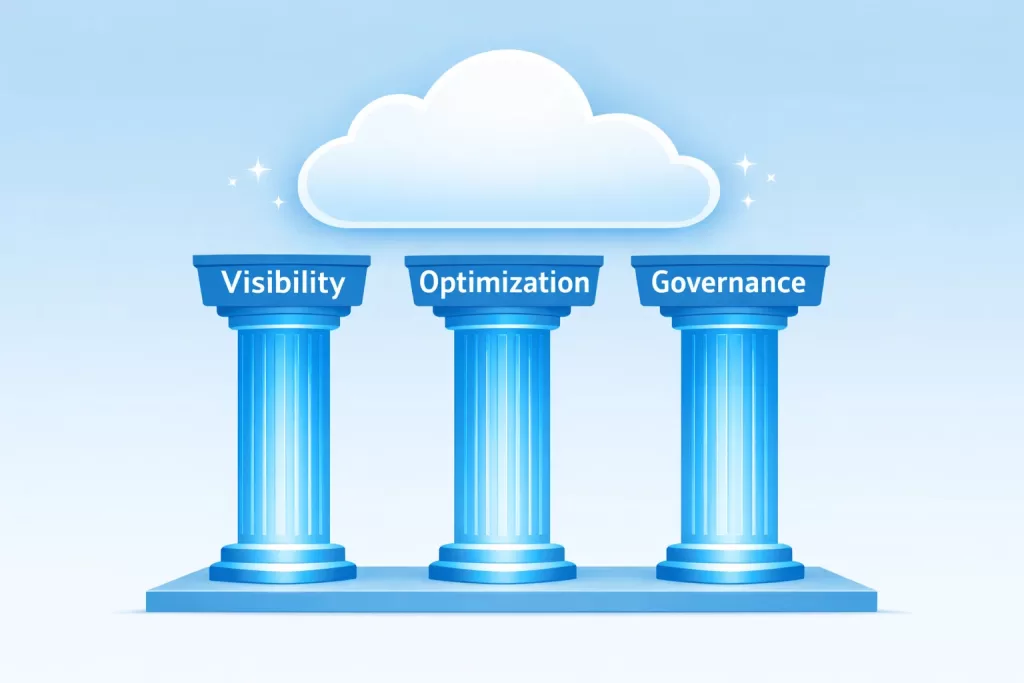
The Three Pillars of Cloud Cost Optimization
| Pillar | What It Means |
|---|---|
| Visibility | Know where every dollar is going — by team, service, environment, and workload. |
| Optimization | Right-size, architect efficiently, and eliminate waste continuously. |
| Governance | Enforce policies that prevent cloud sprawl, untagged resources, and budget overruns. |
2. Establish Full Cost Visibility Before Optimizing
You cannot optimize what you cannot measure. The foundational prerequisite for any cloud cost optimization strategy is granular, real-time visibility into cloud spend. Engineering leaders who skip this step often find themselves optimizing the wrong workloads while their biggest cost drivers go undetected.
Implement a Robust Tagging Strategy
Resource tagging is the backbone of cost attribution. Without consistent tags, cloud costs appear as an undifferentiated mass, making it impossible to hold teams accountable or identify the most expensive workloads. Define a mandatory tagging taxonomy that covers at minimum:
- Environment — production, staging, development, QA
- Owning team or cost center
- Application or service name
- Project or initiative code
- Data classification — public, internal, confidential
Enforce tagging through AWS Service Control Policies (SCPs) or equivalent guardrails on your cloud platform. Untagged resources should trigger automated alerts — and in mature organizations, automated termination of non-production resources.
Use Cloud Cost Management Tools
Native tools like AWS Cost Explorer, AWS Budgets, and AWS Cost and Usage Reports (CUR) provide the foundational data layer. Layer third-party cloud cost optimization tools such as CloudHealth, Apptio Cloudability, or Spot.io on top for multi-cloud visibility, anomaly detection, and rightsizing recommendations. These cloud cost optimization software platforms typically pay for themselves many times over in identified savings within the first quarter of deployment.
3. Right-Size Your Infrastructure Continuously
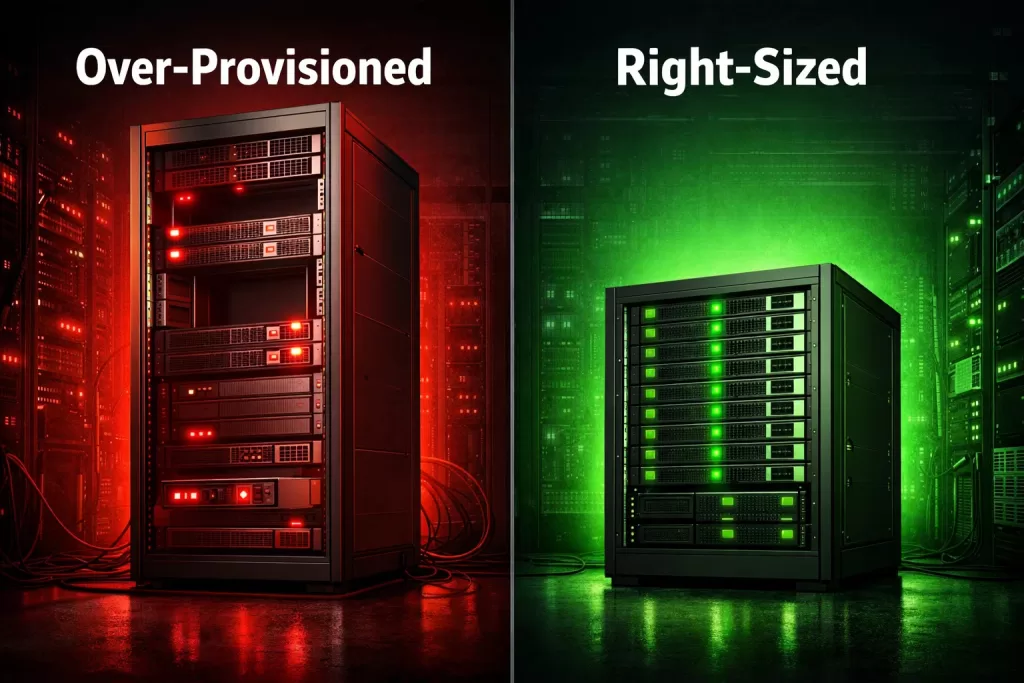
Over-provisioning is endemic in enterprise cloud environments. Engineering teams, understandably risk-averse, provision instances larger than needed to absorb traffic spikes — and those oversized instances run at low utilization 95% of the time. AWS itself reports that the majority of EC2 instances run at less than 40% average CPU utilization.
Right-sizing is one of the highest-impact cloud cost optimization best practices because the savings are immediate and recurring. The process involves analyzing actual CPU, memory, network I/O, and disk throughput metrics over a representative period — typically 30 to 90 days — and then selecting instance types that match actual demand rather than perceived peak demand.
AWS Right-Sizing Recommendations
AWS Cost Explorer’s Right Sizing Recommendations analyzes your EC2 fleet and suggests downsizing or instance family changes. AWS Compute Optimizer goes further, using machine learning to recommend optimal instance types for EC2, EBS, Lambda, and ECS. For AWS cloud cost optimization specifically, Compute Optimizer is one of the most underused yet highest-value tools available at no additional cost.
Automate Rightsizing with Infrastructure as Code
Manual right-sizing creates a maintenance burden that teams deprioritize. The engineering-grade approach is to encode rightsizing decisions into Terraform, CloudFormation, or CDK templates, and run automated rightsizing pipelines on a scheduled basis. This ensures the fleet self-corrects as workload patterns evolve, without requiring a quarterly manual review.
4. Maximize Commitment-Based Discounts
On-demand pricing is the most expensive way to run persistent workloads. Commitment-based purchasing models — Reserved Instances (RIs) and Savings Plans on AWS — can reduce compute costs by 30% to 72% compared to on-demand rates, depending on commitment term and payment option.
Reserved Instances vs. Savings Plans
Reserved Instances offer the deepest discounts but require you to commit to a specific instance family, size, region, and operating system. Savings Plans provide more flexibility — Compute Savings Plans apply across EC2, Fargate, and Lambda regardless of instance family or region — making them the preferred choice for most organizations that regularly change their instance mix.
The optimal approach for AWS cloud cost optimization is a layered commitment strategy:
- Cover your stable, predictable baseline with 1-year or 3-year Compute Savings Plans
- Use Reserved Instances for specialized instance families where you have high confidence in long-term usage
- Cover variable and peak demand with Spot Instances where the workload supports interruption
Spot Instances for Fault-Tolerant Workloads
Spot Instances offer up to 90% savings over on-demand pricing, but require workloads that tolerate interruption. Ideal candidates include batch processing, data analytics, machine learning training jobs, CI/CD build pipelines, and stateless web tier components. AWS Spot Instance Advisor and EC2 Fleet enable intelligent Spot procurement across multiple instance pools to minimize interruption risk.
5. Architect for Cost from the Ground Up
The most expensive cloud cost optimization effort is retrofitting a cost-inefficient architecture. The cloud cost optimization best practices that deliver the most sustainable long-term value are those baked into architectural decisions at design time — not bolted on after deployment.
Embrace Serverless and Event-Driven Architectures
Serverless architectures — AWS Lambda, API Gateway, DynamoDB, SQS, EventBridge — eliminate the cost of idle compute. With serverless, you pay only for actual invocations and execution time, not for provisioned capacity that sits idle between requests. For workloads with variable or unpredictable traffic patterns, serverless can reduce compute costs by 60% to 80% compared to always-on EC2 instances.
Containerization and Kubernetes Optimization
Containers enable significantly higher resource density than virtual machines, reducing the number of underlying instances needed to run equivalent workloads. Kubernetes-native cost optimization involves tuning resource requests and limits to reflect actual consumption, enabling Cluster Autoscaler to scale node pools down aggressively during off-peak hours, and using Vertical Pod Autoscaler (VPA) to right-size pods automatically.
AWS-specific Kubernetes cost optimization includes selecting Graviton-based node instances (typically 20% cheaper than x86 equivalents at equivalent performance), using EKS Managed Node Groups with Spot capacity, and enabling Fargate for serverless pod execution on workloads that do not require dedicated node-level control.
Storage Tiering and Data Lifecycle Management
Storage is a silent cost driver in many cloud environments. Data accumulates across S3 buckets, EBS volumes, EFS shares, and RDS snapshots without anyone actively managing it. Cloud cost optimization best practices for storage include:
- Implementing S3 Intelligent-Tiering to automatically migrate objects to lower-cost storage classes based on access frequency
- Setting S3 Lifecycle Policies to transition data to S3-IA, S3 Glacier Instant Retrieval, or S3 Glacier Deep Archive as it ages
- Identifying and deleting unattached EBS volumes — a common and entirely avoidable source of waste
- Auditing RDS and EC2 snapshot retention policies and deleting obsolete snapshots systematically
- Using EBS gp3 volumes instead of gp2 — gp3 delivers the same or better IOPS at approximately 20% lower cost
6. Implement FinOps: Make Cost a Team Sport
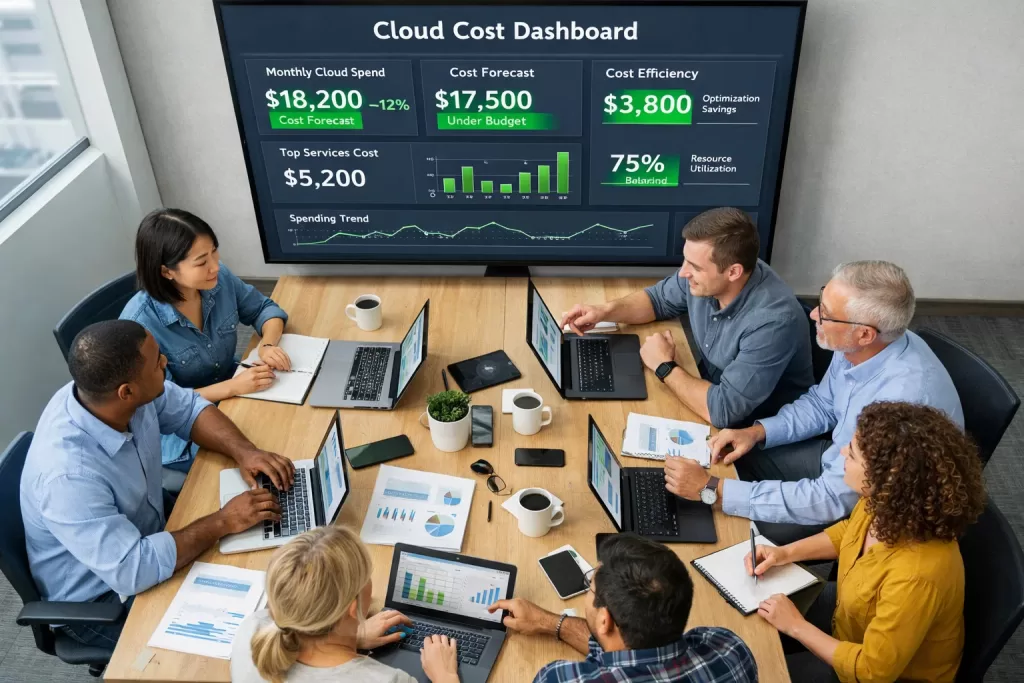
Cloud cost optimization strategies fail when cost accountability sits exclusively with a central cloud or finance team. The FinOps framework — developed by the FinOps Foundation — addresses this by distributing cost ownership to the engineering teams that make infrastructure decisions, while providing the tooling, processes, and culture to make that accountability actionable.
The FinOps Lifecycle: Inform, Optimize, Operate
The FinOps model operates in three phases. In the Inform phase, teams gain visibility into their cloud costs, understand unit economics, and benchmark spend against peers. In the Optimize phase, teams act on rightsizing recommendations, commitment purchases, and architectural improvements. In the Operate phase, organizations build continuous feedback loops — budget alerts, anomaly detection, and cost-aware deployment pipelines — that institutionalize optimization as an ongoing engineering practice rather than a periodic initiative.
Showback and Chargeback Models
Showback makes cloud costs visible to individual teams without financial consequence — an effective starting point for building cost awareness. Chargeback goes further, allocating actual cloud costs to business units or product teams’ budgets. Organizations that implement chargeback models consistently report meaningful reductions in cloud waste because engineers who see their team’s AWS bill become far more deliberate in their provisioning decisions.
7. Automate Cost Governance with Policy-as-Code
Manual governance processes cannot scale with the velocity of modern cloud provisioning. Every sprint, every deployment, every infrastructure change is an opportunity for cloud costs to spiral. The only scalable approach to cloud cost governance is to encode policies in code — enforced automatically through CI/CD pipelines, IaC pre-flight checks, and cloud-native policy engines.
AWS Service Control Policies (SCPs) and AWS Config Rules
AWS Organizations SCPs allow you to define permission guardrails at the organizational unit or account level. Cost-relevant SCPs include restricting provisioning of instance types above a defined size, requiring specific tags on all resources, or preventing creation of resources in unapproved regions. AWS Config Rules enforce compliance continuously — detecting drift from cost policies as soon as a misconfigured resource is provisioned, and triggering automated remediation through Systems Manager Automation or Lambda.
Cost Guardrails in CI/CD Pipelines
Integrating cost estimation directly into pull request workflows is one of the most powerful — and underutilized — cloud cost optimization strategies. Tools such as Infracost generate cost estimates for Terraform changes and post them as PR comments, giving engineers immediate feedback on the financial impact of infrastructure changes before they reach production. This shifts cost awareness left in the development lifecycle, where it is cheapest to address.
8. Eliminate Idle and Orphaned Resources
In any cloud environment that has been running for more than six months without active cost governance, idle and orphaned resources are a near-certainty. These include stopped EC2 instances that continue to incur EBS storage charges, unattached Elastic IP addresses, load balancers with no registered targets, forgotten RDS instances in development accounts, and old NAT Gateways attached to unused VPCs.
A systematic cloud cost optimization audit should address the following categories of idle spend:
| Resource Type | Common Issue | Recommended Action |
|---|---|---|
| EC2 Instances | Stopped but still incurring EBS costs | Snapshot and terminate, or use Instance Scheduler |
| EBS Volumes | Unattached after instance termination | Automate deletion with AWS Config rule |
| Elastic IPs | Allocated but unassociated | Release unused EIPs — $7.20/month each |
| Load Balancers | No registered targets | Delete and replace with API Gateway if needed |
| RDS Instances | Dev/test DBs running 24/7 | Automate start/stop schedules outside business hours |
| NAT Gateways | Attached to unused VPCs | Audit and delete; consider VPC endpoints as replacement |
| Snapshots | No defined retention policy | Implement lifecycle policy — delete after 30/60/90 days |
9. Optimize Network and Data Transfer Costs
Data transfer costs are one of the most frequently overlooked components of cloud spend. AWS charges for data transfer out to the internet, data transfer between Availability Zones, and cross-region replication. In data-intensive architectures — particularly those with distributed microservices, large-scale analytics pipelines, or high-volume media workflows — data transfer can represent 20% or more of total cloud spend.
Reduce Data Transfer Costs with These Strategies
- Deploy services in the same Availability Zone where cross-AZ traffic is a significant cost driver, accepting the trade-off in resilience for non-critical workloads
- Use VPC Endpoints (Gateway and Interface) to route traffic to AWS services like S3, DynamoDB, and Secrets Manager over the private network, avoiding NAT Gateway charges
- Deploy Amazon CloudFront as a CDN for static assets and frequently accessed content — CloudFront egress rates are substantially lower than direct S3 or EC2 egress, and caching reduces origin load
- Enable S3 Transfer Acceleration only for workloads that demonstrably benefit from it; disable it where the performance gain does not justify the premium
- Review inter-service communication patterns in microservices architectures — excessive chatty API calls between services in different AZs can accumulate material data transfer costs over time
10. Build a Cloud Cost Optimization Roadmap
Effective cloud cost optimization is not a sprint — it is a program. Organizations that achieve and sustain 20–40% reductions in cloud spend treat cost optimization as a continuous engineering function with dedicated ownership, quarterly OKRs, and a rolling roadmap of initiatives.
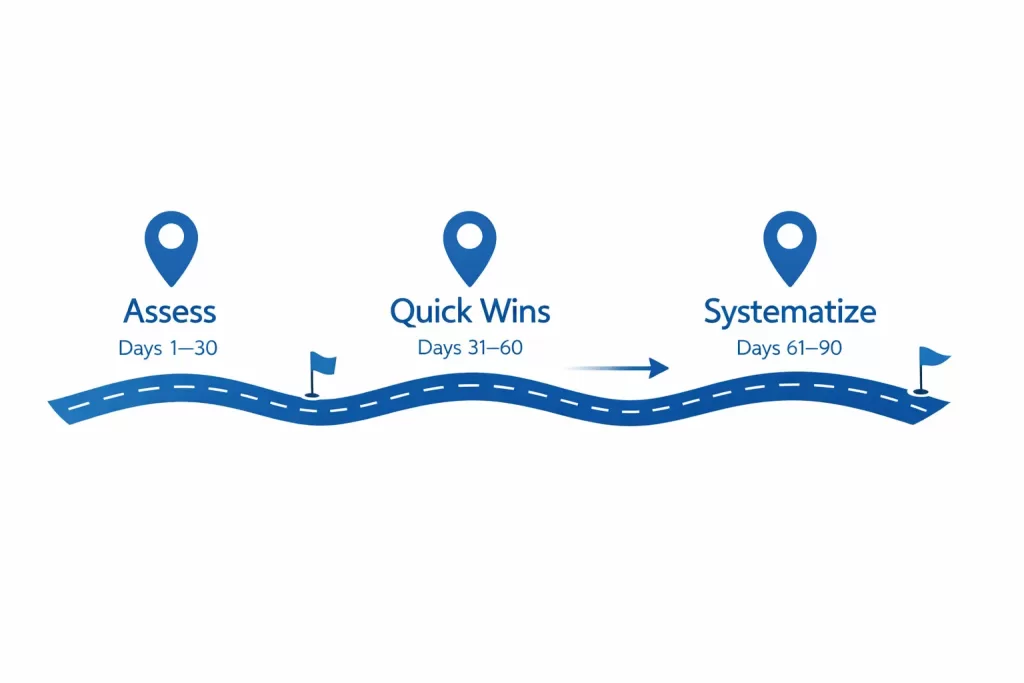
A Practical 90-Day Kickstart Plan
| Phase | Key Activities | Expected Outcome |
|---|---|---|
| Days 1–30 (Assess) | Enable Cost Explorer and CUR. Audit tagging compliance. Identify top 10 cost drivers. Run Compute Optimizer. Inventory idle resources. | Full cost visibility. Quantified savings opportunity. |
| Days 31–60 (Quick Wins) | Terminate idle resources. Purchase Savings Plans for stable baseline. Implement Instance Scheduler for non-prod. Enable S3 Intelligent-Tiering. | 10–20% immediate cost reduction. |
| Days 61–90 (Systematize) | Deploy cost guardrails in CI/CD. Implement tagging enforcement SCPs. Establish FinOps review cadence. Begin architectural optimization backlog. | Sustainable governance. Foundation for ongoing savings. |
11. Leverage the AWS Well-Architected Framework for Cost Excellence
The AWS Well-Architected Framework’s Cost Optimization pillar provides a structured methodology for evaluating and improving the financial efficiency of AWS workloads. It defines best practices across five areas: practice cloud financial management, expenditure and usage awareness, cost-effective resources, manage demand and supply resources, and optimize over time.
A Well-Architected Review (WAR) — either self-conducted using the AWS Well-Architected Tool or performed by an AWS Partner — provides a systematic assessment of how well your workloads align with these best practices, and generates a prioritized improvement plan.
Electromech Cloud, as an experienced AWS Partner, conducts Well-Architected Reviews that identify actionable cost optimization opportunities and provide a remediation roadmap specific to your infrastructure, workloads, and business context.
12. Cloud Cost Optimization Tools: A Reference Overview
Selecting the right cloud cost optimization tools is critical to sustaining any optimization program. Below is a categorized overview of the key tools available.
Native AWS Tools
- AWS Cost Explorer — Visualize spend, identify trends, access rightsizing recommendations. Essential starting point.
- AWS Compute Optimizer — ML-powered recommendations for EC2, EBS, Lambda, ECS, and Auto Scaling groups.
- AWS Budgets — Set cost and usage budgets with automated alerts and actions.
- AWS Cost and Usage Report (CUR) — Granular, line-item billing data for analysis in Athena, QuickSight, or third-party tools.
- AWS Trusted Advisor — Cost-focused checks covering underutilized EC2 instances, idle RDS, and unassociated EIPs.
Third-Party Cloud Cost Optimization Software
- CloudHealth by VMware — Enterprise-grade multi-cloud cost management, policy governance, and showback/chargeback.
- Apptio Cloudability — Deep FinOps capabilities including unit cost analytics and forecasting.
- Spot.io (NetApp) — Automated Spot Instance management and container-level cost optimization.
- Infracost — Open-source cost estimation for Terraform, integrated into CI/CD for shift-left cost awareness.
- CAST AI — Kubernetes cost optimization with automated rightsizing and Spot rebalancing.
13. When to Engage Cloud Cost Optimization Services
Many organizations have the tools but lack the bandwidth or specialized expertise to execute cloud cost optimization programs effectively. Cloud cost optimization services provided by experienced partners can accelerate time-to-savings, surface opportunities that internal teams miss, and provide the architectural guidance needed to address cost at the infrastructure design level — not just the operational level.
Electromech Cloud brings nearly three decades of cloud and infrastructure expertise — having been in the cloud and open-source technology space since 1996 — to help enterprises design, migrate, and operate cost-efficient cloud environments on AWS. Their cloud cost optimization services span the full spectrum: from Well-Architected Reviews and rightsizing audits to architectural re-design for cloud-native efficiency and ongoing Managed Services that keep costs under control without consuming internal engineering capacity.
For CTOs evaluating cloud cost optimization companies, the key differentiators to look for are:
- Demonstrated AWS expertise — ideally AWS Partner status with active engagement in the AWS community
- Architectural depth — the ability to address cost at the infrastructure design level, not just through tooling
- Verifiable case studies — real-world evidence of cost reductions achieved for clients in comparable industries
- Ongoing managed services capability — cloud cost optimization is continuous; a partner who only engages project-by-project will not deliver sustained results
Conclusion: Cost Optimization Is an Engineering Discipline
Cloud cost optimization best practices are not shortcuts or workarounds — they are engineering disciplines that, when applied systematically, transform cloud infrastructure from a runaway cost center into a precisely managed business asset. The organizations that achieve and sustain the largest cost reductions are those that treat cloud cost as an engineering metric, not a finance problem.
The strategies outlined in this guide — from granular cost visibility and continuous right-sizing to FinOps culture and policy-as-code governance — represent the full spectrum of cloud cost optimization. Applied together, they reliably produce 20–40% reductions in cloud spend without compromising the performance, reliability, or agility that modern businesses demand.
If your organization is ready to take a structured, engineering-grade approach to cloud cost optimization, Electromech Cloud’s team of AWS-certified architects and cloud engineers is ready to help — from an initial Well-Architected Review to a full-scale cloud cost optimization program.
Frequently Asked Questions
What is cloud cost optimization?
Cloud cost optimization is the continuous process of reducing cloud infrastructure expenditure while maintaining or improving performance, reliability, and scalability. It involves visibility into spending, rightsizing resources, purchasing commitment-based discounts, eliminating idle resources, and embedding cost governance into engineering workflows.
What are the best cloud cost optimization tools?
The best cloud cost optimization tools depend on your cloud provider and maturity level. For AWS, native tools include AWS Cost Explorer, AWS Compute Optimizer, AWS Budgets, and AWS Trusted Advisor. Third-party cloud cost optimization software such as CloudHealth, Apptio Cloudability, Spot.io, and Infracost provide additional depth, especially for multi-cloud environments or advanced FinOps workflows.
How much can cloud cost optimization save?
Organizations that implement a comprehensive cloud cost optimization program typically achieve 20% to 40% reductions in cloud spend. Quick wins from eliminating idle resources and purchasing Savings Plans can deliver 10–20% savings within 30 to 60 days. Architectural optimizations — migrating to serverless, improving storage tiering, optimizing data transfer — add further savings over a 6–12 month horizon.
What is AWS cloud cost optimization?
AWS cloud cost optimization refers to applying cloud cost optimization best practices specifically within the Amazon Web Services environment. This includes using AWS-native tools (Cost Explorer, Compute Optimizer, Savings Plans, Reserved Instances), implementing AWS-specific architectural patterns (Graviton instances, serverless with Lambda, S3 storage tiering), and leveraging the AWS Well-Architected Framework’s Cost Optimization pillar.
What is the difference between cloud cost optimization solutions and cloud cost optimization services?
Cloud cost optimization solutions typically refer to software platforms and tools that provide cost visibility, recommendations, and automation. Cloud cost optimization services refer to the professional services delivered by cloud consulting partners — such as Electromech Cloud — who assess your environment, design optimization strategies, and implement improvements on your behalf. The most effective programs combine both: tools for ongoing monitoring and automation, and expert services for strategy, architecture, and execution.
What are the best cloud cost optimization strategies for enterprises?
The highest-impact cloud cost optimization strategies for enterprises are: establishing full cost visibility with tagging and CUR, purchasing Savings Plans for baseline compute, eliminating idle and orphaned resources, implementing a FinOps operating model with distributed cost accountability, and redesigning cost-inefficient workloads to use serverless or containerized architectures. A Well-Architected Review is the most structured starting point for a comprehensive optimization program.