








Introduction
On March 1, 2026, the Middle East witnessed something unprecedented in the history of cloud computing — a major AWS UAE outage triggered not by a software bug or a hardware failure, but by drone and missile strikes. For businesses running critical workloads on AWS in the region, the consequences were immediate, costly, and sobering.
This event marks the first time a major US tech company’s data center has been directly disrupted by military action. The AWS UAE outage is not just a story about cloud infrastructure — it is a wake-up call about geopolitical risk, single-region dependency, and the urgent need for a resilient cloud strategy in conflict-adjacent markets.
At Electromech, we believe every business deserves infrastructure that can withstand the unexpected. Here’s a full breakdown of what happened, what it means for your operations, and how you can protect yourself going forward.
What Happened: The AWS UAE Outage Explained
The Timeline
At approximately 4:30 AM PST on Sunday, March 1, 2026, AWS’s Middle East (UAE) region — known as ME-CENTRAL-1 — experienced a critical incident. According to AWS’s official status update, one of its Availability Zones (mec1-az2) was impacted by objects that struck the data center, creating sparks and a fire.
The local fire department shut off power to the facility and its generators to safely contain the fire. By Monday, March 2, Amazon confirmed what many had suspected: two UAE facilities had been directly struck by drone strikes, and a Bahrain facility suffered physical damage from a drone strike in close proximity to its infrastructure.
Iran had launched 137 missiles and 209 drones across Gulf states in retaliation for US and Israeli strikes that killed Ayatollah Ali Khamenei. The AWS UAE outage became, in the words of AWS itself, a “prolonged” recovery situation.

Which AWS Services Were Affected?
The AWS UAE outage was not limited to one or two services. At its peak, nearly 60 AWS services were disrupted or degraded across the ME-CENTRAL-1 (UAE) and ME-SOUTH-1 (Bahrain) regions. Key services affected included:
- Amazon EC2 (Elastic Compute Cloud) — Virtual servers offline
- Amazon S3 (Simple Storage Service) — Storage access disrupted
- Amazon RDS (Relational Database Service) — Databases unavailable
- Amazon DynamoDB — NoSQL database errors
- Amazon Lambda — Serverless functions impacted
- Amazon EKS (Elastic Kubernetes Service) — Container orchestration disrupted
- Amazon Redshift — Data warehousing affected
- Amazon CloudWatch — Monitoring and logging compromised
- Amazon Cognito — Authentication services degraded
Financial institutions were among the hardest hit. Abu Dhabi Commercial Bank reported that its platforms and mobile app became unavailable due to the region-wide IT disruption.
AWS advised customers to fail over to alternate Availability Zones or other regions wherever their architecture allowed. For those running single-AZ or single-region workloads, there was no automatic escape hatch.
Why This AWS UAE Outage Is Different from Any Before
Previous AWS outages — including the significant US-EAST-1 disruption in October 2025 — were caused by operational issues: misconfigurations, software bugs, power grid failures. The AWS UAE outage of March 2026 introduces an entirely new category of cloud risk: kinetic, physical attacks on data center infrastructure.
This distinction matters for several reasons:
1. Recovery timelines are unpredictable
Software outages can often be resolved in hours. Physical damage to cooling systems, power infrastructure, and server hardware requires on-site assessment, component replacement, and safety clearances from local authorities. AWS itself warned that recovery would “be many hours away” and later extended that estimate to at least a full day.
2. The operating environment remains volatile
AWS stated openly: “Even as we work to restore these facilities, the ongoing conflict in the region means that the broader operating environment in the Middle East remains unpredictable.” This is an extraordinary admission — a hyperscale cloud provider acknowledging that it cannot guarantee stability in an active conflict zone.
3. This sets a precedent
As the Washington-based Centre for Strategic and International Studies noted, in previous conflicts regional adversaries targeted pipelines and oil fields. In the compute era, data centers, energy infrastructure supporting compute, and fibre chokepoints become equally valid targets. The AWS UAE outage confirms that cloud infrastructure is now part of the geopolitical chessboard.

The Business Impact: Who Was Hit Hardest?
The AWS UAE outage created cascading disruptions across multiple sectors:
- Financial services — Banks and payment processors relying on AWS for core banking APIs saw transaction failures and customer-facing app outages.
- Government and public sector — The UAE is one of AWS’s most strategic cloud regions, serving government entities and digital transformation initiatives across the Gulf.
- Enterprise and SMB — Companies using AWS for ERP systems, CRM platforms, e-commerce, and communication tools found their operations partially or fully halted.
- AI and data workloads — US tech giants have been building the UAE into a regional AI computing hub. Workloads dependent on GPU compute instances and large-scale data pipelines were disrupted.
The ripple effect extended to Bahrain’s ME-SOUTH-1 region as well, compounding disruption for customers running single-region workloads across the Gulf.
5 Lessons Every Business Must Learn from the AWS UAE Outage
The AWS UAE outage is a masterclass in what can go wrong when cloud strategy doesn’t account for physical and geopolitical risk. Here are five critical takeaways:
1. Multi-AZ Architecture Is Non-Negotiable
AWS customers running workloads redundantly across multiple Availability Zones were not impacted. Those on single-AZ deployments had no recourse. Multi-AZ is not a premium — it is the baseline for any mission-critical workload.
2. Single-Region Dependency Is a Business Risk
If your entire operation is anchored to one AWS region, a region-level disruption becomes a business-level crisis. Architect for multi-region failover, especially for customer-facing systems and financial workloads.
3. You Must Test Your Disaster Recovery Plan — Not Just Write It
The AWS UAE outage proved a hard truth: a recovery plan on paper is very different from one that actually works. Specifically, you need to test cross-zone replication, automated failover, and degraded-mode behaviour on a regular schedule.
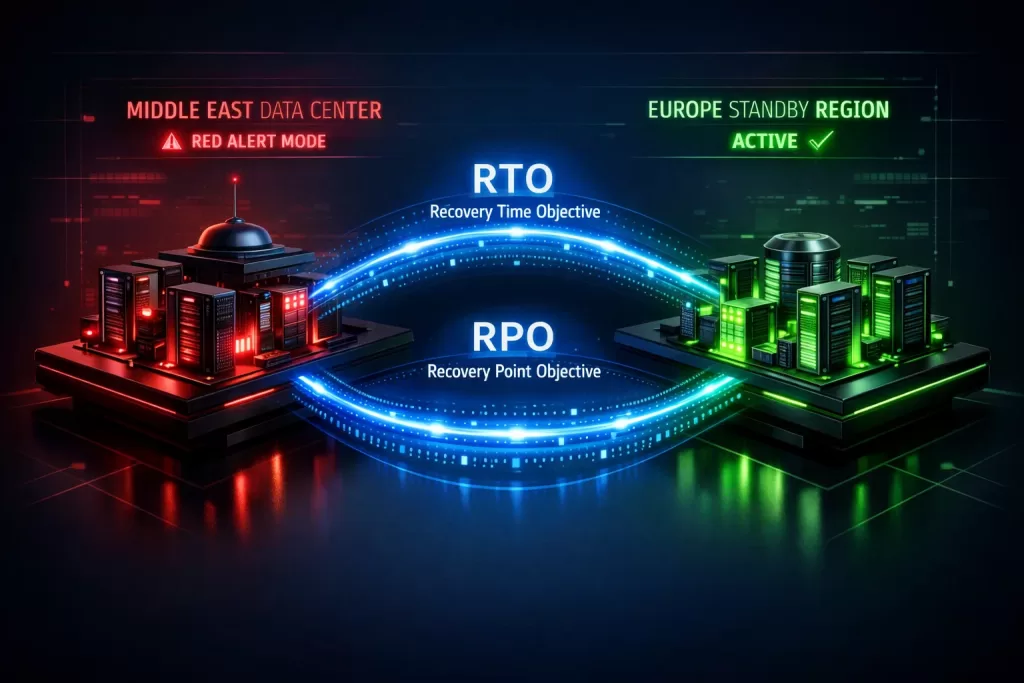
The foundation of any serious DR strategy is defining your Recovery Time Objective (RTO) and Recovery Point Objective (RPO) before an incident occurs — not during one. RTO defines how long your business can tolerate being offline; RPO defines how much data loss is acceptable. For most financial and enterprise workloads in the Gulf, an RTO of under 1 hour and an RPO of under 15 minutes should be the baseline target. During the AWS UAE outage, businesses without pre-defined RTO/RPO thresholds had no automated systems configured to meet them — and no benchmark to measure recovery progress against.
From an architecture standpoint, DR in a conflict-adjacent region demands more than standard multi-AZ replication. A robust approach layers three strategies: active-active multi-region deployment for the most critical workloads, where traffic runs simultaneously across UAE and a secondary region such as Europe or Asia Pacific; pilot light architecture for secondary workloads, where a minimal environment runs in standby and scales up within minutes; and warm standby for less time-sensitive systems. AWS services like Route 53 health checks, Aurora Global Database cross-region replication, and S3 Cross-Region Replication (CRR) are the building blocks here — but they must be deliberately configured, not assumed to be on by default.
4. Geopolitical Risk Is Now an Infrastructure Variable
Data center location strategy can no longer ignore geopolitical context. Conflict-adjacent regions introduce risks that no SLA can fully cover. Factor political stability into your cloud region selection — and always maintain workload portability.
5. Backup and Data Portability Must Be Independent
AWS advised customers to back up critical data and shift operations to unaffected regions. If your backups are in the same region as your primary workload, they are just as vulnerable. True resilience requires geographically independent backup storage.
How Electromech Can Help You Build a Resilient Cloud Strategy
The AWS UAE outage demonstrates that cloud resilience is not optional — it is a business continuity imperative. At Electromech, we specialise in helping businesses across the Middle East and beyond design, implement, and manage cloud infrastructure that can withstand the unexpected.
Our cloud resilience services include:
- Multi-region cloud architecture design — Distribute your workloads intelligently so no single region failure takes your business offline.
- Disaster Recovery as a Service (DRaaS) — Automated, tested failover with recovery time objectives that match your business needs.
- Cloud infrastructure audits — Identify single points of failure in your current setup before they become outages.
- Hybrid and multi-cloud strategy — Combine AWS, Azure, Google Cloud, and on-premise infrastructure to eliminate dependency on any single provider or region.
- 24/7 infrastructure monitoring — Proactive detection and response so you know about issues before your customers do.
Conclusion
The AWS UAE outage of March 2026 will be remembered as a turning point — the moment the cloud industry confronted the reality that data centers are physical assets in a physical world, and that world includes conflict, geopolitical risk, and unpredictable threats.
For businesses in the UAE and across the Gulf, the question is no longer if a disruption can happen — it is how prepared you are when it does.
At Electromech, we’re here to make sure your answer is: very prepared.
Ready to future-proof your cloud infrastructure? Contact our team today to schedule a cloud resilience assessment.