








Something fundamental has shifted in the world of artificial intelligence — and most businesses haven’t caught up yet.
For the past few years, AI meant assistants. You asked a question, AI gave an answer. A chatbot guided a customer. A generative AI tool drafted a paragraph. Smart, useful, but ultimately reactive — it waited for you to make the move.
Agentic AI for business breaks that model entirely. Instead of responding to prompts, agentic AI systems set goals, plan multi-step workflows, take actions across tools and systems, and self-correct — all with minimal human intervention. They don’t just answer. They act.
The numbers back this up in a big way. Gartner predicts that 40% of enterprise applications will be integrated with task-specific AI agents by the end of 2026 — up from less than 5% today. That is not a slow-burn trend. That is an eight-fold expansion in under twelve months.
If your business has not yet started thinking about agentic AI, this is your signal. Let’s break down what it is, why it matters, how enterprises are deploying it right now, and what it takes to get it right.
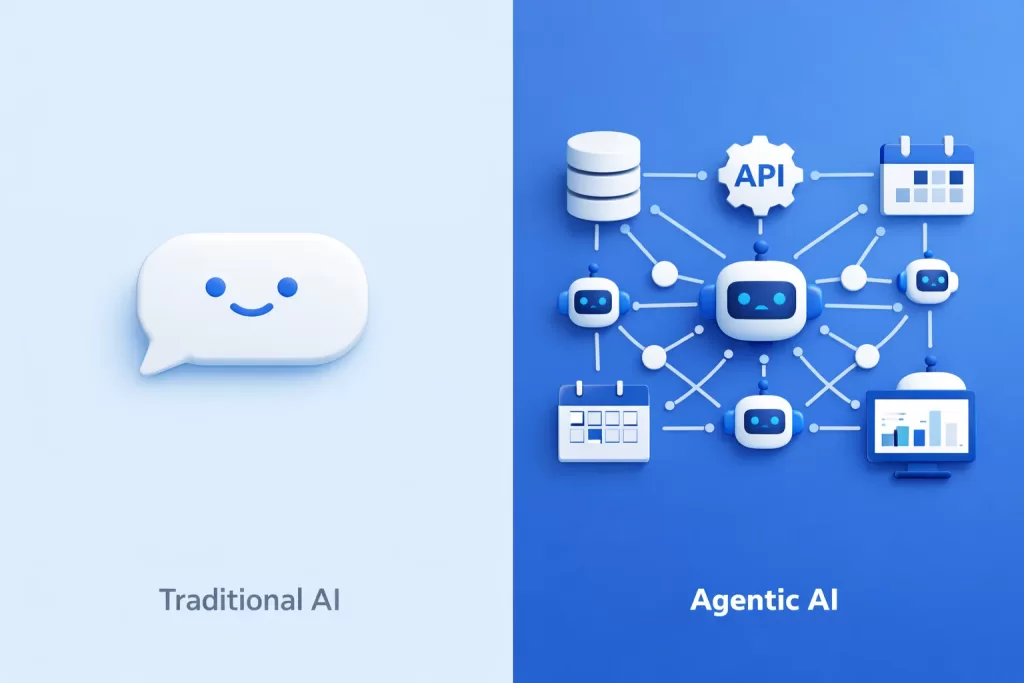
What Is Agentic AI, and How Is It Different from Regular AI?
To understand agentic AI for business, it helps to draw a clear line between the AI you already know and what comes next.
Traditional generative AI — think ChatGPT, Google Gemini, or Amazon Bedrock used as a standard assistant — responds to a single input. You type, it responds. It is one-shot, one-session. The moment you close the window, the context is gone.
Agentic AI operates on a completely different architecture. An AI agent is given a goal, not just a prompt. It then:
- Breaks that goal into a sequence of logical steps
- Calls the right APIs, databases, and tools autonomously
- Remembers context across multiple sessions
- Adjusts its approach when it encounters an obstacle
- Reports back when it needs human input — but only when it truly does
Gartner describes this shift as AI moving from tools that assist humans to platforms that replace manual effort for complex workflows. That is the definition of agentic AI for business: autonomous, goal-driven execution at scale.
It is also worth calling out what agentic AI is not. Many vendors are currently guilty of what Gartner calls “agent washing” — relabelling an existing chatbot or RPA workflow as an “AI agent” to ride the hype. A genuine agentic AI system plans, acts, monitors, and adapts. If it cannot do those four things, it is not agentic.

The Numbers That Make Business Leaders Sit Up
The business case for agentic AI is no longer theoretical. The data is stacking up fast.
- 40% of enterprise applications will embed task-specific AI agents by end of 2026, up from under 5% today (Gartner, 2025).
- 15% of day-to-day work decisions will be made autonomously by agentic AI by 2028, up from zero in 2024 (Gartner).
- 93% of IT leaders plan to introduce autonomous agents within two years — nearly half have already started (MuleSoft & Deloitte, 2025).
- 57% of organisations are putting 21–50% of their annual digital transformation budgets into AI automation, with 20% investing more than half of their budget (Deloitte Tech Value Survey, 2025).
- AI spend is forecast to reach $1.3 trillion by 2029, growing at 31.9% year-on-year — fuelled primarily by agentic AI (IDC).
- By 2035, agentic AI could drive nearly 30% of enterprise application software revenue, potentially exceeding $450 billion (Gartner best-case scenario).
The window for early movers is open right now. Deloitte’s 2025 Emerging Technology Trends study found that while 30% of organisations are exploring agentic AI and 38% are running pilots, only 11% are actively using it in production. That gap between exploration and execution is where competitive advantage lives.
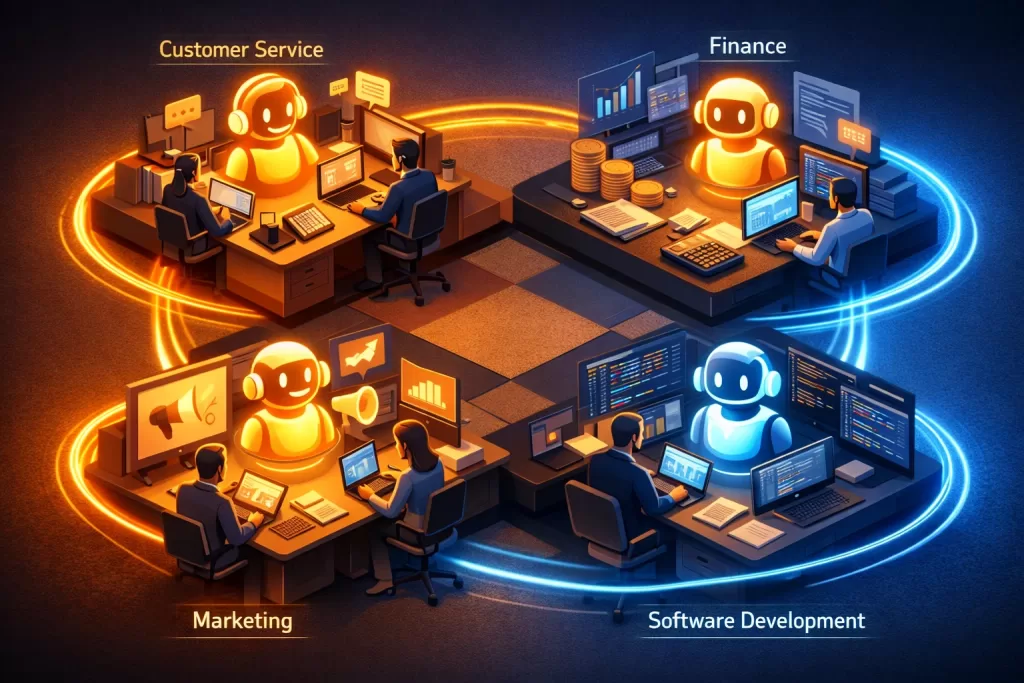
Agentic AI for Business: Real-World Applications Happening Right Now
Agentic AI is not a future concept. Here is what enterprises are deploying today:
Customer Experience and Service Automation
AI agents are handling complex, multi-turn customer interactions end to end — not just answering FAQs, but resolving issues, processing refunds, escalating appropriately, and following up without any human touching the workflow. Gartner predicts 60% of brands will use agentic AI to deliver personalised one-to-one interactions by 2028. One retail organisation that deployed AI agents saw inbound calls to stores drop by 47% while customer satisfaction scores actually rose.
Finance, Operations, and Back-Office Efficiency
Financial services institutions are using multi-agent systems to detect fraud, analyse risk, and generate compliance reports. A healthcare system deploying an AI documentation agent saw a 42% reduction in documentation time — saving clinical staff around 66 minutes per day. In IT operations, enterprises like Iberdrola have implemented agentic architectures to optimise incident management and change request validation in ServiceNow, dramatically reducing resolution bottlenecks.
Marketing, Sales, and Campaign Automation
Epsilon used Amazon Bedrock AgentCore to automate complex campaign workflows, reducing campaign setup time by 30%, increasing personalisation by 20%, and saving marketing teams eight hours of manual work per week — all while maintaining enterprise-grade security and compliance.
Software Development and Engineering
Agentic AI is reshaping how software is built. Robinhood scaled from 500 million to 5 billion daily AI tokens in just six months using Amazon Bedrock — cutting AI costs by 80% and slashing development time in half. Amazon’s own devices team used agentic systems to reduce model fine-tuning tasks that previously took days of engineering work to under one hour.

How AWS Is Leading the Agentic AI Infrastructure Race
When it comes to building agentic AI for business at enterprise scale, infrastructure is everything. This is where AWS has made a decisive strategic move.
Amazon Bedrock has evolved from a model-hosting service into a full governance and agent orchestration platform. Amazon Bedrock AgentCore is a purpose-built agentic platform that lets enterprises build, deploy, and operate AI agents securely at scale — using any framework and any model, without managing infrastructure.
What makes AgentCore significant for enterprise deployments:
- Multi-agent collaboration: Multiple specialised agents work in parallel under a supervisor agent, handling complex multi-step workflows that no single agent could manage alone.
- Memory retention: Agents remember context across sessions, enabling truly personalised and continuous interactions.
- Deterministic guardrails: AgentCore Policy enforces what agents can and cannot do at the infrastructure level — not in a system prompt that can be reasoned around, but as a hard enforcement layer that executes in milliseconds.
- Full observability: Built on OpenTelemetry, AgentCore provides a complete audit trail of every agent action — critical for regulated industries.
- Bedrock Guardrails: Blocks up to 88% of harmful content and minimises hallucinations using Automated Reasoning checks — with up to 99% accuracy in identifying correct model responses.
For compliance teams who have been nervous about autonomous AI, this architecture answers the most common objection: how do we know the agent won’t go rogue? With AgentCore, the guardrails are enforced at the infrastructure layer, not the prompt layer. Agents can operate autonomously within clearly defined, provable boundaries.

Why 40% of Agentic AI Projects Will Fail — And How to Not Be One of Them
Here is the difficult truth that belongs in any honest conversation about agentic AI for business: Gartner also predicts that over 40% of agentic AI projects will be cancelled by end of 2027. The reason is not a flaw in the technology. It is a failure in how organisations approach deployment.
The three most common failure patterns are:
1. Legacy System Incompatibility
Traditional enterprise systems were never built for agentic interactions. Most agents today still rely on APIs and conventional data pipelines to connect with enterprise systems . Organisations that try to bolt agentic AI onto legacy infrastructure without rethinking the underlying architecture will hit a wall. Successful deployments rethink the workflow from the ground up, not as an add-on.
2. Piloting Without a Clear ROI Target
Deloitte’s research found that 35% of organisations have no formal agentic AI strategy at all. Many pilots are launched because of executive pressure around buzzwords.. Gartner’s guidance is direct: pursue agentic AI only where it delivers clear and measurable value or ROI. Start narrow, prove it, then scale.
3. Underestimating Governance and Risk Controls
Autonomous agents make real decisions with real consequences. Without proper guardrails, audit trails, and human oversight triggers, the risk exposure is significant. This is not a reason to avoid agentic AI — it is a reason to build it right. Governance is not a blocker to agentic AI deployment; it is the thing that makes enterprise-scale deployment possible.
How Businesses Should Start Their Agentic AI Journey
There is a pragmatic, proven path into agentic AI for business — and it does not require betting the farm on a single ambitious deployment.
- Audit your high-volume, repetitive workflows. Any workflow where a human repeatedly makes the same kind of decision using the same kind of data is an immediate candidate for agentic AI.
- Assess your data readiness. Agents are only as good as the data they can access. A data quality and integration audit before deployment prevents most of the legacy infrastructure failures mentioned above.
- Define your governance framework before you build. Decide up front what the agent can and cannot do, what triggers human review, and how every action will be logged. This is not bureaucracy — it is what makes autonomous AI trustworthy to regulators, boards, and customers.
- Choose infrastructure built for agents. Platforms like Amazon Bedrock AgentCore abstract away the infrastructure complexity — memory management, runtime isolation, observability — so your teams can focus on solving business problems instead of building plumbing.
- Partner with AWS-validated expertise. The AWS Generative AI Competency programme recognises partners who have demonstrated real-world agentic AI delivery capability. Working with a validated partner significantly reduces deployment risk.
Electromech Cloudtech: Your AWS-Validated Agentic AI Partner
We are proud to announce that Electromech Cloudtech has achieved the AWS Generative AI Competency — one of the most rigorous validations in the AWS Partner Network, awarded only to partners who have demonstrated deep technical expertise and proven, customer-validated generative AI and agentic AI delivery.
This is not a certification you earn by completing a course. It requires demonstrated delivery of real GenAI and agentic AI use cases, technical vetting by AWS, and a track record of measurable outcomes for customers.
For businesses beginning or accelerating their agentic AI for business journey, this means working with a partner that has been independently validated to deliver — on the world’s leading cloud platform for agentic AI.
The Bottom Line
Agentic AI for business is not a trend to monitor from the sidelines. By the end of 2026, it will be embedded in 40% of enterprise applications. By 2028, it will be making 15% of everyday business decisions autonomously. The question is not whether agentic AI will reshape your industry — it is whether your business will be leading that reshape or reacting to it.
The organisations winning right now are not the ones who waited for the technology to mature. They are the ones who picked the right use case, built the right governance framework, chose the right infrastructure, and moved.
If you are ready to explore what agentic AI can do for your business — without the hype, without the guesswork, and with a partner who has the AWS validation to back it up — let’s talk.