







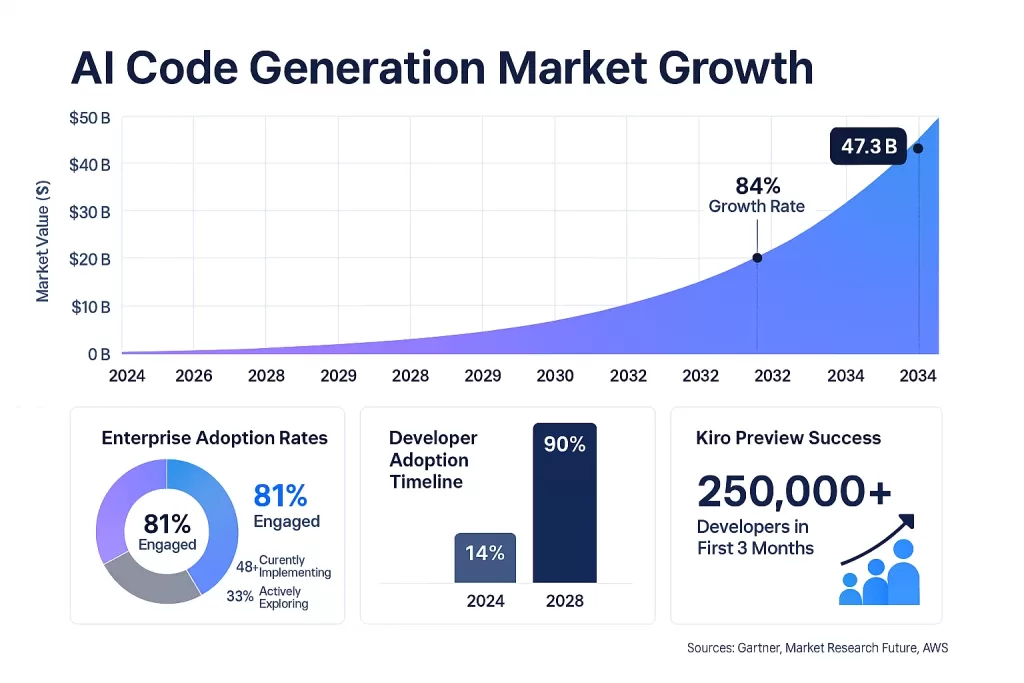
The enterprise software development landscape is experiencing a seismic shift. According to Gartner, 90% of enterprise software engineers will use AI code assistants by 2028, up from less than 14% in early 2024. But here’s the challenge: while AI code generation tools promise rapid development, they often deliver unstructured prototypes that become maintenance nightmares for enterprise teams.
Enter Amazon Kiro, AWS’s revolutionary approach to agentic AI enterprise development. In its first three months of preview, more than 250,000 developers adopted Kiro, not just for speed, but for something more critical: production-ready, maintainable systems with enterprise-grade governance built in from day one.
This isn’t about replacing developers with AI. It’s about transforming how enterprise teams build, document, and maintain cloud-native applications at scale. If your organization is grappling with legacy systems, compliance requirements, and the pressure to innovate faster, understanding Kiro’s spec-driven development approach could be the competitive advantage you’re seeking.
What is Amazon Kiro? Understanding AWS’s AI Development Platform
Amazon Kiro represents AWS’s answer to a fundamental problem in enterprise AI development: the gap between rapid prototyping and production-ready systems. Unlike traditional AI code generation tools that focus solely on writing code faster, Kiro introduces a paradigm shift with its spec-driven development methodology.
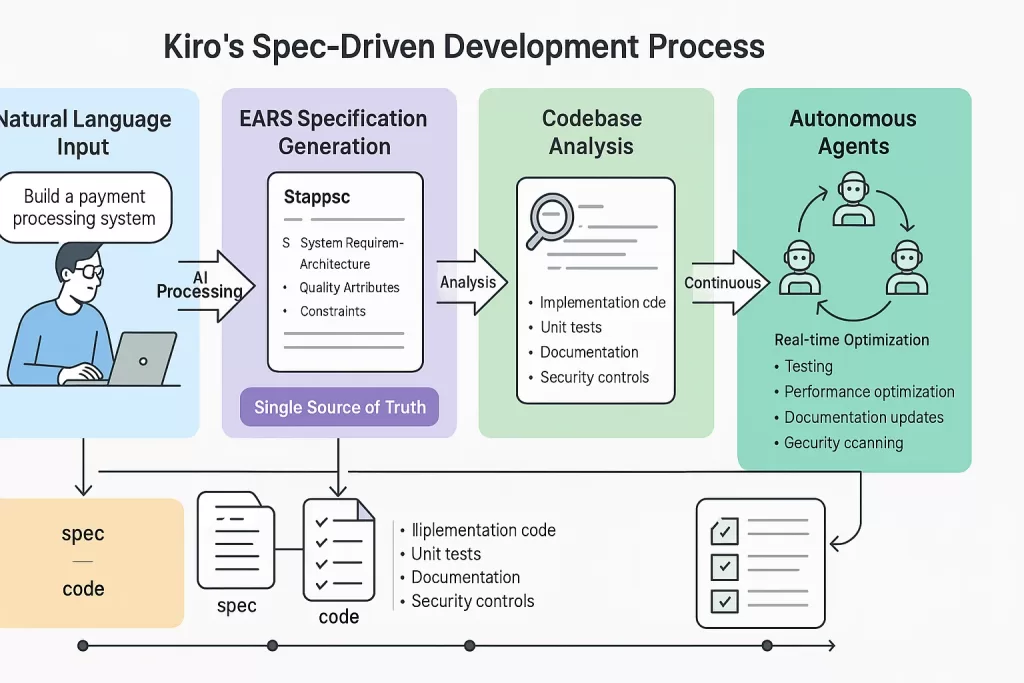
At its core, Kiro transforms natural language prompts into structured requirements using EARS notation, then analyzes your existing codebase to determine the optimal architecture, system design, and technology stack. The platform doesn’t just generate code; it creates comprehensive development specifications that serve as a single source of truth for your entire team.
The platform operates through the Kiro CLI, integrating seamlessly with your existing development workflows. Developers describe what they want to build in plain language, and Kiro handles the translation into technical specifications, code generation, testing, documentation, and ongoing maintenance through autonomous agent hooks.
What makes Kiro particularly powerful for enterprises is its cloud-agnostic flexibility. You can build applications in JavaScript, Python, Go, or other languages and deploy them anywhere: on AWS, other cloud platforms, on-premises infrastructure, or locally. This flexibility ensures you’re not locked into a single deployment model while still leveraging AWS’s powerful AI capabilities.
The platform integrates deeply with AWS services through the Model Context Protocol, giving AI agents a callable interface to discover AWS operations and generate execution plans that invoke AWS APIs in real-time. For cloud-native development teams, this means your AI-generated applications can leverage the full breadth of AWS services without manual integration work.
The Rise of Agentic AI in Enterprise Software Development
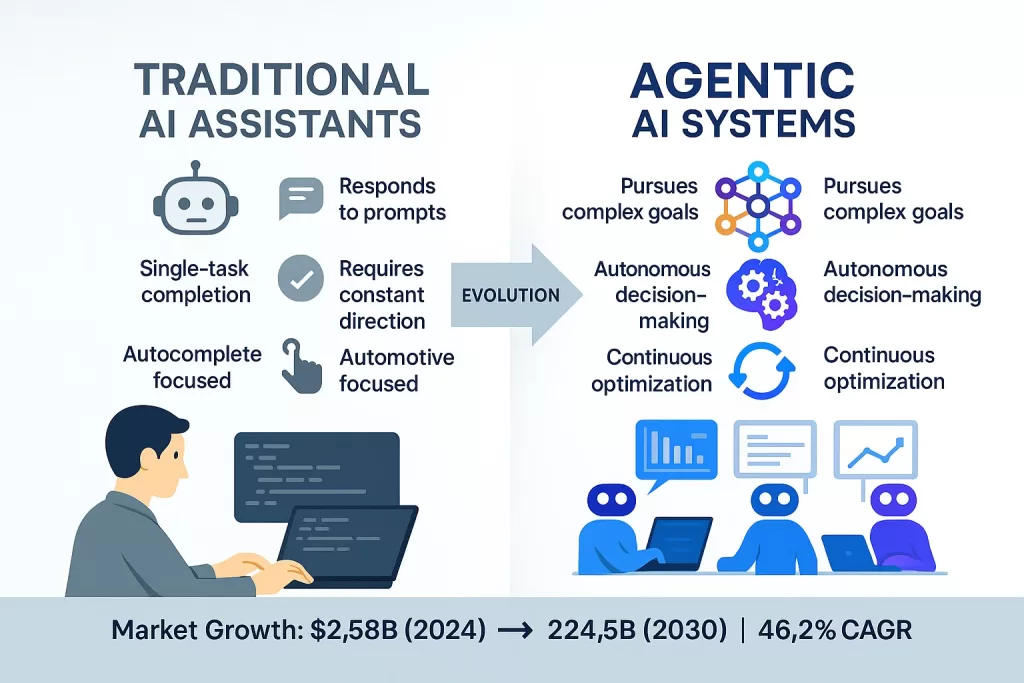
To understand why Kiro matters, we need to understand the broader shift toward agentic AI in enterprise environments. Traditional AI assistants respond to prompts and complete discrete tasks. Agentic AI systems, by contrast, pursue complex goals autonomously, make decisions, and orchestrate multiple workflows without constant human intervention.
The market validates this shift dramatically. The enterprise agentic AI market is projected to grow from $2.58 billion in 2024 to $24.50 billion by 2030, representing a compound annual growth rate of 46.2%. This isn’t speculative hype; it’s driven by real enterprise adoption. Currently, 48% of enterprises are already implementing agentic solutions, with another 33% actively exploring them.
Industry analysts predict that by 2028, 33% of enterprise software applications will include agentic AI capabilities, up from less than 1% in 2024. This represents one of the fastest technology adoption curves in enterprise software history.
But what makes agentic AI different from the AI tools enterprises already use? The distinction lies in autonomy and goal-orientation. Traditional AI code assistants provide autocomplete suggestions or generate code snippets when prompted. Agentic AI systems understand broader objectives, break them into subtasks, execute those tasks autonomously, and adapt their approach based on results.
In the context of enterprise development, this means AI agents that don’t just write code but also generate comprehensive test suites, optimize performance automatically, update documentation in real-time, identify and fix security vulnerabilities, and maintain consistency across large codebases without direct supervision for each action.
For enterprise teams managing complex, mission-critical applications, this shift from assistive AI to agentic AI represents a fundamental change in how software gets built and maintained. It’s the difference between having a smart autocomplete tool and having a senior developer who handles entire categories of work autonomously.
How Amazon Kiro Benefits Enterprise Development Teams
1. Spec-Driven Development: From Chaos to Clarity
The “vibe coding” problem has become endemic in AI-assisted development. Teams use AI to rapidly generate prototypes, but these prototypes lack structure, documentation, and clear requirements. The result? Code that works initially but becomes unmaintainable as complexity grows.
Kiro solves this through spec-driven development. When you describe what you want to build, Kiro doesn’t immediately jump to code generation. Instead, it creates a comprehensive specification using EARS notation, a proven requirements engineering standard. These specifications define system behavior, constraints, architecture decisions, and quality attributes before a single line of code gets written.
This approach mirrors how enterprise teams have always built critical systems, but with AI acceleration. Your specifications become version-controlled artifacts that serve as the definitive source of truth. When requirements change, you update the spec, and Kiro regenerates the implementation consistently.
For financial services companies managing regulatory requirements, healthcare organizations dealing with HIPAA compliance, or any enterprise with stringent governance needs, this traceability is transformative. Every piece of generated code can be traced back to its originating specification, making audits straightforward and compliance verification systematic rather than chaotic.
The specification-first approach also solves a critical collaboration problem. When multiple developers work on AI-generated code, maintaining consistency becomes difficult. With Kiro, the shared specification ensures everyone works from the same understanding, while the AI handles the mechanical work of keeping implementations synchronized.
2. Production-Ready Code, Not Just Prototypes
Traditional AI code generation tools excel at creating demos and proofs of concept. They struggle with production readiness. The code works for the happy path but lacks error handling, edge case management, performance optimization, and comprehensive testing.
Kiro addresses this by understanding system architecture, not just individual functions. When generating code, it considers how components interact, where potential bottlenecks exist, what failure modes need handling, and how the system scales under load.
The platform analyzes your existing codebase to understand your organization’s patterns, conventions, and architectural decisions. Rather than generating generic code, it creates implementations that match your team’s style and integrate seamlessly with your existing systems.
Enterprise teams report accelerating feature development dramatically, reducing time to customer value from weeks to days. But more importantly, the code Kiro generates requires minimal refactoring before production deployment. This is the critical difference between AI-assisted prototyping and AI-powered production development.
For enterprises, this means faster time-to-market without accumulating technical debt. You’re not choosing between speed and quality; Kiro delivers both by building systems correctly from the start.
3. Enterprise-Grade Governance & Compliance
Compliance and governance concerns represent major barriers to AI adoption in regulated industries. How do you prove that AI-generated code meets security standards? How do you audit decisions made by autonomous systems? How do you maintain the paper trail required for regulatory compliance?
Kiro’s architecture provides answers through comprehensive traceability. Every line of generated code links back to its specification. Every specification captures the requirements that drove it. Every change is version-controlled and auditable.
For security teams, this visibility is crucial. You can review specifications to ensure security requirements are captured, trace how those requirements influenced implementation, and verify that security controls are present in the generated code.
For compliance officers, the structured approach means audits become straightforward. Rather than trying to reverse-engineer why code exists in a particular form, you have clear documentation showing the requirements, decision rationale, and implementation details.
The platform also supports role-based access controls, allowing enterprises to define who can approve specifications, who can trigger code generation, and who can deploy to production environments. This governance layer ensures AI augments your existing processes rather than circumventing them.
4. Autonomous Agent Hooks for Continuous Optimization
Perhaps Kiro’s most powerful feature for enterprises is its autonomous agent hooks. These AI agents run continuously in the background, handling tasks that traditionally consume significant developer time but don’t require creative problem-solving.
When you save a file, Kiro’s agents automatically generate comprehensive unit tests that cover edge cases and error conditions, optimize code performance by identifying bottlenecks and suggesting improvements, update technical documentation to reflect code changes, check for security vulnerabilities and suggest fixes, and ensure consistency with architectural standards across your codebase.
This isn’t scheduled batch processing; it happens in real-time as you develop. The agents learn from your codebase, understanding your patterns and preferences, and become more effective over time.
For enterprise teams, the time savings are substantial. Tasks that previously required hours of manual work now happen instantly and consistently. Senior developers can focus on architectural decisions and complex problem-solving rather than mechanical code maintenance.
The multi-agent orchestration capability takes this further. You can configure specialized agents for different aspects of your system: backend specialists that optimize database queries and API performance, frontend agents that ensure UI consistency and accessibility compliance, DevOps agents that maintain infrastructure-as-code and deployment configurations, and security agents that continuously scan for vulnerabilities and compliance issues.
These agents don’t work in isolation. They collaborate through Kiro’s orchestration layer, sharing context and coordinating their actions to maintain system-wide consistency.
Agentic AI Use Cases in Cloud Development
The theoretical benefits of agentic AI become concrete when examining real-world use cases in enterprise cloud development.
Microservices Architecture Management: Large enterprises typically manage dozens or hundreds of microservices. Keeping these services consistent in terms of API contracts, error handling, logging, and monitoring is a constant challenge. Kiro’s agents monitor your microservices architecture, automatically propagate changes to API contracts across dependent services, ensure consistent error handling and retry logic, maintain synchronized documentation, and verify that services comply with organizational standards.
Legacy System Modernization: Many enterprises struggle with legacy monoliths they need to modernize. Kiro can analyze existing systems, generate modernization specifications that map legacy functionality to cloud-native architectures, create migration paths that minimize risk, and generate the new cloud-native code while maintaining functional parity with legacy systems.
Multi-Cloud Deployment Optimization: Organizations using multi-cloud strategies face complexity in maintaining applications across different platforms. Kiro’s cloud-agnostic approach allows teams to define infrastructure requirements once, then generate platform-specific implementations for AWS, Azure, Google Cloud, or on-premises environments.
Citizen Development Enablement: One of the most transformative use cases involves citizen developers—business users who need applications but lack deep technical expertise. Kiro enables supply chain managers to build inventory optimization tools directly, compliance officers to create audit tracking applications, and business analysts to develop data pipeline tools. These users describe what they need in domain language, and Kiro handles the technical implementation, including security, scalability, and integration with existing systems.
Compliance Automation: Regulated industries spend enormous effort ensuring applications meet compliance requirements. Kiro agents can continuously monitor code for compliance violations, automatically implement required controls based on specification updates, generate compliance reports for auditors, and maintain the documentation trail required for regulatory approval.
Amazon Kiro vs Traditional AI Code Assistants
Understanding how Kiro differs from other AI development tools helps clarify its enterprise value proposition.
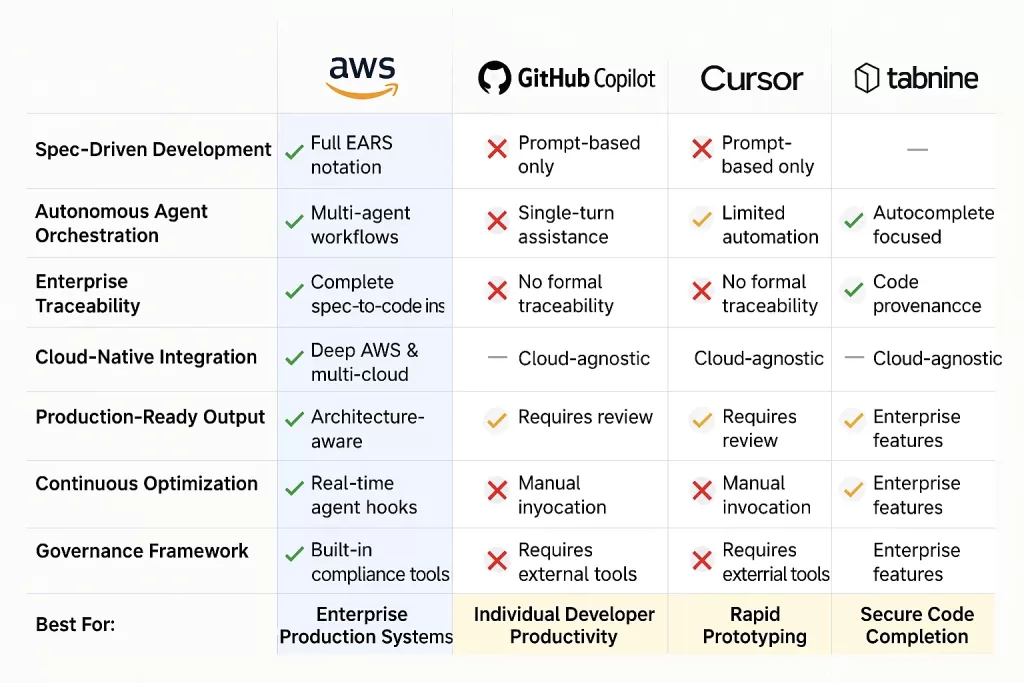
| Feature | Amazon Kiro | GitHub Copilot | Cursor | Tabnine |
| Spec-Driven Development | ✓ Full EARS notation specs | ✗ Prompt-based only | ✗ Prompt-based only | ✗ Prompt-based only |
| Autonomous Agent Orchestration | ✓ Multi-agent workflows | ✗ Single-turn assistance | Partial (limited automation) | ✗ Autocomplete focused |
| Enterprise Traceability | ✓ Complete spec-to-code lineage | ✗ No formal traceability | ✗ No formal traceability | ✓ Code provenance tracking |
| Cloud-Native Integration | ✓ Deep AWS & multi-cloud | ✗ Cloud-agnostic | ✗ Cloud-agnostic | ✗ Cloud-agnostic |
| Production-Ready Output | ✓ Architecture-aware | Partial (requires review) | Partial (requires review) | Partial (requires review) |
| Continuous Optimization | ✓ Real-time agent hooks | ✗ Manual invocation | ✗ Manual invocation | ✗ Manual invocation |
| Governance Framework | ✓ Built-in compliance tools | ✗ Requires external tools | ✗ Requires external tools | Partial (enterprise features) |
GitHub Copilot excels at code completion and suggestion within your IDE. It helps developers write code faster by predicting what comes next. However, it doesn’t understand system architecture or maintain specifications. Each suggestion is contextual but not part of a broader architectural vision.
Cursor provides an AI-powered IDE experience with conversational code generation. It’s powerful for individual developers building applications from scratch but lacks the enterprise governance features and autonomous agent capabilities that large organizations require.
Tabnine focuses on secure, private code completion with strong privacy guarantees. For enterprises concerned about code leaving their environment, Tabnine offers important protections. However, it remains primarily an autocomplete tool rather than an architectural development platform.
Kiro’s differentiation lies in treating software development as a systems engineering discipline rather than just coding. The platform understands that enterprise applications require specifications, architecture, testing, documentation, compliance, and ongoing maintenance. By addressing all these dimensions simultaneously through autonomous agents, Kiro delivers truly production-ready systems.
Real-World Enterprise Impact: Statistics & Case Studies
The market response to Kiro validates its enterprise value proposition. More than 250,000 developers adopted the platform in its first three months of preview, a remarkably rapid adoption rate for enterprise development tools.
The broader market trends support this momentum. The AI code generation tools market is projected to grow from $5.5 billion in 2024 to $47.3 billion by 2034, representing an 84% compound annual growth rate. This growth is driven by enterprises recognizing that development speed has become a competitive differentiator.
AWS internally demonstrates Kiro’s impact through its own development practices. Using cost-to-serve software metrics and AI-powered optimization, AWS reduced their software pipeline costs by 15.9% year-over-year in 2024. This wasn’t just about cutting expenses; it represented improved efficiency in how they build and deploy software.
For enterprise teams, the time savings translate directly to competitive advantage. Development cycles that previously required weeks now complete in days. This acceleration doesn’t come from developers working faster; it comes from eliminating the mechanical overhead of testing, documentation, and code maintenance through autonomous agents.
The compliance benefits prove equally valuable. Financial services companies report that the traceability features reduce audit preparation time by more than 60%. Instead of reconstructing the rationale behind code decisions, audit teams simply review the specifications and trace them to implementations.
Healthcare organizations leveraging Kiro for HIPAA-compliant applications note that the automatic security scanning and compliance checking catches issues early in development, preventing costly remediation in later stages.
Manufacturing companies using Kiro for supply chain applications report that citizen developers in their operations teams now build applications directly, reducing the backlog in IT departments and accelerating operational improvements.
Implementation Strategy for Enterprises
Successfully implementing Kiro in an enterprise environment requires thoughtful planning beyond simply granting access to the tool.
Getting Started with Kiro
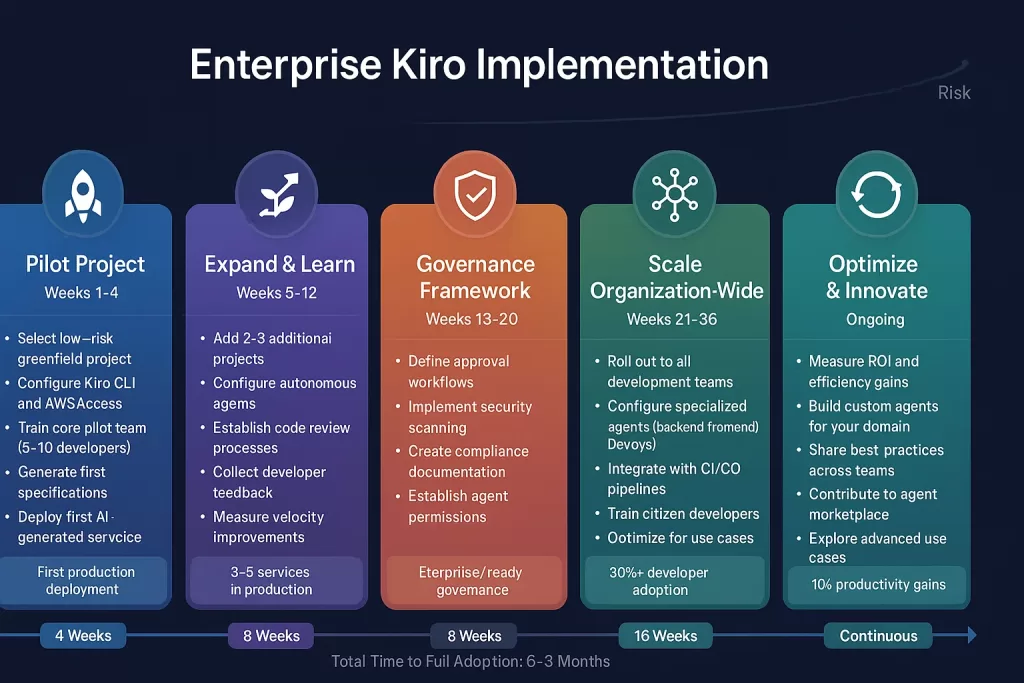
The technical prerequisites are straightforward. You need AWS account access with appropriate permissions, development environment configuration with the Kiro CLI, and integration with your existing version control systems. Most enterprises complete initial setup within a few days.
The more important prerequisites are organizational. You need clear understanding of which projects are suitable for early adoption, executive sponsorship to overcome inevitable organizational resistance, and pilot teams willing to work through learning curves and provide feedback.
Start with a pilot project that has genuine business value but limited risk. Greenfield projects work well because they don’t require complex integration with legacy systems. Internal tools represent ideal candidates—they matter to your operations but don’t directly impact customers if issues arise.
Best Practices for Enterprise Adoption
Team training should go beyond tool mechanics. Developers need to understand spec-driven development principles, how to write effective requirements that Kiro can translate into code, when to let agents work autonomously versus when to intervene, and how to review and refine AI-generated outputs.
Establish governance frameworks before broad rollout. Define who approves specifications, who can deploy AI-generated code to production, how you measure code quality and security, and what compliance documentation you need to maintain.
Measure ROI systematically. Track development velocity improvements, code quality metrics over time, reduction in maintenance burden, time saved on documentation and testing, and compliance preparation efficiency gains.
Change management matters enormously. Some developers will embrace AI agents enthusiastically; others will resist out of concern that AI threatens their roles. Address these concerns directly by emphasizing that Kiro handles mechanical tasks, allowing developers to focus on creative problem-solving and architectural thinking. The most successful implementations position AI as augmenting developer capabilities rather than replacing them.
Common Challenges and Solutions
Trust and security concerns represent the most common barrier. Developers worry about AI-generated code containing vulnerabilities or violating security policies. Address this through comprehensive code review processes initially, gradually increasing autonomy as confidence builds, automated security scanning integrated into your pipeline, and clear documentation of what agents can and cannot do autonomously.
Some organizations struggle with data requirements. Kiro works best when it can analyze your existing codebase to understand your patterns and conventions. If your code lacks consistency or documentation, initial results may be suboptimal. Consider starting with better-maintained codebases for pilot projects, using early Kiro projects to establish improved standards, and gradually expanding to legacy systems as patterns emerge.
Integration complexity varies by organization. Companies with clean microservices architectures typically integrate Kiro smoothly. Those with complex monoliths or tightly coupled systems may face challenges. Plan integration carefully, potentially starting with new services rather than modifying existing ones, and use Kiro to help modernize architecture over time.
The Future of Agentic AI in Enterprise Development
The trajectory for agentic AI in enterprise development extends well beyond current capabilities. Gartner predicts that by 2028, 33% of enterprise software applications will include agentic AI, representing a fundamental shift in how software gets built.
The evolution of multi-agent collaboration represents the next frontier. Current systems like Kiro coordinate specialized agents for different tasks. Future platforms will feature agents that negotiate with each other to optimize system design, learn from production feedback to improve their outputs, and collaborate across organizational boundaries to solve complex problems.
The integration of no-code and low-code platforms with agentic AI will democratize application development further. Business users will describe what they need in natural language, AI agents will generate both the specification and the implementation, and the platform will handle deployment, monitoring, and maintenance automatically. This isn’t about eliminating developers; it’s about freeing them from building routine applications so they can focus on genuinely complex problems.
AI-powered citizen development will transform how enterprises operate. When business users can build the tools they need directly, innovation accelerates dramatically. Operations teams won’t wait for IT to build supply chain optimization tools; they’ll build them themselves with AI assistance. Compliance teams will create audit tracking systems tailored to their specific requirements without writing code.
The governance and compliance capabilities will become more sophisticated. Future agentic AI systems will automatically generate compliance documentation as code gets written, monitor for regulatory changes and update implementations proactively, provide real-time compliance dashboards for auditors, and even simulate audit scenarios to identify potential issues before auditors arrive.
For enterprises, the strategic question isn’t whether to adopt agentic AI for development—it’s how quickly to scale it and how to position your organization to leverage it effectively. The companies that master agentic AI development platforms will move faster, operate more efficiently, and deliver better products than competitors still relying on traditional development approaches.
Conclusion: Positioning Your Enterprise for AI-Powered Development
Amazon Kiro represents more than just another AI development tool. It embodies a fundamental shift in how enterprise teams can build, maintain, and scale cloud-native applications. By combining spec-driven development with autonomous agents and enterprise-grade governance, Kiro addresses the real challenges enterprises face: building systems that are both innovative and maintainable, moving fast without sacrificing quality, and maintaining compliance without slowing development.
The market momentum is clear. With 250,000 developers already adopting Kiro and the AI code generation market projected to reach $47.3 billion by 2034, enterprises that delay exploration risk falling behind competitors who are already accelerating their development cycles.
For enterprise leaders evaluating Kiro, the question isn’t whether AI will transform development—that transformation is already underway. The question is how to position your organization to leverage that transformation effectively. Start with pilot projects that have genuine business value, build organizational understanding through hands-on experience, establish governance frameworks that enable confidence, and scale thoughtfully based on demonstrated results.
The future of enterprise development is agentic, cloud-native, and spec-driven. Amazon Kiro provides a pathway to that future that balances innovation with the governance, security, and reliability that enterprises require.
Ready to explore how Amazon Kiro can transform your development processes? Visit the AWS Console to start your journey with agentic AI in cloud development, or reach out to AWS to discuss how Kiro fits your specific enterprise requirements.