







What if your support team could instantly answer every customer query, 24/7, without hiring extra staff? This isn’t science fiction—it’s the reality of AI-powered customer support transforming businesses today.
In today’s hyper-connected digital landscape, customer expectations have skyrocketed. Modern consumers demand instant, accurate responses regardless of the time or day. Meanwhile, support ticket volumes continue to surge, with studies showing that businesses receive 40% more customer inquiries than they did just three years ago. Traditional manual support models are buckling under this pressure, leading to longer wait times, frustrated customers, and burned-out support teams.
Enter Generative AI customer support—a game-changing solution that combines artificial intelligence, natural language processing, and cloud infrastructure to deliver smarter, faster, and infinitely scalable customer service. By leveraging large language models and machine learning algorithms, businesses can now provide personalized, context-aware support that rivals human interaction while operating at machine speed and scale.
How Generative AI Enhances Customer Support
Understanding Generative AI for Support Operations
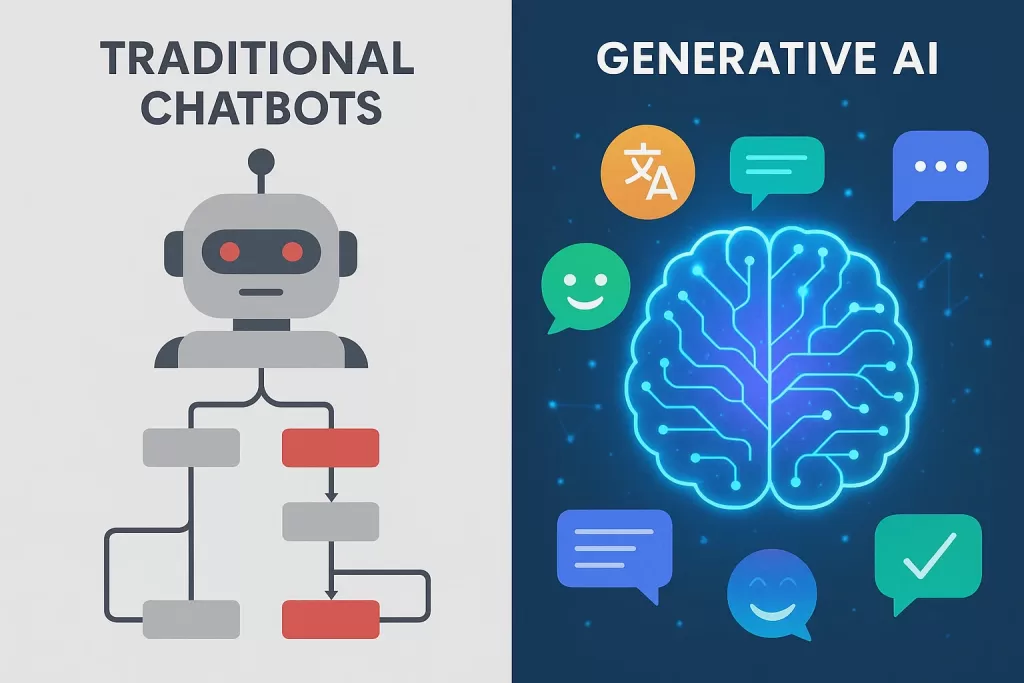
Generative AI models, particularly Large Language Models (LLMs) like GPT, Claude, and other transformer-based architectures, represent a quantum leap beyond traditional chatbot technology. These sophisticated AI systems can be fine-tuned on domain-specific data, enabling them to understand the nuances of your business, products, and customer base with remarkable precision.
Core Capabilities Transforming Support
Natural Language Understanding: Unlike rule-based chatbots that rely on keyword matching, generative AI customer service solutions comprehend customer intent, sentiment, and context. Whether a customer writes “My account isn’t working” or “I can’t log into my dashboard,” the AI recognizes these as the same underlying issue.
Instant, Intelligent Responses: AI-powered support systems generate human-like responses in milliseconds, drawing from your entire knowledge base, past interactions, and product documentation. This eliminates the frustrating wait times that plague traditional support channels.
Conversation Summarization: Generative AI excels at processing lengthy email threads or complex chat histories, extracting key points and providing agents with concise summaries. This capability dramatically reduces the time agents spend catching up on context.
Beyond Traditional Chatbots
The difference between legacy chatbots and AI customer support automation powered by generative AI is profound:
- Context Retention: Modern AI maintains conversation history across multiple interactions, remembering previous issues and preferences
- Personalized Responses: Each answer is tailored to the specific customer, their history, and their unique situation
- Adaptability: The system learns from every interaction, continuously improving without manual reprogramming
- Multilingual Support: Advanced LLMs can seamlessly handle queries in dozens of languages without separate training
Technical Deep Dive: How AI-Powered Customer Support Works
Data Ingestion and Preparation
The foundation of effective machine learning customer service begins with comprehensive data collection. Organizations aggregate support tickets from help desk platforms, chat transcripts, email conversations, FAQ documents, product manuals, and historical customer interactions into a centralized data repository.
This data undergoes preprocessing—cleaning, anonymization for privacy compliance, and structuring into formats optimized for AI training. Quality data directly correlates with AI performance, making this phase critical for success.
Model Training and Fine-Tuning
While base LLMs possess impressive general knowledge, fine-tuning AI models for customer support on company-specific data unlocks their true potential. This process involves:
Domain-Specific Training: The model learns your product terminology, company policies, common customer pain points, and approved response patterns. A SaaS company’s AI will understand terms like “API rate limits” or “webhook configurations” specific to their platform.
Embedding-Based Knowledge Retrieval: Modern systems often implement Retrieval-Augmented Generation (RAG), where customer queries trigger semantic searches through your knowledge base. The most relevant information is retrieved and fed to the LLM, which then generates accurate, grounded responses that minimize hallucinations.
Continuous Learning Loop: As the AI handles more tickets, it encounters edge cases and learns from agent corrections, steadily expanding its capabilities without extensive retraining.
Real-Time Response Generation
When a customer submits a query, the AI support system follows this workflow:
- Query Analysis: The system parses the input, identifying intent, sentiment, urgency level, and key entities (account numbers, product names, etc.)
- Context Assembly: Retrieves relevant customer history, account details, and knowledge base articles
- Response Generation: The LLM synthesizes this information into a coherent, helpful answer
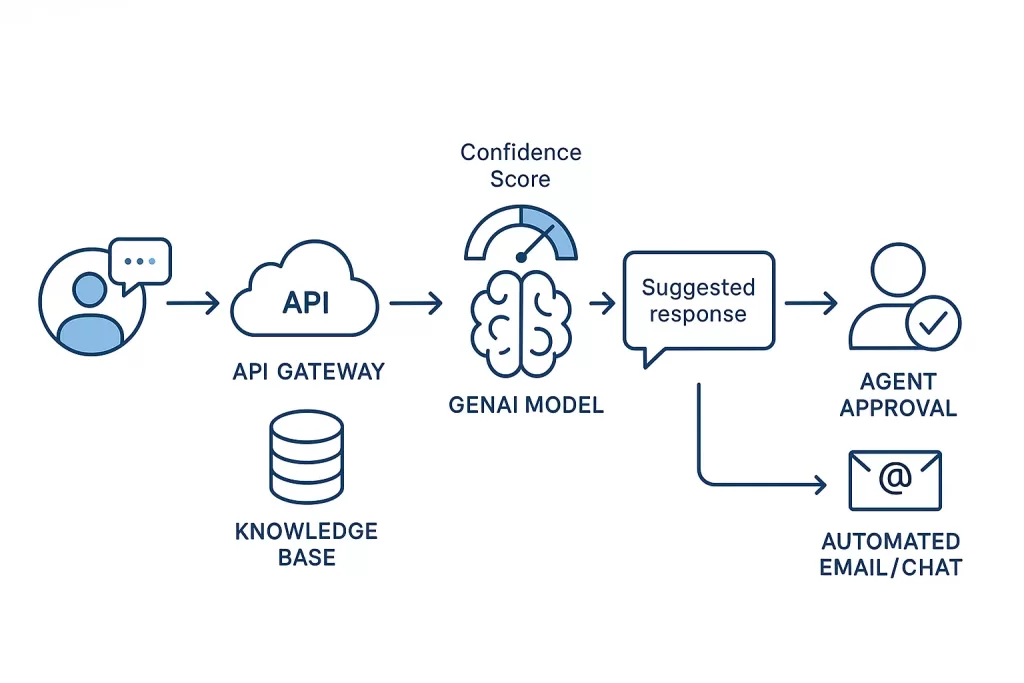
- Confidence Scoring: The system assigns a confidence score to its response—high-confidence answers can be sent automatically, while uncertain responses are routed to human agents with AI-generated suggestions
Seamless Integration Architecture
Cloud-based customer support solutions integrate with existing infrastructure through APIs and webhooks. Popular integrations include:
- Ticketing Systems: Zendesk, Freshdesk, ServiceNow, Salesforce Service Cloud
- Communication Channels: Email, live chat widgets, WhatsApp Business, Slack, Microsoft Teams
- CRM Platforms: Synchronize customer data for personalized interactions
- Analytics Tools: Track AI performance metrics and customer satisfaction scores
A typical architecture might look like: Customer Query → API Gateway → GenAI Model → Suggested Response → Agent Approval/Auto-Send → CRM Update
Real-World Use Case: Transforming Password Reset Requests
Let’s examine a concrete example that illustrates the power of AI-powered help desk automation.
Traditional Approach (Pre-AI)
An employee contacts IT support: “How do I reset my password? I’ve been locked out for 20 minutes and have an urgent meeting.”
Traditional workflow:
- Ticket automatically created and enters queue (Position #47)
- Average wait time: 30-45 minutes during peak hours
- Agent reads ticket, finds password reset documentation
- Agent sends standardized response with reset link
- Total resolution time: 35+ minutes
- Result: Missed meeting, frustrated employee, wasted agent time on routine issue
Generative AI Approach
The same query enters an AI customer support platform:
AI-enhanced workflow:
- Intent Recognition (< 1 second): AI identifies this as a password reset request with high urgency
- Knowledge Retrieval (< 1 second): System pulls relevant self-service articles and step-by-step reset procedures
- Personalized Response Generation (2 seconds): AI crafts a response addressing the specific user, their role, and system access level
- Automated Delivery (instant): High-confidence score triggers automatic response with secure reset link and alternative recovery options
- Follow-up Monitoring: AI tracks if issue is resolved or requires agent escalation
Total resolution time: Under 5 seconds
Impact Metrics:
- 98% reduction in response time
- Agent freed to handle complex, high-value issues
- Consistent, accurate answers across all shifts
- Improved employee satisfaction scores

Business Benefits: The ROI of AI Customer Support
Operational Efficiency and Cost Reduction
24/7 availability without headcount expansion represents the most immediate benefit. A single AI system can handle thousands of simultaneous conversations—scaling that would require hundreds of human agents. Companies typically see 30-50% reduction in support costs within the first year of implementing intelligent customer service automation.
Enhanced Customer Satisfaction
Speed matters. Research shows that 68% of customers expect responses within 4 hours, yet many companies struggle to meet this benchmark. AI chatbot customer service delivers instant acknowledgment and resolution for common queries, dramatically improving satisfaction scores and Net Promoter Scores (NPS).
Continuous Improvement Through Machine Learning
Unlike human agents who plateau in knowledge, AI support agents improve with every interaction. The system identifies patterns in customer inquiries, revealing product issues, documentation gaps, or confusing user interfaces that need attention. This feedback loop transforms customer support from a cost center into a strategic business intelligence source.
Data-Driven Insights and Analytics
Advanced customer service AI software provides unprecedented visibility into support operations:
- Trending issues and seasonal patterns
- Customer sentiment analysis across all interactions
- Agent performance optimization opportunities
- Predictive analytics for proactive support
Cloud & Infrastructure Considerations for AI Customer Support
AWS Architecture for Scalable AI Support
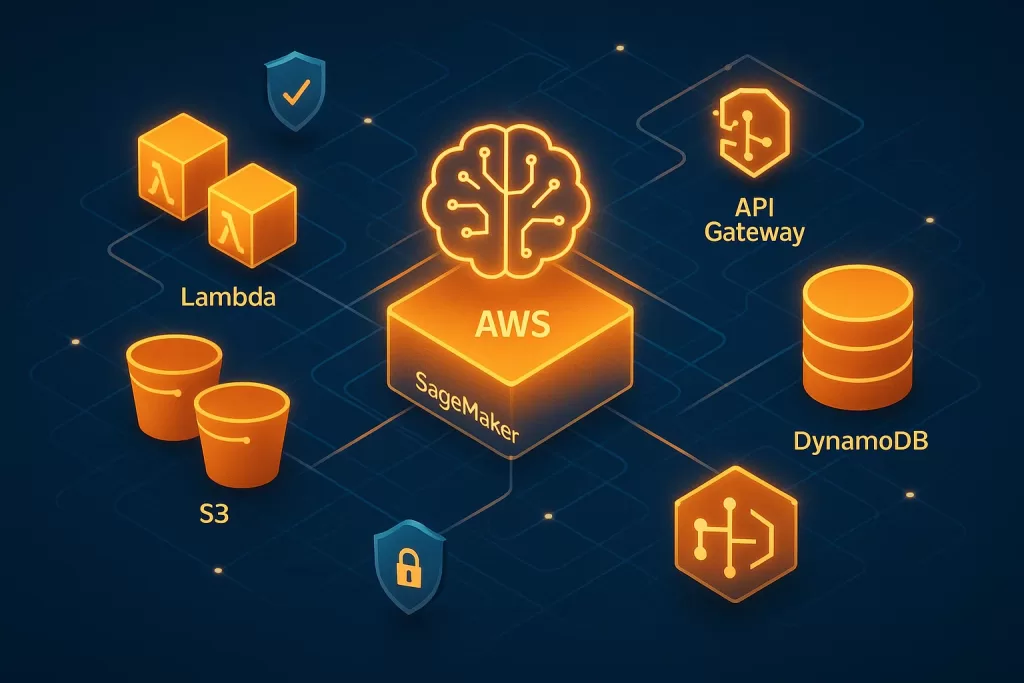
Building robust cloud-based AI customer support requires careful infrastructure design. Amazon Web Services offers comprehensive tools:
Amazon SageMaker: The cornerstone for AI operations, SageMaker handles model training, fine-tuning with your support data, and deployment of inference endpoints. Its built-in algorithms and notebook environments accelerate development cycles.
AWS Lambda and API Gateway: Serverless architecture enables cost-effective query handling. Lambda functions process incoming support requests, invoke SageMaker endpoints, and return responses—scaling automatically from zero to thousands of requests without manual intervention.
Data Storage Solutions:
- Amazon S3: Store training data, chat logs, and knowledge base documents with 99.999999999% durability
- Amazon DynamoDB: Lightning-fast NoSQL database for storing conversation history and session data
- Amazon RDS: Relational database for structured customer and ticket data
Monitoring and Optimization: CloudWatch provides real-time monitoring of AI model performance, latency metrics, and cost tracking, enabling continuous optimization.
Security, Compliance, and Data Protection
Implementing AI-powered customer support platforms demands rigorous security:
- Data Encryption: End-to-end encryption for data in transit (TLS 1.3) and at rest (AES-256)
- GDPR Compliance: Automated data anonymization, right-to-deletion workflows, and audit trails
- Access Control: Role-based access control (RBAC) and multi-factor authentication
- SOC 2 Compliance: Regular security audits and penetration testing
- Data Residency: Geographic data storage controls for international compliance
Challenges & Mitigations: Building Reliable AI Support Systems
Handling Sensitive and Ambiguous Queries
Not every customer inquiry suits automated resolution. Hybrid AI-human customer support models implement confidence thresholds—queries involving financial disputes, emotional distress, or complex technical issues automatically escalate to human agents. The AI still provides value by preparing comprehensive context summaries and suggested approaches.
Preventing AI Hallucinations and Errors
Generative AI accuracy requires ongoing vigilance. Mitigation strategies include:
- Retrieval-Augmented Generation: Ground responses in verified documentation rather than relying solely on model knowledge
- Human-in-the-Loop Review: Random sampling of AI responses for quality assurance
- Explicit Uncertainty Expression: Configure AI to acknowledge when it lacks sufficient information
- Feedback Mechanisms: Easy pathways for agents and customers to flag incorrect responses
Scaling Infrastructure for Growth
As adoption grows, AI customer support scalability becomes critical. Cloud auto-scaling policies automatically provision additional resources during traffic spikes. Caching frequently accessed knowledge base articles reduces latency and costs. Geographic distribution through content delivery networks (CDNs) ensures consistent performance worldwide.

Conclusion: Embracing the AI Support Revolution
The transformation of customer support through generative AI technology isn’t a distant possibility—it’s happening now across industries. Forward-thinking organizations are already reaping the benefits: faster response times, happier customers, more efficient operations, and deeper insights into their business.
The competitive advantage goes to companies that act decisively. As AI capabilities continue advancing and customer expectations keep rising, the gap between AI-enabled and traditional support will only widen.
Future-proof your support operations by integrating Generative AI with your cloud infrastructure. Start with pilot programs addressing high-volume, low-complexity queries, then expand as your team gains confidence and expertise. The investment in AI-powered customer service platforms delivers measurable ROI while positioning your organization at the forefront of customer experience innovation.
The question isn’t whether AI will transform customer support—it’s whether you’ll lead the transformation or scramble to catch up. The technology is ready. The infrastructure is proven. The time to act is now.
Ready to implement AI-powered customer support in your organization? Begin by auditing your current support data, identifying high-volume query categories, and exploring cloud-based AI platforms that integrate with your existing systems. The future of customer service is intelligent, instant, and infinitely scalable.