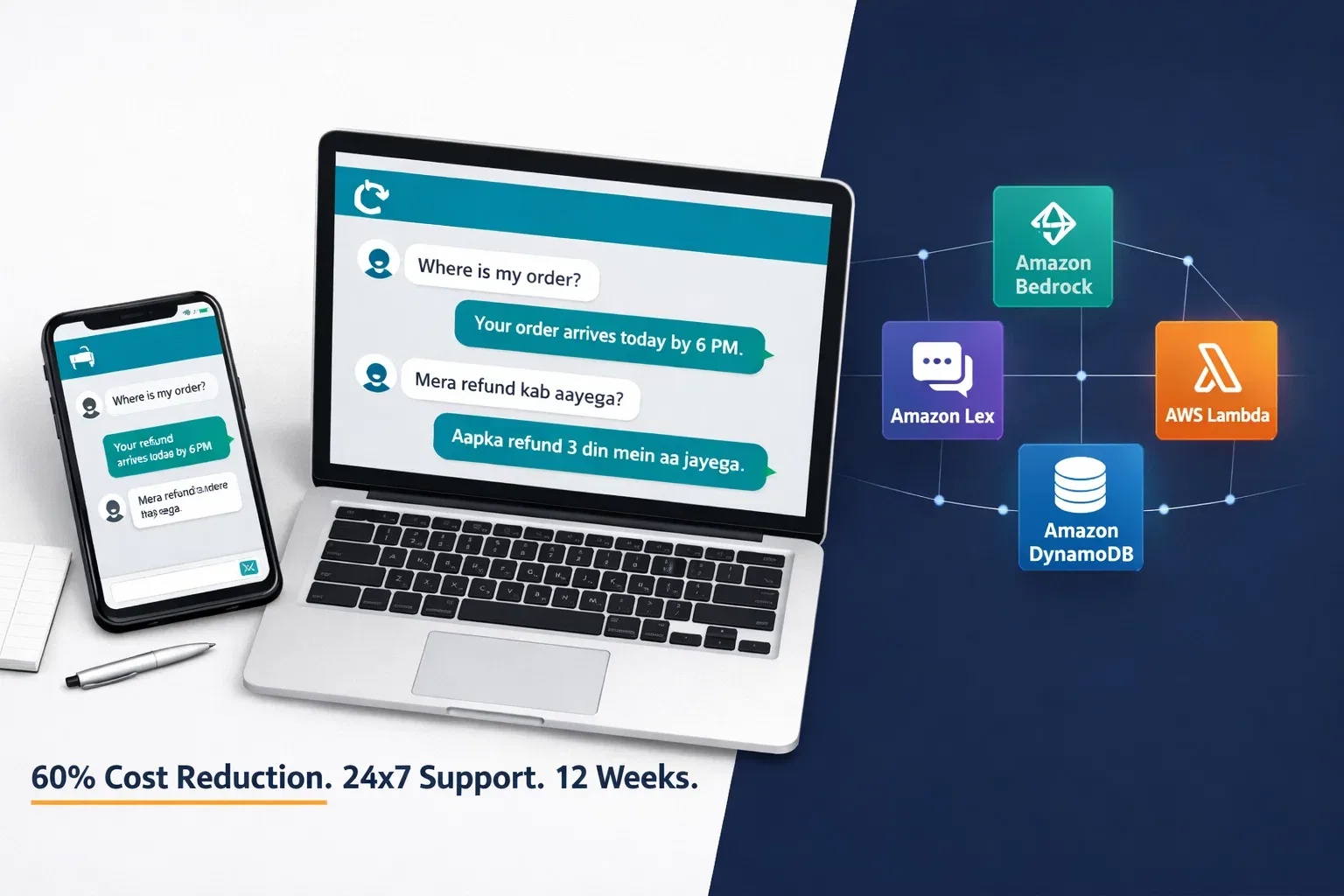
An intelligent customer support assistant for an Ahmedabad-based retail company. The customer is not named, so the figures in this write-up are theirs rather than independently verifiable.
Intelligent Customer Support Chatbot: AWS Case Study
How an Ahmedabad-Based Retail Company Cut Support Costs by 60%
How an Intelligent Customer Support Chatbot Changed Everything
India’s e-retail market moves very fast. As a result, customers now want instant answers around the clock. However, a growing multi-channel retailer based in Ahmedabad could not keep up.
Their 90-person support team worked hard. But response times stretched past four hours. Moreover, customer satisfaction scores fell to an all-time low. The company served 1.2 million customers across 14 cities, so the pressure was immense.
To solve this, they launched an intelligent customer support chatbot on AWS. Specifically, they used Amazon Bedrock, Amazon Lex, AWS Lambda, Amazon DynamoDB, and CloudFront. As a result, they achieved 24×7 automated support, a 60% drop in costs, and a CSAT score that jumped from 3.1 to 4.6 — all in just 12 weeks.
Company Background
This Ahmedabad-based retailer started in 2018. Today, they sell groceries, household goods, and personal care products. In addition, they run 38 stores across Gujarat, Rajasthan, and Maharashtra, as well as a website and mobile app.
Detail
Profile
Founded
2018, Ahmedabad
Cities served
14 (Tier 1 & Tier 2)
Registered customers
1.2 million+
Monthly orders
~320,000
Support team size
90 agents (pre-automation)
Channels
Website, Android/iOS app, WhatsApp
India’s online grocery market will reach $160 billion by 2028. Because of this, rivals like Blinkit and JioMart keep raising the bar. For a regional brand with a lean budget, therefore, the need to move fast was critical.
The Problem: Repetitive Queries Broke the Support Team
Between FY2022 and FY2024, monthly order volumes grew 3×. Consequently, support tickets grew at the same rate. However, the team grew by only 20%.
By mid-2024, the support function was in crisis. Here is what went wrong.
Five Core Pain Points
First, repetitive queries took over. In fact, 78% of tickets were simple questions. For example: “Where is my order?” or “When will my refund come?” These questions drained agent time every single day.
Second, the team had no after-hours cover. Peak traffic hit between 9 PM and 12 AM IST. So customers who wrote in at night waited up to 48 hours for a reply.
Third, responses were not consistent. Different agents gave different answers to the same questions. As a result, complaints grew on social media and trust fell.
Fourth, a language gap hurt scores. Many customers in Tier 2 cities spoke Hindi or Gujarati. However, most agents only worked in English.
Fifth, agent burnout rose sharply. Because the work was repetitive, staff turnover hit 28% per year. So the company kept spending money on hiring and training.
Pre-Automation Metrics
Metric
Value
Average response time
4.2 hours
First contact resolution (FCR)
54%
CSAT score
3.1 / 5
Monthly support cost
₹2,00,00,000 (~$240,000)
Agent turnover rate
28% annually
Repeat contact rate
41%
After-hours resolution
0%
Hiring more staff was not the answer. Instead, the company needed a smarter solution.
The Solution: An AWS-Powered Intelligent Customer Support Chatbot
The team launched a cloud-native intelligent customer support chatbot fully on AWS. In addition, each service had a clear and specific job to do.
AWS Technology Stack
Service
Role in the Chatbot
Amazon Bedrock
Handles open-ended queries with generative AI in plain language
Amazon Lex
Runs chat flows, reads user intent, and supports English and Hindi
AWS Lambda
Runs business logic and links to OMS, CRM, and payment tools in real time
Amazon DynamoDB
Saves chat history, session data, and customer profiles
Amazon CloudFront
Sends the chat interface fast — under 100ms across all of India
Five Design Principles
First, intent mapping came before code. The team studied 18 months of real tickets and mapped 50+ user intents. Only then did they start building.
Second, the bot hands off smoothly. When a customer feels frustrated, the bot passes the chat to a human agent. Importantly, the agent gets the full chat history — so the customer never has to repeat themselves.
Third, the bot speaks two languages. Amazon Lex handles English and Hindi natively. In addition, the team added support for Hinglish and Gujarati-style inputs.
Fourth, the chatbot works everywhere. The team launched it on the website, the Android and iOS apps, and WhatsApp Business — all at the same time.
Fifth, the bot keeps improving. Agent feedback and weekly data help the model get better over time, without any manual retraining.
Implementation: 12 Weeks from Start to Launch
Phase 1 — Discovery and Data Prep (Weeks 1–3)
The team reviewed 280,000+ support chats from the past 14 months. They then found the top 50 repeat intents, cleaned the data, and checked it with experts.
One challenge stood out. Many customers mixed Hindi, English, and Gujarati in a single message. Standard AI tools could not read this well. So the team built custom input models to handle it.
Phase 2 — Build and Connect (Weeks 4–7)
The team built Amazon Lex flows for all 50+ intents. Then they added Amazon Bedrock on top for open-ended questions. After that, AWS Lambda linked the bot to the order system, Razorpay, and Freshdesk CRM in real time.
Phase 3 — Test and Improve (Weeks 8–10)
150 internal testers ran real chat scenarios across devices and languages. As a result, the team caught tricky edge cases and fixed the fallback flows. Moreover, the bot had to beat human agent accuracy on the top 30 intents before launch.
Phase 4 — Launch and Monitor (Weeks 11–12)
CloudFront made the launch smooth with zero downtime. For two weeks after launch, a close monitoring team watched every live chat. Meanwhile, human agents got training to focus on complex cases and high-value customers.
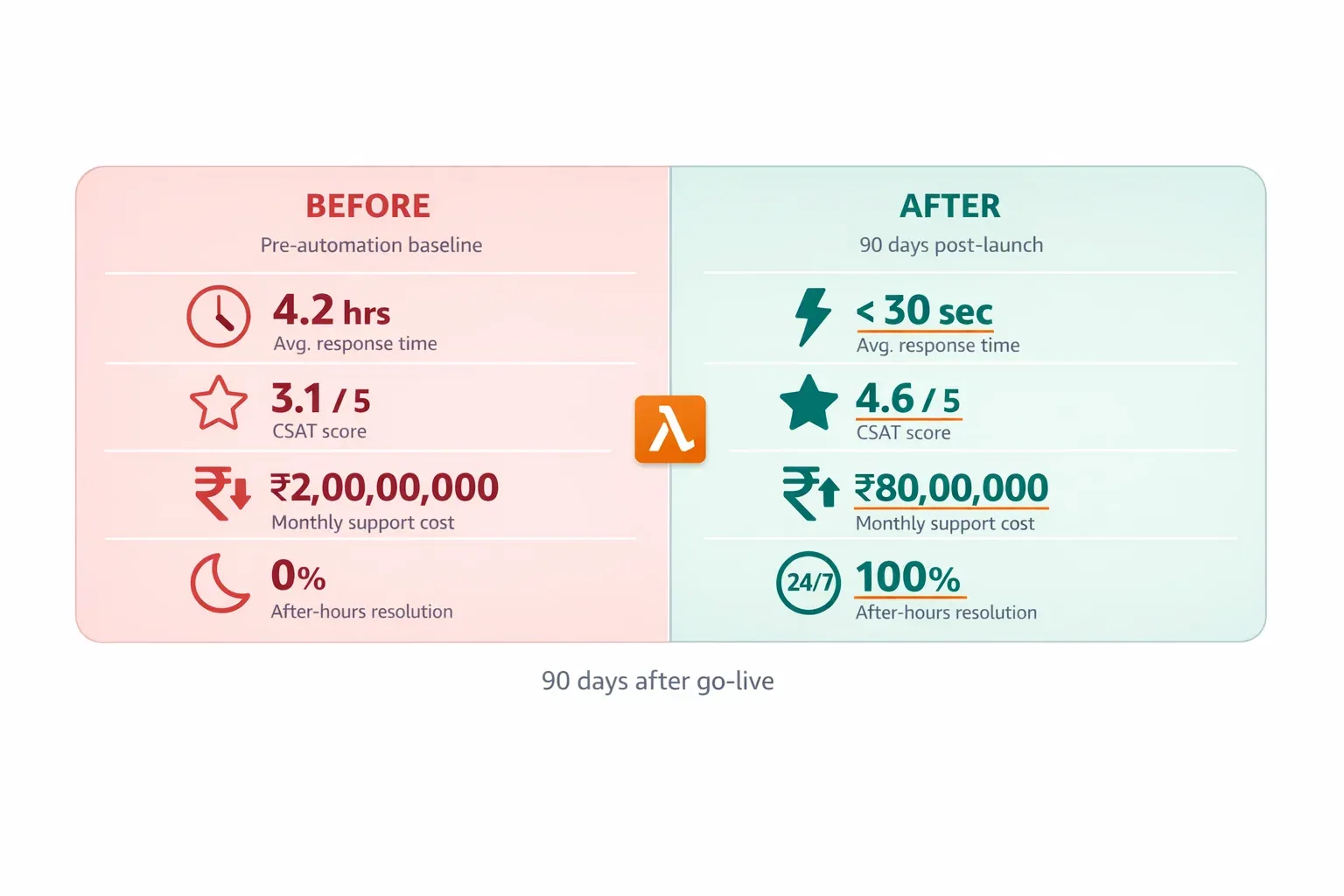
Results: 90 Days After Launch
The intelligent customer support chatbot showed strong results within just three months.
Metric
Before
After
Change
Average response time
4.2 hours
< 30 seconds
↓ 99%
First contact resolution
54%
87%
↑ 33 pts
CSAT score
3.1 / 5
4.6 / 5
↑ 48%
Monthly support cost
₹2,00,00,000
₹80,00,000
↓ 60%
Automated query resolution
22%
78%
↑ 56 pts
After-hours resolution
0%
100%
Full coverage
Agent turnover rate
28%
14%
↓ 50%
Repeat contact rate
41%
18%
↓ 56%
WhatsApp call deflection
—
64%
New channel
The company earned back its investment in 6 months. Monthly savings of ₹1.2 crore covered the full project cost within two quarters.
Key Wins
Order tracking now takes under 15 seconds. The bot handles it fully, because it links directly to the order system in real time.
Returns and refunds run end to end. As a result, every customer gets a clear, consistent answer about their refund — every time.
Late-night support is now fully covered. In fact, 34% of all chatbot chats now happen between 9 PM and 12 AM IST — a window that previously had zero coverage.
Hindi and Gujarati chats make up 29% of all bot talks. So the company now serves a segment that previously had the lowest satisfaction scores.
“We spent a fortune just telling people where their orders were. Now the bot handles it in seconds. Our team finally does meaningful work.”
— VP, Customer Experience
Lessons Learned
What Worked Well
Starting with data made a big difference. Three weeks of ticket study before any building meant the bot launched with strong accuracy from Day 1. As a result, early user trust was high.
Smart hand-offs built confidence. Customers do not mind chatbots — as long as they work. Therefore, a fast and smooth pass to a human agent was the most important trust builder in the whole system.
WhatsApp opened a new door. Because many customers preferred WhatsApp, the team found a whole new group who had never used the website or app for support. Moreover, WhatsApp delivered the highest CSAT of any channel.
What the Team Would Do Differently
Bring agents in from Week 1. Frontline staff knew tricky edge cases that no data audit could find. So involving them in design earlier would have saved time in testing.
Plan for multiple languages from the start. The Gujarati and Hinglish gap added time mid-build. For that reason, any India-first chatbot should treat multilingual support as a Day 1 need — not an add-on.
Conclusion: A Scalable Intelligent Customer Support Chatbot for Indian Retail
In short, this Ahmedabad-based retailer showed that an intelligent customer support chatbot does not reduce customer experience. Instead, it defines it.
Today, the bot handles 78% of all customer chats — instantly, consistently, and in the customer’s own language. Furthermore, the roadmap includes voice support via Amazon Connect, proactive WhatsApp alerts, live sentiment tracking, and full Gujarati support.
For Indian retailers facing fast growth and high customer needs, this is the playbook to follow.
The client’s identity stays private at their request. All numbers reflect real outcomes from the project.
The full architecture behind GTU's generative AI programme: retrieval, identity, analytics and delivery, for one of India's largest public universities.
A serverless retrieval assistant over a fast-growing cybersecurity knowledge base, so analysts get an answer with its source instead of a list of documents.
Tell us what you are trying to move, modernise or automate
A short call with an AWS practice lead, not a sales qualification call. You will leave with a candid read on the work involved and the order to do it in.