A serverless retrieval assistant over a fast-growing cybersecurity knowledge base, so analysts get an answer with its source instead of a list of documents. The customer reported a two to tenfold efficiency gain.
Infopercept is a global platform-led managed security services company, and with this approach, it is reshaping the cybersecurity landscape. It’s redefining how Cybersecurity tackles two critical challenges:
The mounting pressure of security compliance imposed by various regulatory bodies across different geographies.
Through its platform, “Invinsense”, Infopercept has unified various security approaches: offensive security, defensive security, and security compliance. It incorporates an array of technologies such as detection and response (including SIEM, SOAR, EDR, Threat Intelligence, Threat
Exchange, Case Management), deception, attack surface monitoring, Digital Forensic and Incident Response, vulnerability management (VM), breach and attack simulation (BAS), continuous red teaming (CART) and RedOps. It brings together multiple teams, including the blue team, the red team, the purple team, the compliance team, and the engineering team. Moreover, it encompasses all landscapes: IT, Cloud, OT, and IoT.
Infopercept approach comprehensively addresses adversaries launching cyberattacks and also meets the stringent demands of security compliance enforced by regulatory bodies.
Challenges:
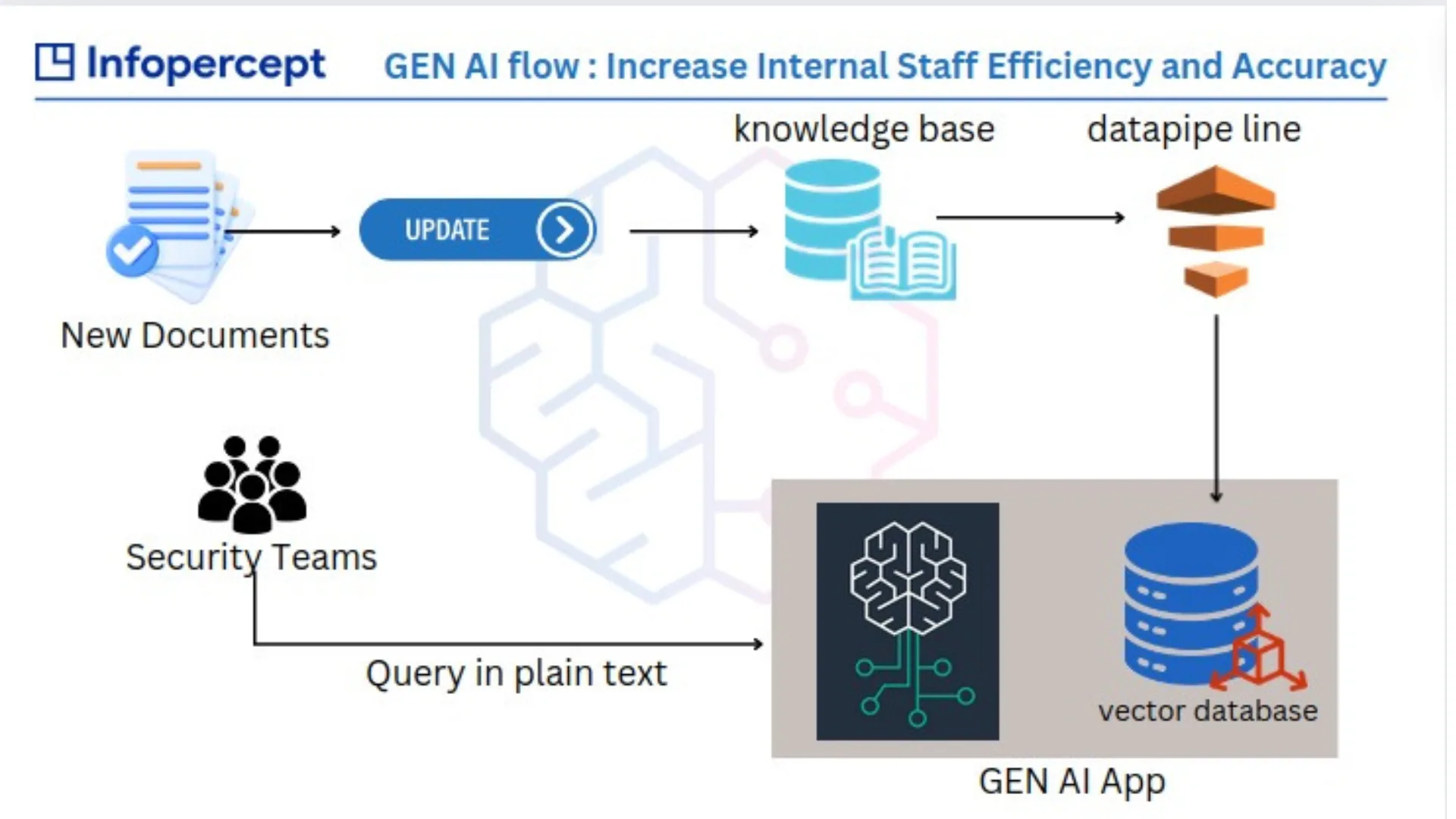
Invinsense, as a security platform, offers numerous features and modules that are rapidly expanding. It is essential to regularly update all new security innovations and requirements. All processes are meticulously documented and stored in a knowledge base. Effectively retrieving specific information from the document repository poses a challenge. The extensive knowledge base increases the risk of missing crucial information, which can be perilous for a security company. Additionally, internal experts sometimes avoid retrieving information due to the time-consuming nature of navigating the large knowledge base.
Large and rapidly growing knowledge base.
Risk of missing critical information due to the extensive repository.
Potential security risks from not accessing the correct information.
Time-consuming process to retrieve information from the large knowledge base.
Internal experts sometimes avoid retrieving information due to the lengthy process.
Regular updates for all new security innovations and requirements.
Comprehensive documentation of all processes.
Efficient retrieval of specific information from the documents repository.
Solution for specific Challenges:
Large and Rapidly Growing Knowledge Base: Solution: Use AI to continuously crawl, index, and categorize the expanding knowledge base to ensure up-to-date and well-organized information. Risk of Missing Critical Information: Solution: Employ AI to highlight and prioritize critical information, ensuring that important updates are easily accessible and not overlooked. Potential Security Risks: Solution: Integrate AI-driven security checks to ensure that retrieved information is accurate and relevant, reducing the risk of security breaches due to misinformation. Time-Consuming Information Retrieval: Solution: Utilize AI to provide quick and precise search results, minimizing the time spent on finding relevant information. Internal Experts Avoiding Information Retrieval: Solution: Create an intuitive AI-driven interface that simplifies the search process, encouraging experts to engage with the knowledge base without hesitation.
Proposed Solution
Implement a generative AI system to maintain and update documentation with new security innovations and requirements automatically.
Use AI to index and categorize the knowledge base effectively for easier retrieval.
Develop an AI-powered search tool that can understand and respond to natural language
Queries, improving information retrieval efficiency.
Solution & Approach
User Authentication:
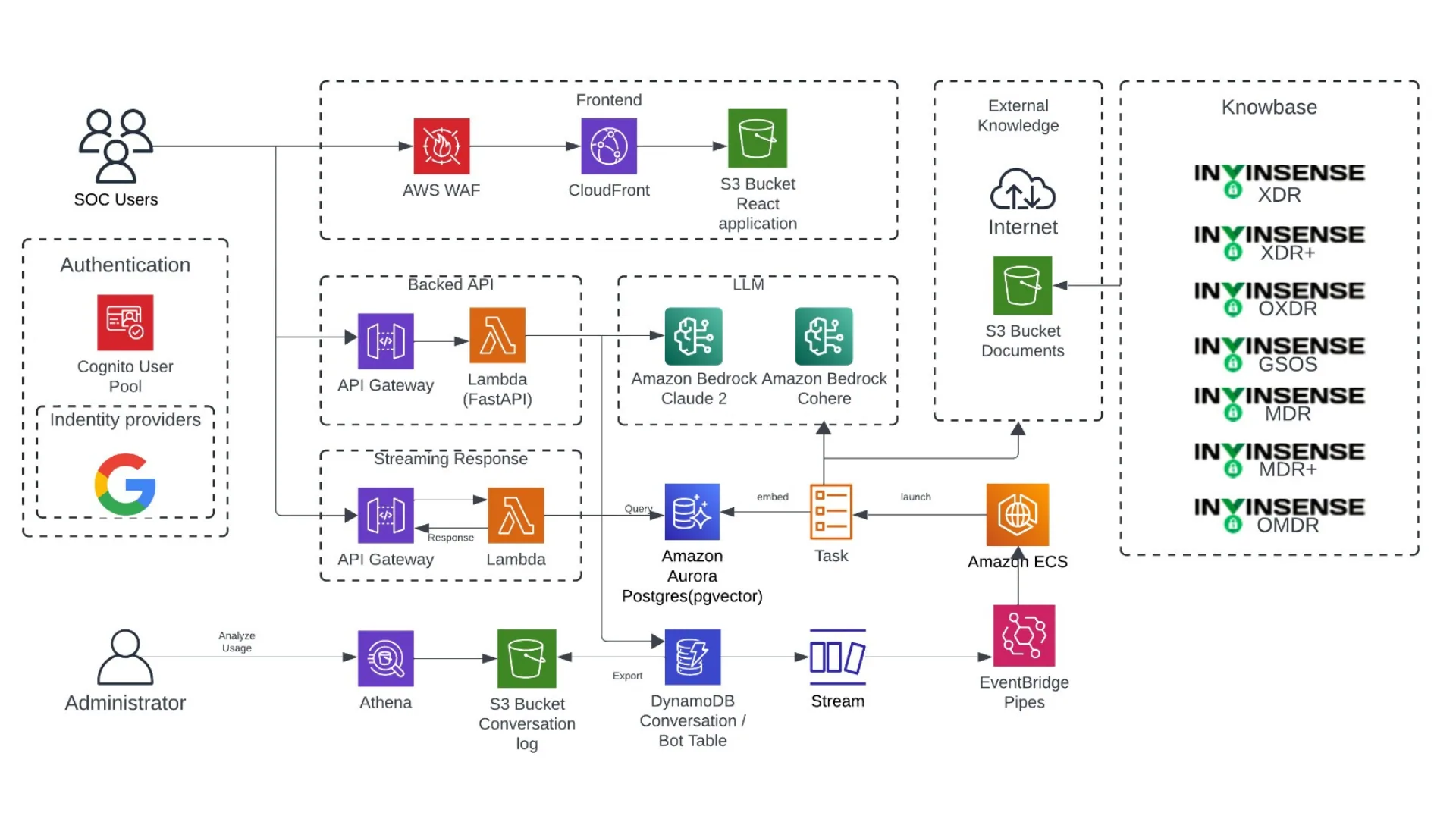
● SOC Users: They authenticate via AWS Cognito User Pool, which may integrate with various identity providers (e.g., Google) for single sign-on (SSO). ● AWS WAF: Provides security for the frontend applications by filtering and monitoring incoming HTTP/HTTPS requests. Frontend: ● AWS CloudFront and S3: The React application is hosted in an S3 bucket, served through CloudFront for efficient content delivery. Backend API: ● API Gateway: Acts as the entry point for all API requests, routing them to appropriate backend services. ● AWS Lambda (FastAPI): Handles the business logic for the chatbot and other backend functionalities. External Knowledge Integration: ● S3 Bucket for Documents: Stores external documents and knowledge bases that can be queried by the chatbot for additional information. ● Internet: External knowledge sources can be accessed and stored in the S3 bucket for reference. LLM Integration: ● Amazon Bedrock Claude 2 and Cohere: Provides natural language processing capabilities for understanding and generating human-like responses. ● Tasks: These LLM services are invoked by the backend to generate responses based on user queries. Data Storage and Retrieval: ● Amazon Aurora (Postgres with pgvector): Stores structured data, including conversation history and bot interactions, enabling efficient querying and retrieval. ● DynamoDB Conversation/Bot Table: Stores real-time conversation logs for quick access and analysis. Streaming and Response Handling: ● Streaming Response Lambda: Utilizes API Gateway to provide real-time streaming responses to user queries. ● Athena : Analyzes conversation logs stored in the S3 bucket to gain insights into user interactions and bot performance. Administrator Access: ● Athena and S3 Buckets: Administrators can analyze usage data and logs to monitor system performance and usage patterns. Event Processing: ● Amazon ECS: Manages and orchestrates containerized applications and tasks
EventBridge Pipes: Facilitates event-driven processing, linking various AWS services and ensuring smooth data flow between components.
Architecture Flow
Authentication Layer
Users authenticate via Amazon Cognito User Pool
Federation with Identity Providers (Google)
Secure, role-based access to Gen AI services
2. Data Ingestion & Processing
Input Documents are processed using Amazon Textract for text extraction
Extracted & processed data is stored in Amazon S3
S3 acts as the primary data lake for AI processing and model interactions
3. Gen AI Processing Pipeline
Amazon Bedrock provides foundation models for:
Text generation
Document summarization
Question answering
AWS Lambda executes serverless AI workflows, orchestration, and prompt handling
4. Knowledge Management Layer
Invinsense Knowledge Base acts as a centralized AI-driven knowledge repository
Amazon Comprehend performs NLP tasks such as:
Entity extraction
Key phrase detection
Content classification
Amazon DynamoDB stores:
Conversation context
Metadata
Knowledge references
5. Output & Integration Layer
Amazon EventBridge enables event-driven AI workflows
Amazon API Gateway exposes secure REST APIs for AI services
Amazon Athena provides analytics on AI-generated insights and system usage
Key Gen AI Capabilities
Document Intelligence
Automated document processing using Textract
Intelligent content extraction and classification
Searchable, AI-ready document repository
Conversational AI
Natural language understanding using Amazon Comprehend
Context-aware, intelligent responses powered by Bedrock
Secure and scalable conversational workflows
Knowledge Discovery
Bedrock-powered content generation
Automated knowledge base creation
Intelligent insight extraction from enterprise data
This architecture outlines a scalable, secure, and fully serverless Gen AI solution built on AWS services and tightly integrated with the Invinsense platform to enable intelligent document processing, knowledge discovery, and business insights.
Key Benefits
Scalability: ● With the help of a data pipeline newly created documents will be automatically added and available . ● The solution is based on serverless components (Lambda, API Gateway) and managed services (Bedrock, Aurora, DynamoDB) to scale automatically with demand. ● Automated updation to the knowledge base referred by Electromech AWS Gen AI solution highly reduces the risk of missing any critical security information. Security: ● Electromech leverages AWS cloud computing GEN AI services which is privately available at customer accounts only. ● Customer Data will never be used to train AWS LLM models . ● Customer Data is never publicly available / published over the internet. Efficiency: ● Automated Data pipeline and Serverless scalable AWS infrastructure design easily allow applications to introduce any updates very fast. Almost at no time and without much effort. Flexibility: ● Supports integration with external knowledge sources and third-party identity providers. Real-time Processing: ● Enables real-time data streaming responses and event-driven architecture for responsive user interactions.
Conclusion
Using AWS GEN AI services, a secure information retrieval system with a simple, intuitive interface has been delivered. ● Employee efficiency has significantly increased, allowing them to retrieve accurate information within seconds. ● This has led to a heightened self-motivation to use the GEN AI-driven system in daily activities. ● Infopercept has seen employee efficiency improve by nearly 2x to 10x across various departments.
The full architecture behind GTU's generative AI programme: retrieval, identity, analytics and delivery, for one of India's largest public universities.
Tell us what you are trying to move, modernise or automate
A short call with an AWS practice lead, not a sales qualification call. You will leave with a candid read on the work involved and the order to do it in.