

Reimagining Student Experience at GTU Using AWS Generative AI
Gujarat Technological University (GTU) is one of India’s leading public universities, serving a large and diverse student population across urban and rural regions. With extensive academic and administrative information published online, GTU aimed to improve how students discover and consume information in a faster, more intuitive manner.
Business Challenge
GTU’s website hosted comprehensive and up-to-date information; however, students faced challenges due to:
- Complex navigation with multiple URLs and deep menu structures
- Time-consuming searches for specific academic or administrative details
- Repetitive queries reaching administrative teams
Although information was available, it was not easily consumable. GTU required an intelligent, conversational system that could provide instant, accurate, and contextual answers to student queries.
Solution Overview
Electromech Cloudtech Pvt. Ltd. designed and implemented a Generative AI–powered Intelligent Question & Answer System using AWS cloud-native and serverless services.
The solution allows students to ask questions in natural language and receive accurate, reference-backed answers in real time. It leverages AWS Bedrock foundation models, vector-based search, and secure APIs to deliver a scalable and highly available system.
Solution Architecture & Implementation
Data Access & Preparation
- GTU shared publicly available website URLs and documents
- Electromech Cloudtech preprocessed, cleaned, and structured the content for AI consumption
AI Model Training & Fine-Tuning
- AWS Bedrock foundation models were used and fine-tuned to understand GTU-specific academic context
- Contextual understanding ensured precise and relevant answers
Backend & Frontend Development
- Serverless backend APIs were built using AWS Lambda and Amazon API Gateway
- A React-based frontend interface enables students to interact with the AI assistant
- HTML frames were developed to support frontend integration where required
Access Control & Security
- User authentication and authorization are managed by GTU
- Sensitive data is protected while public information remains accessible
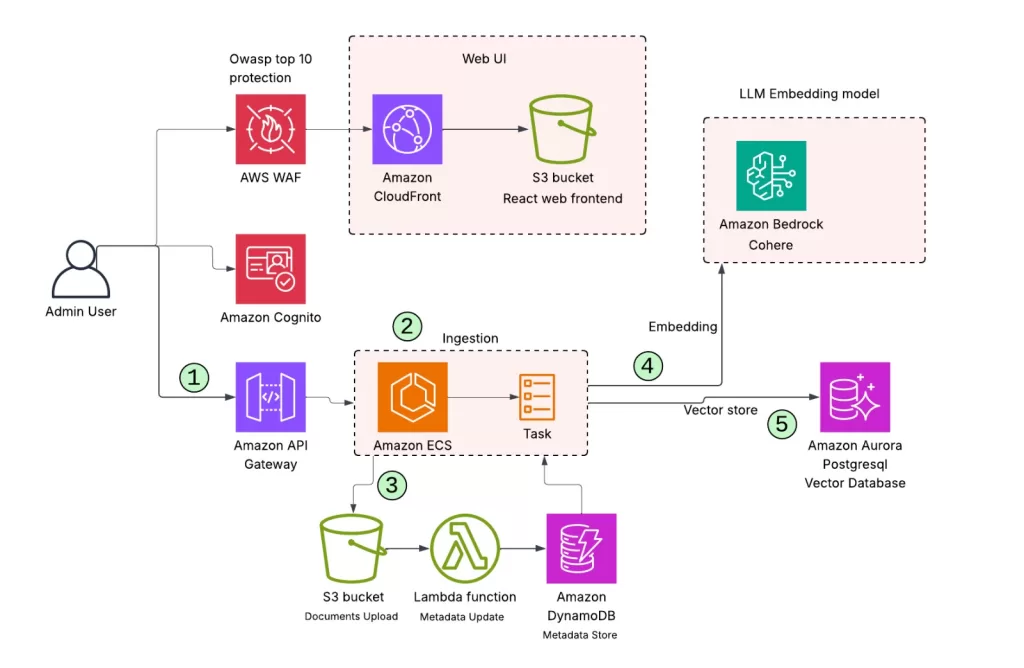
How AWS Services Were Used
The platform follows a secure, scalable, and event-driven AWS architecture, ensuring low latency, high availability, and strong security controls.
User Access, Security & Frontend Delivery
- Amazon CloudFront delivers the React frontend with low latency using global edge caching.
- AWS WAF protects the application from OWASP Top 10 threats such as SQL injection and XSS attacks.
- Amazon S3 hosts the static frontend assets and stores knowledge base documents.
- Amazon Cognito manages authentication for students and admin users, issuing secure tokens for API access.
API Layer & Backend Processing
- Amazon API Gateway acts as the secure entry point for frontend requests and validates user tokens.
- AWS Lambda (Python with FastAPI) processes user queries, orchestrates GenAI calls, retrieves contextual data, and returns structured responses.
- Separate APIs enable synchronous and streaming AI responses for improved user experience.
Generative AI & Semantic Search
- Amazon Bedrock (Claude 3.1) generates conversational, context-aware answers.
- Amazon Bedrock (Cohere) generates embeddings for semantic search.
- Amazon Aurora PostgreSQL (Vector Database) stores embeddings and retrieves relevant content using vector similarity, enabling Retrieval-Augmented Generation (RAG).
Document Processing & Containerized Workloads
- Amazon ECS (Docker-based containers) handles document ingestion, preprocessing, and embedding workflows.
- Content is securely fetched from S3 and prepared for AI consumption.
Event-Driven Processing & Streaming
- Amazon DynamoDB stores session metadata, query logs, and interaction data.
- DynamoDB Streams capture real-time data changes.
- Amazon EventBridge processes these events to enable decoupled workflows, analytics, and monitoring.
Analytics, Monitoring & Administration
- Amazon Athena allows administrators to query usage data and logs stored in S3 using SQL.
- This enables insights into common student queries, system adoption, and areas for service improvement.
Identity & Access Management
- AWS IAM enforces least-privilege access across all AWS services, ensuring compliance and secure service-to-service communication.
AWS Services Used
- AWS Bedrock (Claude 3.1, Cohere)
- AWS Lambda
- Amazon API Gateway
- Amazon Aurora PostgreSQL
- Amazon DynamoDB & DynamoDB Streams
- Amazon EventBridge
- Amazon ECS
- Amazon S3
- Amazon CloudFront
- AWS WAF
- Amazon Cognito
- Amazon Athena
- AWS IAM
Project Timeline
- Start Date: June 1, 2024
- End Date: December 31, 2024
Business Outcomes & Success Metrics
- Enhanced Student Experience
- Faster access to accurate information
- Improved satisfaction and engagement
- Operational Efficiency
- ~30% reduction in administrative workload
- 24×7 Accessibility
- Always-on access regardless of location or time
- Data-Driven Insights
- Analytics on student queries to improve services
- Information Utilization
- Nearly 90% improvement in effective use of existing content
Key Learnings
- Local Language Enablement
- Gujarati language support was added to address regional and rural accessibility needs
- Frontend Adaptability
- HTML-based interfaces enabled smooth integration despite frontend resource constraints
Conclusion
By adopting AWS Generative AI services and a serverless-first architecture, Gujarat Technological University transformed how students access information. The Intelligent Q&A System improved student satisfaction, reduced operational overhead, and maximized the value of existing digital content—setting a strong foundation for future AI-driven initiatives in higher education.