


Is Red Hat Certification Still Valuable in 2026?
The Complete Guide to RHCSA, RHCE, and Career Success in Modern Enterprise IT
Reading Time: 25 minutes | Last Updated: January 28, 2026
TL;DR: Red Hat certifications (RHCSA & RHCE) remain highly valuable in 2026 with average salaries of $122,228, strong job demand across industries, and clear career progression paths. This comprehensive guide covers market trends, salary data, learning paths, and why these performance-based certifications stand out in the modern IT landscape.
Introduction: The Red Hat Certification Question
The technology landscape has undergone dramatic transformations over recent years. Consequently, many IT professionals find themselves questioning whether traditional certifications still hold weight in today’s cloud-native, automation-first environment. Among these credentials, Red Hat certifications—particularly the RHCSA (Red Hat Certified System Administrator) and RHCE (Red Hat Certified Engineer)—have sparked considerable debate regarding their ongoing relevance.
Nevertheless, market data from 2026 tells a compelling story that might surprise skeptics. Rather than becoming obsolete, Red Hat certifications have evolved into some of the most sought-after credentials in enterprise IT. In fact, professionals holding these certifications are experiencing unprecedented demand across multiple industry sectors. Moreover, recent salary surveys reveal that RHCSA-certified professionals now earn an average of $122,228 annually in the United States, while experienced RHCE holders command even higher compensation packages.
Key Statistics at a Glance
- Average RHCSA Salary: $122,228/year (United States)
- RHEL Market Share: 43.1% (leading paid enterprise Linux distribution)
- Salary Premium: RHCE adds 15-20% more than RHCSA alone
- Job Growth: Ansible-related postings up 245% year-over-year
- Time to ROI: 1-3 months after certification achievement
Furthermore, the enterprise adoption of Red Hat Enterprise Linux (RHEL) has reached 43.1% market share, solidifying its position as the dominant paid enterprise Linux distribution globally. This widespread adoption directly translates into sustained demand for certified professionals who can effectively manage, automate, and secure these critical infrastructure platforms.
Throughout this comprehensive guide, we’ll explore precisely why Red Hat certifications remain incredibly valuable in 2026. Additionally, we’ll examine the career opportunities, salary prospects, and strategic advantages these credentials offer to both newcomers and experienced professionals. Subsequently, you’ll discover actionable pathways to earning your RHCSA and RHCE certifications, ultimately positioning yourself for long-term success in the continuously evolving IT industry.
Understanding Red Hat Certifications in 2026
What Makes Red Hat Certifications Truly Unique?
Unlike conventional IT certifications that rely heavily on multiple-choice questions and theoretical knowledge, Red Hat certifications stand distinctly apart through their rigorous performance-based examination format. Specifically, candidates must demonstrate genuine hands-on competency by completing real-world tasks on live Red Hat Enterprise Linux systems within strict time constraints. Consequently, passing these challenging exams proves not merely theoretical understanding but actual technical capability that directly applies to production environments.
This distinctive approach resonates powerfully with hiring managers and technical leaders across industries. Indeed, when employers encounter ‘RHCSA’ or ‘RHCE’ credentials on a resume, they immediately recognize that the candidate possesses verified, practical skills rather than just book knowledge. Furthermore, these certifications cannot be obtained through simple memorization techniques—they demand genuine proficiency in Linux system administration, automation technologies, and problem-solving under pressure.
The performance-based format also eliminates the widespread issue of ‘brain dumps’ and cheating that plague many theory-based certification programs. Since candidates must actually perform tasks rather than selecting answers from preset options, the certification accurately reflects their true capabilities. Therefore, Red Hat certifications maintain exceptionally high credibility among employers, technical teams, and industry peers alike.
The Evolution of Red Hat’s Certification Ecosystem
Red Hat has strategically adapted its certification program to align precisely with modern enterprise technology needs and emerging industry trends. Initially, the certification pathway focused primarily on traditional system administration tasks such as user management, file permissions, and service configuration. However, recognizing the industry’s accelerating shift toward automation, containerization, and cloud-native architectures, Red Hat has transformed its offerings significantly over recent years.
Today, the RHCSA certification validates essential Linux administration competencies required for managing Red Hat Enterprise Linux environments effectively. These foundational skills encompass:
- User and group management
- Storage configuration and partitioning
- Network services setup
- SELinux policy implementation
- Containerization with Podman
- Systemd service management
- Firewall configuration
- Basic shell scripting
Meanwhile, the RHCE certification has undergone a dramatic transformation, shifting its focus almost entirely to Ansible automation—a critical competency for modern DevOps engineers, site reliability engineers, and senior system administrators. Rather than testing traditional manual configuration tasks, the current RHCE exam evaluates candidates’ ability to:
- Write complex Ansible playbooks
- Manage inventories effectively
- Implement reusable roles
- Use Ansible Vault for secrets management
- Automate comprehensive infrastructure deployments
- Orchestrate multi-system configurations
Moreover, Red Hat has expanded far beyond these foundational certifications to offer specialized tracks addressing specific enterprise needs. Professionals can pursue advanced credentials in:
- Red Hat OpenShift (Kubernetes-based container orchestration)
- Advanced automation with Ansible Automation Platform
- Security hardening and compliance
- Hybrid cloud management
- Edge computing
Thus, the certification ecosystem comprehensively supports career progression from entry-level administrators through elite-level architects and specialists.
Performance-Based vs. Theory-Based: Why It Matters
The distinction between performance-based and theory-based certifications cannot be overstated when evaluating credential value. Traditional multiple-choice examinations often primarily test memorization abilities and pattern recognition rather than genuine practical application skills. Conversely, Red Hat’s performance-based exams require candidates to solve actual technical problems within a realistic, timed environment that closely mirrors production scenarios.
During the RHCSA examination, for instance, candidates must independently:
- Configure complete systems from initial setup
- Troubleshoot diverse technical issues without predefined solutions
- Manage complex storage configurations including LVM and file systems
- Implement security policies through SELinux
- Configure network services
- Manage containerized applications
- All without internet access, external documentation, or assistance
The exam environment deliberately mimics the constraints and pressures of real-world troubleshooting situations where administrators must rely on their internalized knowledge and problem-solving skills.
Similarly, the RHCE exam demands that candidates write sophisticated Ansible playbooks to automate infrastructure tasks across multiple systems with different roles and requirements. Candidates must demonstrate proficiency in creating reusable roles, managing complex inventories with groups and variables, implementing conditional logic and loops, handling errors gracefully, and orchestrating multi-step deployments that coordinate actions across diverse infrastructure components.
Employer Value Proposition: Employers consistently report that Red Hat-certified professionals require 30-40% less onboarding time, demonstrate higher productivity levels during initial months, make fewer critical errors in production environments, and show greater confidence when handling complex troubleshooting scenarios compared to non-certified counterparts.
Consequently, these rigorous assessments completely eliminate the possibility of obtaining ‘paper certifications’ that unfortunately plague many areas of the IT industry. Furthermore, the hands-on nature of Red Hat certifications builds genuine confidence that certified candidates can effectively handle production environments, emergency situations, and high-pressure scenarios without constant supervision or guidance.
The IBM Acquisition: Strengthening Red Hat’s Position
When IBM acquired Red Hat in 2019 for an unprecedented $34 billion—the largest software acquisition in history at that time—many industry observers questioned whether the deal would positively or negatively impact Red Hat’s product direction, open-source commitment, and certification program value. However, rather than diminishing Red Hat’s market position or diluting its technical excellence, the IBM acquisition has considerably strengthened Red Hat’s capabilities, market reach, and strategic importance within enterprise IT ecosystems.
IBM’s substantial backing has provided Red Hat with unprecedented financial resources for:
- Continued innovation and product development
- Expanded research and development investments
- Enhanced global support infrastructure
- Accelerated market expansion into new geographic regions
- Entry into new industry verticals
Additionally, IBM’s long-established relationships with Fortune 500 companies, government agencies, and multinational corporations have opened new doors for Red Hat technologies, resulting in increased enterprise adoption and consequently higher demand for certified professionals.
More recently, IBM’s strategic acquisition of HashiCorp in 2024 further enhanced Red Hat’s automation portfolio and market positioning. This significant move integrated industry-leading tools including:
- Terraform (infrastructure-as-code)
- Vault (secrets management and encryption)
- Consul (service networking)
Subsequently, organizations now have access to comprehensive, trusted, end-to-end automation solutions that seamlessly span infrastructure provisioning, configuration management, application deployment, security policy enforcement, and compliance automation.
The IBM relationship has also substantially expanded Red Hat’s enterprise credibility and market penetration:
- Financial institutions process trillions of dollars in daily transactions on Red Hat platforms
- Telecommunications providers build their 5G network infrastructure on Red Hat technologies
- Healthcare organizations rely on RHEL for HIPAA-compliant systems
- Government agencies worldwide deploy Red Hat solutions for mission-critical services
Therefore, Red Hat certifications have become even more strategically valuable as they directly align with the technology standardization choices of Fortune 500 companies, major government entities, and leading organizations across virtually every industry sector globally. The IBM backing essentially guarantees Red Hat’s long-term viability, continued innovation, and sustained market dominance in enterprise Linux and open-source infrastructure solutions.
Market Demand and Career Opportunities in 2026
Current Job Market Landscape Analysis
The employment market for Red Hat-certified professionals remains remarkably robust throughout 2026, with demand consistently outpacing the available supply of qualified candidates. According to comprehensive job market analyses across major employment platforms, thousands of open positions specifically require or strongly prefer RHCSA and RHCE certifications as fundamental qualifications.
These career opportunities span extraordinarily diverse sectors including:
- Technology companies (startups to Fortune 500)
- Financial services institutions (banks, investment firms, fintech)
- Healthcare organizations (hospitals, insurance, healthtech)
- Government agencies (federal, state, local levels)
- Telecommunications providers (5G infrastructure, edge computing)
- Cloud service providers (AWS, Azure, GCP partners)
- Managed service providers (MSPs, consulting firms)
- Industrial companies (manufacturing, energy, logistics)
Enterprise organizations worldwide continue prioritizing candidates with verified Red Hat expertise because they manage mission-critical infrastructure platforms running on RHEL that directly support revenue-generating operations, customer-facing services, and essential business processes.
Real-World Enterprise Examples:
- Major global banks process trillions of dollars daily on RHEL platforms
- Stock exchanges depend on RHEL for ultra-low-latency trading systems
- Telecommunications companies build 5G networks on Red Hat OpenShift
- Cloud providers use RHEL as foundational IaaS infrastructure
Common Job Titles for Red Hat-Certified Professionals
Job titles frequently associated with Red Hat certifications encompass diverse roles across the IT spectrum:
- Linux System Administrator
- Senior Linux Engineer
- DevOps Engineer
- Site Reliability Engineer (SRE)
- Cloud Infrastructure Engineer
- Automation Engineer
- Platform Engineer
- Technical Support Engineer
- Infrastructure Architect
Furthermore, many forward-thinking organizations create highly specialized roles such as:
- OpenShift Platform Administrator
- Ansible Automation Architect
- Red Hat Security Specialist
- Container Platform Engineer
- Hybrid Cloud Engineer
This demonstrates the broad applicability and deep specialization potential of Red Hat skills across contemporary IT landscapes.
Geographic Distribution of Opportunities
Geographic distribution of opportunities also reveals interesting patterns. While technology hubs like San Francisco, Seattle, New York, Austin, and Washington DC consistently offer abundant positions, Red Hat skills are increasingly valued in secondary markets and even remote positions as organizations embrace distributed workforce models. Moreover, international opportunities abound across Europe, Asia-Pacific regions, and emerging markets where enterprises are rapidly adopting Red Hat technologies as part of modernization initiatives.
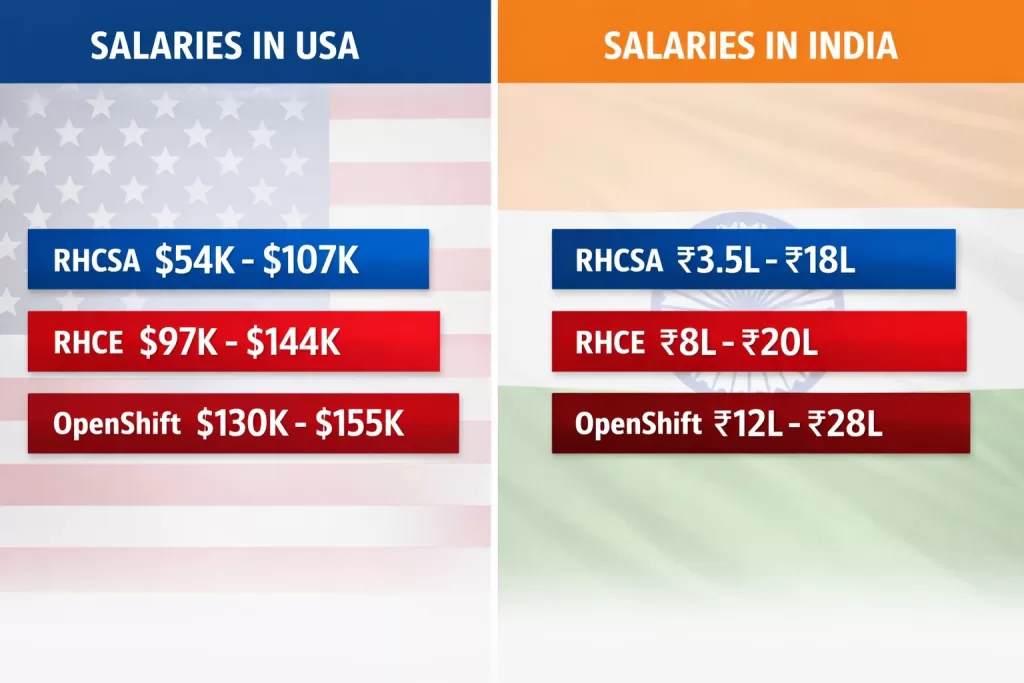
Comprehensive Salary Statistics and Earning Potential
Compensation data collected throughout 2026 reveals that Red Hat certifications deliver substantial, measurable financial returns for professionals at all career stages.
Salary Breakdown by Experience Level:
Entry-Level (0-2 years):
- RHCSA-certified: $70,000 – $90,000/year
- Competitive starting compensation for junior roles
Mid-Level (3-5 years):
- RHCSA/RHCE-certified: $100,000 – $130,000/year
- Strong growth trajectory with automation skills
Senior Level (5+ years):
- RHCE + Specializations: $150,000 – $170,000+/year
- Architects and principal engineers exceed $180,000-$220,000
Average RHCSA Salary:
- $122,228/year (ZipRecruiter data, 2026)
- $97,000 – $194,000 range (PayScale data)
- Median around $107,000
These salary figures significantly exceed the average compensation for non-certified Linux administrators with comparable years of experience—often by 20-30% or more. The substantial salary range reflects multiple factors including experience level, geographic location, industry sector, organization size, and specific technical specializations.
The RHCE Premium
RHCE certification typically adds an additional 15-20% premium to base compensation compared to RHCSA alone, reflecting the advanced automation skills and broader technical expertise that RHCE validation represents. Comprehensive industry research consistently indicates that RHCE-certified professionals earn approximately 20% more than their non-certified peers with similar job responsibilities and experience levels.
This premium reflects employers’ recognition that Ansible automation expertise directly drives:
- Operational efficiency improvements
- Reduction in manual toil
- Minimization of human error
- Infrastructure scaling capabilities impossible through manual approaches
International Salary Data
International salary data also demonstrates strong compensation trends for Red Hat-certified professionals:
- India: ₹6-12 lakhs annually ($7,200-$14,400 USD) for RHCSA; ₹15-25 lakhs ($18,000-$30,000 USD) for senior engineers
- Europe: €50,000 – €90,000 annually in Germany, UK, Netherlands, Switzerland
- Asia-Pacific: Competitive rates in Singapore, Australia, Japan
Specialized Certification Premiums
Specialized Red Hat certifications beyond RHCSA and RHCE can command even higher premiums:
- OpenShift certifications: 25-35% more than RHCSA alone
- Red Hat Certified Architect (RHCA): $180,000-$220,000+ annually
- Performance bonuses and equity compensation often included
Industry Trends Driving Demand
Multiple converging technology trends are simultaneously driving unprecedented demand for Red Hat-certified professionals throughout 2026 and projecting continued strong growth into subsequent years. Understanding these fundamental trends provides valuable insight into why Red Hat skills remain not just relevant but increasingly critical for enterprise IT success.
1. Hybrid Cloud Architecture Adoption
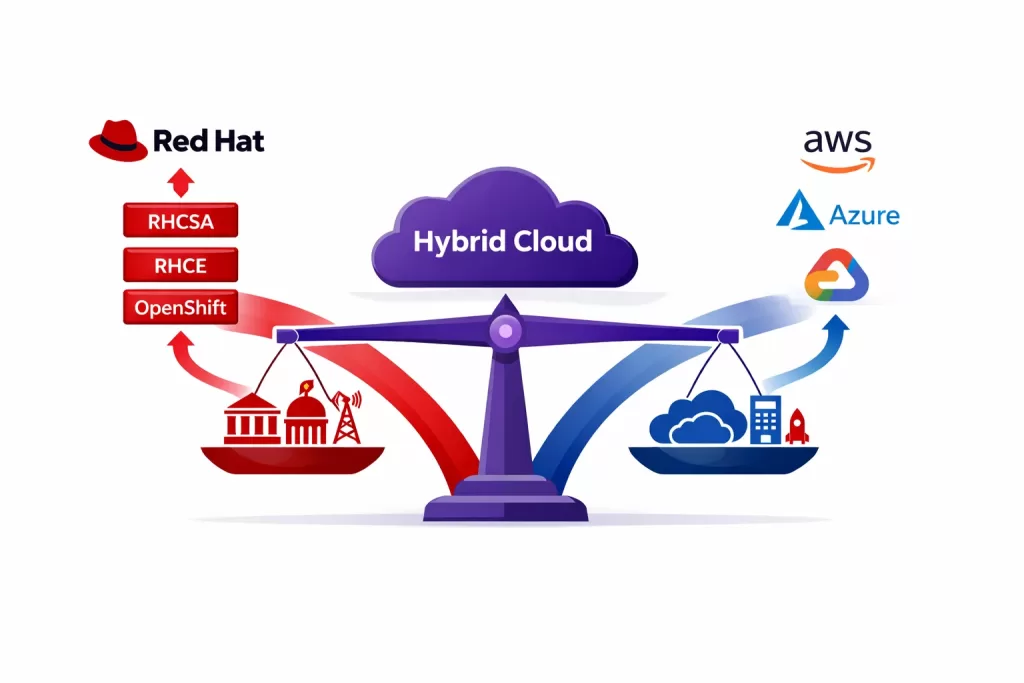
Foremost among these trends stands the accelerating adoption of hybrid cloud architectures combining on-premises infrastructure, private cloud deployments, and multiple public cloud platforms. Organizations worldwide recognize that hybrid cloud strategies offer optimal:
- Flexibility in deployment options
- Cost management and optimization
- Data sovereignty and compliance
- Risk mitigation through diversification
Red Hat Enterprise Linux serves as a consistent, certified foundation across these diverse environments, while Red Hat OpenShift provides unified Kubernetes-based application platforms spanning on-premises data centers, AWS, Azure, Google Cloud, and IBM Cloud. Consequently, professionals who understand Red Hat technologies can seamlessly work across entire hybrid infrastructure landscapes.
2. Containerization and Kubernetes
Containerization and Kubernetes adoption represent another massive trend driving Red Hat skills demand. As organizations modernize legacy applications and build cloud-native architectures, Kubernetes has emerged as the de facto standard for container orchestration.
Red Hat OpenShift, built on Kubernetes, has captured significant enterprise market share due to its:
- Enterprise-grade security features
- Integrated developer tools
- Comprehensive platform services
- Backed support from IBM Red Hat
Professionals holding Red Hat certifications, particularly those with OpenShift specializations, find themselves perfectly positioned to support these transformational initiatives.
3. Automation Imperatives
Automation imperatives continue intensifying across all industry sectors as organizations seek to:
- Reduce operational costs
- Minimize human error
- Improve deployment velocity
- Enable infrastructure scaling without proportional headcount increases
Ansible has become the automation platform of choice for countless enterprises due to its agentless architecture, human-readable YAML syntax, extensive module library, and strong community ecosystem. The RHCE certification’s focus on Ansible automation directly addresses this critical market need, making RHCE holders highly sought after for DevOps roles, SRE positions, and infrastructure automation initiatives.
Automation Job Growth: Ansible-related job postings have increased by 245% year-over-year as organizations accelerate automation adoption to address operational scaling challenges.
4. Security and Compliance
Security concerns have simultaneously escalated to boardroom-level priorities as organizations face:
- Sophisticated cyber threats
- Stringent regulatory requirements
- Potential reputational damage from security breaches
Red Hat’s strong security posture—including SELinux mandatory access controls, regular security updates, comprehensive vulnerability management, and security-focused certifications—makes RHEL the preferred choice for security-conscious organizations. Professionals who understand Red Hat security features, compliance frameworks, and hardening techniques deliver immediate value to organizations navigating complex threat landscapes.
5. Edge Computing Deployments
Edge computing deployment patterns are creating entirely new categories of Red Hat skills demand. As organizations deploy computing resources closer to data sources—in manufacturing facilities, retail locations, telecommunications cell sites, and IoT deployments—they require lightweight, secure, manageable operating systems that can function in resource-constrained, sometimes disconnected environments.
Red Hat Enterprise Linux optimized for edge deployments addresses these requirements, creating opportunities for professionals who understand:
- Edge architecture patterns
- Remote management techniques
- Distributed systems administration
Why Red Hat Certifications Stand Out
Hands-On Practical Approach That Employers Trust
Perhaps the single most compelling differentiator separating Red Hat certifications from numerous competing credentials lies in their uncompromising emphasis on practical, hands-on skill validation. While many certification programs test primarily theoretical knowledge through multiple-choice questions that can be memorized and quickly forgotten, Red Hat exams demand that candidates actually perform real tasks on actual Red Hat systems within realistic time constraints and without access to external resources.
This practical approach fundamentally changes the certification’s meaning and value proposition. When hiring managers review resumes listing Red Hat certifications, they possess high confidence that candidates can immediately contribute to production environments rather than requiring extensive hands-on training to translate theoretical knowledge into practical capability.
Employer Research Findings: Multiple studies and employer surveys confirm that Red Hat-certified professionals consistently require 30-40% less onboarding time compared to candidates with equivalent experience but lacking certification validation.
The hands-on examination format also ensures that certified professionals possess genuine troubleshooting capabilities—perhaps the most valuable skill in system administration and engineering roles. During exams, candidates inevitably encounter scenarios that don’t work perfectly on the first attempt, requiring them to:
- Diagnose issues systematically
- Interpret error messages accurately
- Adjust configurations intelligently
- Verify functionality thoroughly
This exactly mirrors real-world troubleshooting workflows. Therefore, Red Hat certifications validate not just configuration knowledge but critical problem-solving abilities that separate effective engineers from those who struggle when procedures don’t match documentation.
Furthermore, the practical format builds authentic confidence that benefits both employers and certified professionals themselves. Candidates who successfully pass performance-based exams know with certainty that they can handle production systems, whereas those holding only theory-based certifications often experience imposter syndrome when transitioning from study materials to actual infrastructure responsibilities. This confidence translates into better decision-making under pressure, willingness to tackle complex challenges, and faster professional development.
Enterprise Standard: Red Hat’s Market Dominance
Red Hat Enterprise Linux has achieved remarkable market penetration, establishing itself as the unquestioned leader among paid enterprise Linux distributions with a commanding 43.1% market share according to recent industry analyses. This dominant position didn’t emerge accidentally but rather resulted from decades of consistent investment in:
- Enterprise features and capabilities
- Unwavering commitment to stability and security
- Comprehensive hardware/software certification programs
- Industry-leading support services for mission-critical deployments
Enterprise Adoption Across Industries
Major enterprises across virtually every industry vertical have standardized on RHEL for their most critical infrastructure needs:
Financial Services
- JPMorgan Chase, Bank of America, Goldman Sachs
- Core banking systems, trading platforms, risk management
- Cannot tolerate downtime or security vulnerabilities
Government & Defense
- U.S. Department of Defense, intelligence agencies
- Federal civilian agencies, state governments
- Classified systems, citizen services, critical infrastructure
- Specific Red Hat certifications often required for contractors
Telecommunications
- Verizon, AT&T, Deutsche Telekom, international carriers
- Network function virtualization (NFV) and 5G deployments
- Red Hat OpenShift as strategic platform for network modernization
Healthcare
- Major hospital systems and health insurance providers
- HIPAA-compliant systems for patient data
- Electronic health records and medical imaging
The Virtuous Cycle
This widespread enterprise adoption creates a powerful virtuous cycle benefiting Red Hat-certified professionals:
- More organizations standardize on Red Hat platforms → Demand increases for certified expertise
- Certification value becomes recognized → More professionals pursue credentials
- Talent pool grows with certified individuals → Organizations gain confidence in ecosystem
- Confidence drives further adoption → Cycle reinforces
Certified professionals benefit from this cycle through:
- Sustained job security
- Competitive compensation
- Diverse career opportunities
- Increasing specialization options
OpenShift and Kubernetes Integration
Red Hat’s strategic positioning within the Kubernetes ecosystem represents another critical factor driving certification value throughout 2026 and beyond. OpenShift, Red Hat’s enterprise Kubernetes platform, has emerged as one of the leading container orchestration solutions for organizations requiring production-grade capabilities.
Why OpenShift Stands Out
Unlike community Kubernetes distributions requiring extensive customization, integration work, and ongoing maintenance overhead, OpenShift provides a complete, integrated platform including:
- Enterprise-grade container registry
- CI/CD pipelines (built-in automation)
- Service mesh integration
- Monitoring and logging infrastructure
- Developer self-service capabilities
- Streamlined operations management
- All tested, certified, and supported by Red Hat
This comprehensive approach accelerates time-to-value while reducing operational complexity compared to assembling equivalent capabilities from disparate open-source projects.
Kubernetes Skills Gap: The Kubernetes skills shortage remains acute across the industry, with organizations consistently reporting difficulty finding qualified professionals who understand both Kubernetes architectural patterns and production operational requirements.
OpenShift Certification Value
Red Hat certifications addressing OpenShift administration and development directly address this talent gap, positioning certified professionals advantageously within highly competitive job markets. Specialized OpenShift certifications including:
- Red Hat Certified Specialist in OpenShift Administration
- Red Hat Certified Specialist in OpenShift Application Development
These command premium compensation reflecting their scarcity and high market demand, often earning 25-35% more than RHCSA alone.
Hybrid Cloud Capabilities
Moreover, OpenShift’s hybrid cloud capabilities enable consistent application deployment patterns spanning:
- On-premises data centers
- AWS, Azure, Google Cloud
- IBM Cloud
- Edge locations
Organizations implementing multi-cloud or hybrid cloud strategies particularly value professionals who understand OpenShift’s cloud-agnostic approach, as these individuals can support infrastructure spanning diverse environments without mastering multiple proprietary platforms.
Container Security Expertise
Container security represents another area where OpenShift expertise delivers substantial value. OpenShift incorporates security throughout the container lifecycle:
- Base image curation
- Vulnerability scanning
- Runtime security enforcement
- Compliance automation
Professionals understanding OpenShift’s security model, compliance automation capabilities, and integration with Red Hat Advanced Cluster Security can immediately contribute to organizations’ security postures, making them highly attractive candidates for security-conscious enterprises.
Ansible Automation Excellence
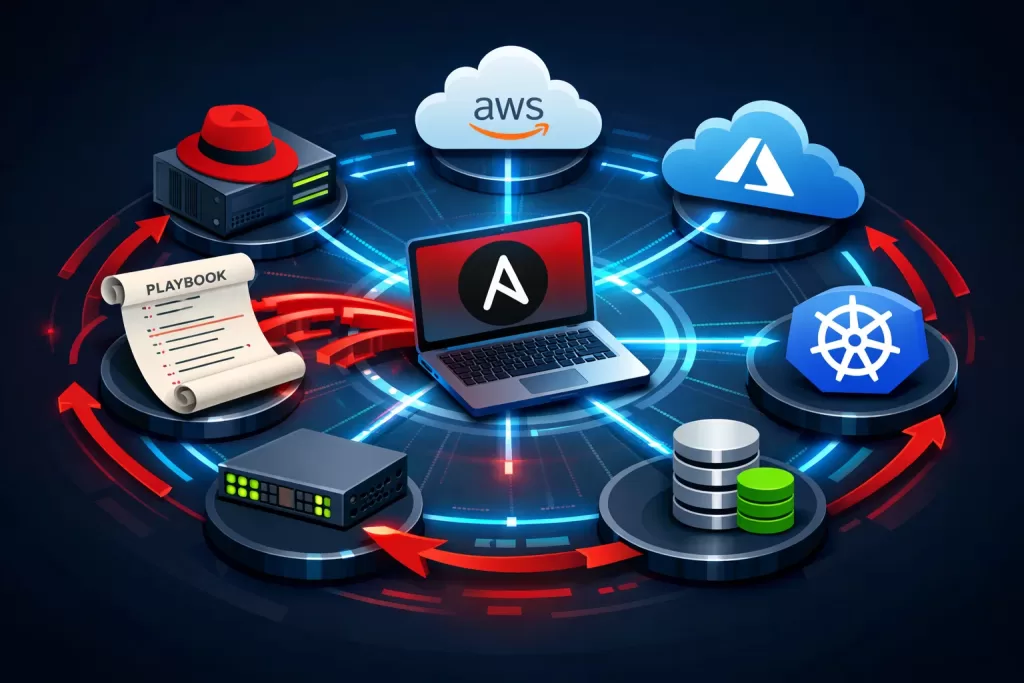
Ansible automation has evolved from a useful configuration management tool into an essential enterprise automation platform addressing:
- Infrastructure provisioning
- Configuration management
- Application deployment
- Security automation
- Network automation
- Cloud orchestration
Red Hat’s acquisition of Ansible (then Ansible Inc.) in 2015 and subsequent development of Ansible Automation Platform has transformed Ansible into the automation standard for countless enterprises worldwide.
RHCE’s Ansible Focus
The RHCE certification’s exclusive focus on Ansible automation skills reflects Ansible’s critical importance within modern IT operations. Organizations implementing DevOps practices, site reliability engineering methodologies, or infrastructure-as-code approaches inevitably adopt Ansible as their primary automation tool due to its:
- Simplicity: Human-readable YAML syntax
- Flexibility: Extensive use cases
- Module ecosystem: 5,000+ modules
- Agentless architecture: No agent installation overhead
RHCE-certified professionals possess validated Ansible expertise that directly supports these strategic automation initiatives.
Explosive Demand Growth: Recent data indicates that Ansible-related job postings have increased by over 245% year-over-year as organizations accelerate automation adoption.
Enterprise Platform Capabilities
Ansible Automation Platform’s enterprise features have expanded Ansible’s enterprise applicability far beyond simple configuration management:
- Automation controller (formerly Ansible Tower) – centralized execution
- Content collections – modular automation content
- Automation mesh – scaled-out execution across distributed environments
- Event-Driven Ansible – reactive automation
Professionals understanding these advanced platform capabilities become invaluable to organizations implementing enterprise-scale automation strategies.
Cross-Technology Integration
The integration between Ansible and other Red Hat technologies further amplifies certification value. Ansible serves as the primary automation engine for:
- OpenShift cluster configuration
- RHEL system provisioning
- Red Hat Satellite content management
- Numerous other Red Hat products
This deep integration means professionals with combined Red Hat certification portfolios can automate comprehensive workflows spanning multiple infrastructure layers—from bare metal provisioning through container deployment—delivering disproportionate value compared to specialists with narrow tool expertise.
Career Progression and Specialization Pathways
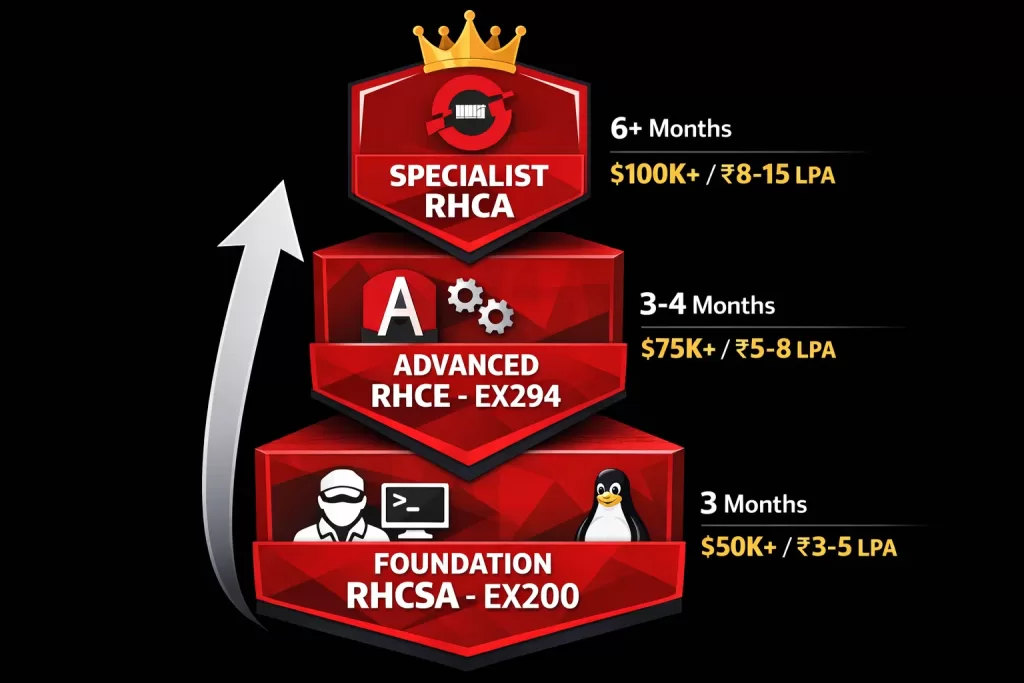
Red Hat’s comprehensive certification portfolio supports structured career progression from entry-level positions through senior architect roles, providing clear learning pathways that align with professional development goals and organizational needs.
The Certification Journey
Level 1: RHCSA (Foundation)
The typical journey begins with RHCSA certification, establishing fundamental Linux administration competencies required for day-to-day system management responsibilities.
- Best for: Career changers, recent graduates, Windows admins expanding skills
- Preparation time: 6-12 months for beginners; 3-6 months with prior Linux experience
- Investment: 200-300 hours of dedicated study and hands-on practice
Level 2: RHCE (Advanced)
Following RHCSA, professionals typically pursue RHCE certification to validate advanced automation skills.
- Best for: Professionals ready to advance beyond basic system administration
- Preparation time: 4-6 months of intensive Ansible study
- Investment: 300-400 hours including extensive playbook development
Level 3: Specialist Certifications
Beyond RHCE, Red Hat offers numerous specialist certifications:
- Red Hat Certified Specialist in Containers
- Red Hat Certified Specialist in OpenShift Administration
- Red Hat Certified Specialist in Advanced Automation
- Red Hat Certified Specialist in Security
- Red Hat Certified Specialist in Performance Tuning
Level 4: RHCA (Architect)
At the pinnacle stands the Red Hat Certified Architect (RHCA) designation:
- Represents: Elite-level expertise across diverse Red Hat technologies
- Career impact: Principal engineer, technical architect, or consulting roles
- Time investment: Typically 2-4 years of progressive certification achievement
- Compensation: $180,000-$220,000+ annually
Benefits of Structured Progression
These clearly defined progression pathways benefit both professionals and employers:
For Professionals:
- Transparent understanding of skill development sequences
- Clear certification investment priorities
- Realistic timeframes for achieving career milestones
For Employers:
- Standardized skill validation enabling effective team building
- Succession planning capabilities
- Capability gap identification
🎓 Expert-Led Training for Career Success
Join our comprehensive RHCSA and RHCE programs with lifetime access, hands-on labs, and dedicated instructor support.
Who Should Pursue Red Hat Certification?
Fresh IT Graduates and Career Starters
For individuals recently completing formal education or considering entry into IT careers, Red Hat certifications offer compelling advantages over alternative starting points. The performance-based exam format ensures that freshly certified professionals possess genuine hands-on capabilities rather than merely theoretical knowledge—a critical differentiator when entering competitive entry-level job markets.
Who Benefits Most
- Computer science graduates wanting practical validation
- Information technology program completers seeking industry credentials
- Self-taught individuals with strong technical aptitude
Entry-Level Advantage: Starting salaries for RHCSA-certified entry-level professionals typically range from $70,000 to $90,000 annually—significantly above average entry-level IT compensation.
Why RHCSA Makes Sense for Beginners
- Quick time to certification: 6-12 months including comprehensive practice
- Accessible to motivated beginners: No prerequisites required
- Structured learning path: Clear objectives and progression
- Affordable investment: $2,000-$5,000 total
- Strong ROI: Investment recovered within 1-2 months of employment
Career Opportunities
Many organizations specifically create junior Linux administrator positions requiring RHCSA certification, recognizing that candidates can immediately contribute to production support with appropriate mentorship.
Furthermore, Linux system administration roles typically offer clearer advancement trajectories with realistic paths toward:
- DevOps Engineering
- Site Reliability Engineering (SRE)
- Cloud Architecture
- Infrastructure Architecture
Career Switchers and Professionals Transitioning into IT
Red Hat certifications represent an exceptionally attractive option for professionals seeking to transition into IT careers from entirely different industries. The performance-based examination format rewards practical competency rather than requiring extensive formal education.
Common Backgrounds for Successful Career Switchers
- Military veterans leveraging technical training from service
- Displaced workers from declining industries
- Customer service professionals attracted to technical problem-solving
- Humanities/business graduates discovering technical aptitudes
Why Performance-Based Testing Helps
Red Hat certifications level the playing field by providing objective skill validation that employers trust more than potentially biased resume screening.
Valuable Soft Skills That Transfer
- Former customer service professionals: Understanding user needs, clear communication
- Military veterans: Discipline, attention to detail, grace under pressure
- Business professionals: Stakeholder management, project coordination
Financial Considerations
Investment & ROI for Career Switchers:
- Total investment: $2,000-$4,000
- Timeline: 6-12 months to certification
- Starting salary: $70,000+ annually
- ROI timeframe: 1-2 months after employment begins
IT Professionals Seeking to Upskill
Experienced IT professionals increasingly pursue Red Hat certifications to expand capabilities, increase marketability, and command higher compensation.
Common Upskilling Scenarios
Windows Administrators → Linux/Hybrid Skills
As organizations adopt heterogeneous infrastructure, administrators with cross-platform expertise become disproportionately valuable.
Network Engineers → DevOps/Automation
RHCE certification’s Ansible focus directly addresses automation knowledge gaps, enabling network engineers to transform domain expertise into powerful network automation capabilities.
Cloud Professionals → Infrastructure Fundamentals
Understanding underlying operating system behaviors remains critically important for effective cloud utilization. OpenShift certifications enable consistent Kubernetes management across diverse cloud providers.
Help Desk → System Administration
RHCSA certification objectively validates technical capability, enabling support professionals to transition confidently into infrastructure roles.
<a id=”specific-roles”></a>
Specific Roles That Benefit Most
1. Linux System Administrators
Most obvious beneficiaries. RHCSA specifically validates core system administration competencies.
2. DevOps Engineers
RHCE certification particularly valuable due to exclusive Ansible focus supporting infrastructure-as-code and automated deployment pipelines.
3. Site Reliability Engineers (SREs)
SRE responsibilities directly leverage Linux administration and automation skills for monitoring, incident response, and automation to reduce manual toil.
4. Cloud Infrastructure Engineers
Building hybrid and multi-cloud architectures increasingly requires Red Hat expertise as organizations standardize on RHEL and OpenShift.
5. Automation Engineers
RHCE certification perfectly aligned with automation engineering missions across enterprise technology estates.
Getting Started: Your Path to Red Hat Certification Success
RHCSA: Building Your Foundation
The Red Hat Certified System Administrator (RHCSA) certification serves as the essential foundation for all Red Hat certification pathways.
RHCSA Exam Objectives
1. Essential Tools
- File manipulation and text processing
- Input/output redirection
- Regular expressions
- Shell scripting
2. System Operation
- Boot systems to different targets
- Process management
- Log file analysis
- Journal preservation
3. Storage Management
- Partitions, logical volumes, file systems
- Automatic mounting
- NFS shares
- Disk encryption
4. User and Group Administration
- Account management
- Password policies
- Access controls
5. Security Management
- Firewall configuration (firewalld)
- SELinux management
- Authentication mechanisms
6. Container Technology
- Container images with Podman
- Container storage and networking
Effective Preparation Strategy
Typical Time Investment:
- Total hours: 200-300 hours of active lab practice
- Timeline: 6-12 months (depending on prior experience)
- Weekly commitment: 10-15 hours for 6-month timeline
Practice Approach
- Build systems from scratch repeatedly
- Intentionally break configurations to develop troubleshooting skills
- Work through comprehensive lab scenarios
- Practice under timed conditions
Training Resources
Official Red Hat Training:
- Cost: $3,500-$4,500
- Highest quality content from certification creators
Alternative Learning Platforms:
- Linux Academy / A Cloud Guru
- Udemy, Pluralsight
- YouTube channels
- Cost: $200-$500
Practice Environment Options
Local Virtualization:
- Software: VirtualBox, VMware Workstation (free)
- Requirements: 16GB+ RAM, multi-core processor
Cloud-Based Labs:
- Cost: $20-$50/month
- No local hardware requirements
RHCE: Mastering Ansible Automation
The Red Hat Certified Engineer (RHCE) certification focuses exclusively on validating advanced Ansible automation skills.
RHCE Exam Focus
The current RHCE exam tests exclusively Ansible capabilities:
- Playbook creation for multi-system automation
- Inventory management with groups and variables
- Conditional logic and iteration
- Role development
- Ansible Vault for secrets management
- Multi-tier orchestration
Preparation Requirements
RHCE Time Investment:
- Total hours: 300-400 hours of intensive study
- Timeline: 4-6 months (assuming solid RHCSA foundations)
Practice Emphasis
- Write hundreds of playbooks automating diverse scenarios
- Create roles implementing complete application stacks
- Debug failed playbook runs
- Complete exam-simulation labs under timed conditions
Lab Environment Needs
Effective RHCE practice requires 4-6 virtual machines simulating different server roles for realistic automation scenario practice.
Study Strategies and Resources That Work
1. Hands-On Practice (80-90% of Time)
Progressive practice approach:
- Guided exercises with step-by-step instructions
- Independent scenarios without instructions
- Troubleshooting challenges with broken configurations
- Timed simulations mimicking exam conditions
2. Systematic Objective Coverage
- Map learning activities to exam objectives
- Track completion progress
- Address weaker areas
- Maintain study journal
3. Progressive Complexity Development
- Start with simple, focused exercises
- Gradually combine multiple objectives
- Introduce time constraints
- Add troubleshooting requirements
4. Realistic Exam Simulation
- Complete 3-5 full practice exams during final weeks
- Review missed objectives carefully
- Repeat until consistently passing
5. Community Engagement
- Reddit: /r/redhat, /r/linuxadmin
- Red Hat Learning Community forums
- Discord servers
- Study groups for accountability
Investment and ROI Timeline
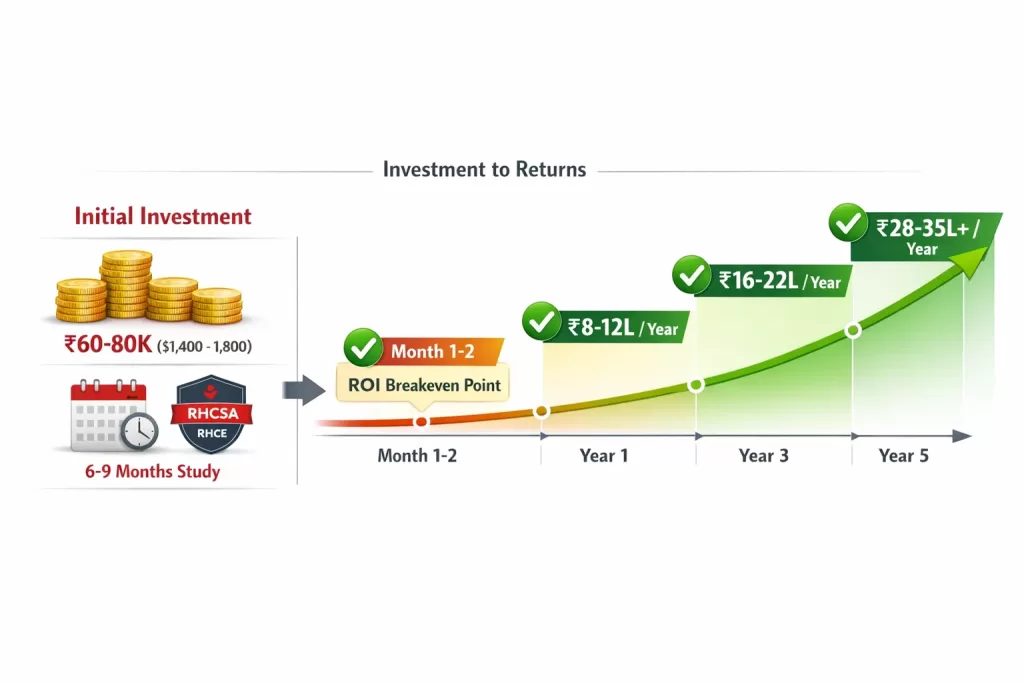
Total RHCSA Investment Breakdown
Cost Components:
Training Materials:
- Official Red Hat training: $3,500-$4,500
- Self-study (books + online courses): $200-$500
Practice Environment:
- Local virtualization: Free software + hardware
- Cloud-based labs: $20-$50/month × 6-12 months = $120-$600
Examination Fee:
- RHCSA exam: $400 (varies by region)
Total Investment Range:
- Self-study approach: $2,000-$3,000
- With official training: $4,000-$5,000
Time Investment
- Career changers/beginners: 200-300 hours over 6-12 months
- Experienced IT professionals: 150-200 hours over 3-6 months
- Consistent study pattern: 10-15 hours/week
Return on Investment
ROI Calculation:
Entry-level position:
- RHCSA salary: $70,000-$90,000/year
- Non-certified help desk: $40,000-$50,000/year
- Annual premium: $30,000-$50,000
Investment recovery:
- Total cost: $2,000-$5,000
- Monthly premium: $2,500-$4,000
- ROI timeline: 1-3 months after employment!
Long-Term Career Value
- Year 1-2: Entry-level ($70K-$90K)
- Year 3-5: Mid-level with RHCE ($100K-$130K)
- Year 5-7: Senior + specializations ($150K-$170K)
- Year 7+: Architect/Principal ($180K-$220K+)
Frequently Asked Questions
How long does it take to get RHCSA certified?
Most dedicated learners achieve RHCSA certification within 6-12 months while working full-time, investing 10-15 hours weekly in study and hands-on practice. Individuals with prior Linux experience may complete preparation in 3-6 months, while complete beginners might require the full 12 months for comprehensive skill development.
Do I need RHCSA before attempting RHCE?
While Red Hat no longer enforces RHCSA as an official prerequisite for RHCE examination, the RHCSA skills remain essential foundations for RHCE success. Most successful RHCE candidates follow the logical progression of RHCSA first, then RHCE.
What is the pass rate for Red Hat exams?
Industry estimates suggest RHCSA first-attempt pass rates typically range from 40-60%, while RHCE rates fall between 30-50%. However, candidates completing comprehensive preparation including substantial hands-on practice typically achieve significantly higher success rates—often 70-80% or better.
Are Red Hat certifications worth it for cloud-focused careers?
Absolutely. Understanding underlying Linux operating systems, networking fundamentals, and automation principles remains critically important for effective cloud utilization. Furthermore, Red Hat OpenShift has become a leading Kubernetes platform deployed across AWS, Azure, Google Cloud, and hybrid environments.
How much can I earn with Red Hat certifications?
RHCSA-certified professionals typically earn:
- Entry-level: $70,000-$90,000 annually
- Mid-level (3-5 years): $100,000-$130,000
- Senior roles: $150,000-$170,000+
RHCE certification typically adds 15-20% premium to these ranges.
Do Red Hat certifications expire?
Yes, Red Hat certifications remain valid for three years from the date of achievement. Recertification can be achieved through retaking the exam or by passing a higher-level examination.
Can I get a job with just RHCSA certification?
Yes, many organizations specifically hire junior Linux administrators and technical support engineers requiring only RHCSA certification. RHCSA alone provides sufficient validation for launching a Linux administration career with strong growth potential.
What’s the difference between RHCSA and Linux+?
- Linux+: Multiple-choice questions testing theoretical knowledge
- RHCSA: Performance-based testing requiring actual task completion
Employers typically perceive RHCSA as more rigorous and valuable due to its hands-on validation approach.
Is Red Hat training mandatory for certification?
No, Red Hat training courses are not mandatory. Candidates can pursue self-study approaches, then register directly for examinations. However, official training significantly improves success probability and reduces preparation time.
<a id=”conclusion”></a>
Conclusion: Your Red Hat Certification Journey Awaits
The evidence overwhelmingly demonstrates that Red Hat certifications remain not just valuable but increasingly critical for IT professionals pursuing rewarding, secure, well-compensated careers in 2026 and beyond.
Key Takeaways:
- ✅ Strong market demand: Thousands of open positions requiring Red Hat skills
- ✅ Impressive salaries: $122,228 average for RHCSA-certified professionals
- ✅ Quick ROI: Investment recovered within 1-3 months of employment
- ✅ Clear career path: Structured progression from RHCSA to RHCE to Architect
- ✅ Enterprise standard: 43.1% market share for RHEL
- ✅ Future-proof skills: Aligned with hybrid cloud, Kubernetes, automation trends
Moreover, the current market timing creates exceptional opportunities for certification pursuit. Organizations worldwide face acute shortages of qualified professionals—creating favorable supply-demand dynamics that translate directly into competitive compensation and abundant job opportunities.
The investment required for certification achievement delivers returns within months rather than years, making Red Hat certification among the highest-ROI educational investments available.
Don’t Wait—Start Today
Don’t allow another year to pass while continuing to postpone your professional development goals. Those who invest in developing verified Red Hat expertise today position themselves for long-term success.
Take the first step today. Explore our comprehensive RHCSA and RHCE training programs designed specifically for working professionals seeking efficient, effective certification preparation.
Your future in enterprise IT begins with a single decision—make it today. 🚀
Related Resources
- RHCSA Exam Objectives 2026 (Complete Guide)
- RHCE Ansible Automation Study Guide
- Red Hat OpenShift Certification Path
- Linux Career Roadmap for 2026
- Top 10 Ansible Best Practices
- RHCSA vs Linux+: Which Certification Should You Choose?
Share This Guide: Facebook | Twitter | LinkedIn | WhatsApp
Last Updated: January 28, 2026 | Reading Time: 25 minutes
Keywords: Red Hat certification 2026, RHCSA worth it, RHCE salary, Linux certification value, Red Hat training, RHCSA exam, RHCE Ansible, Linux administrator career, DevOps certification, Red Hat OpenShift